
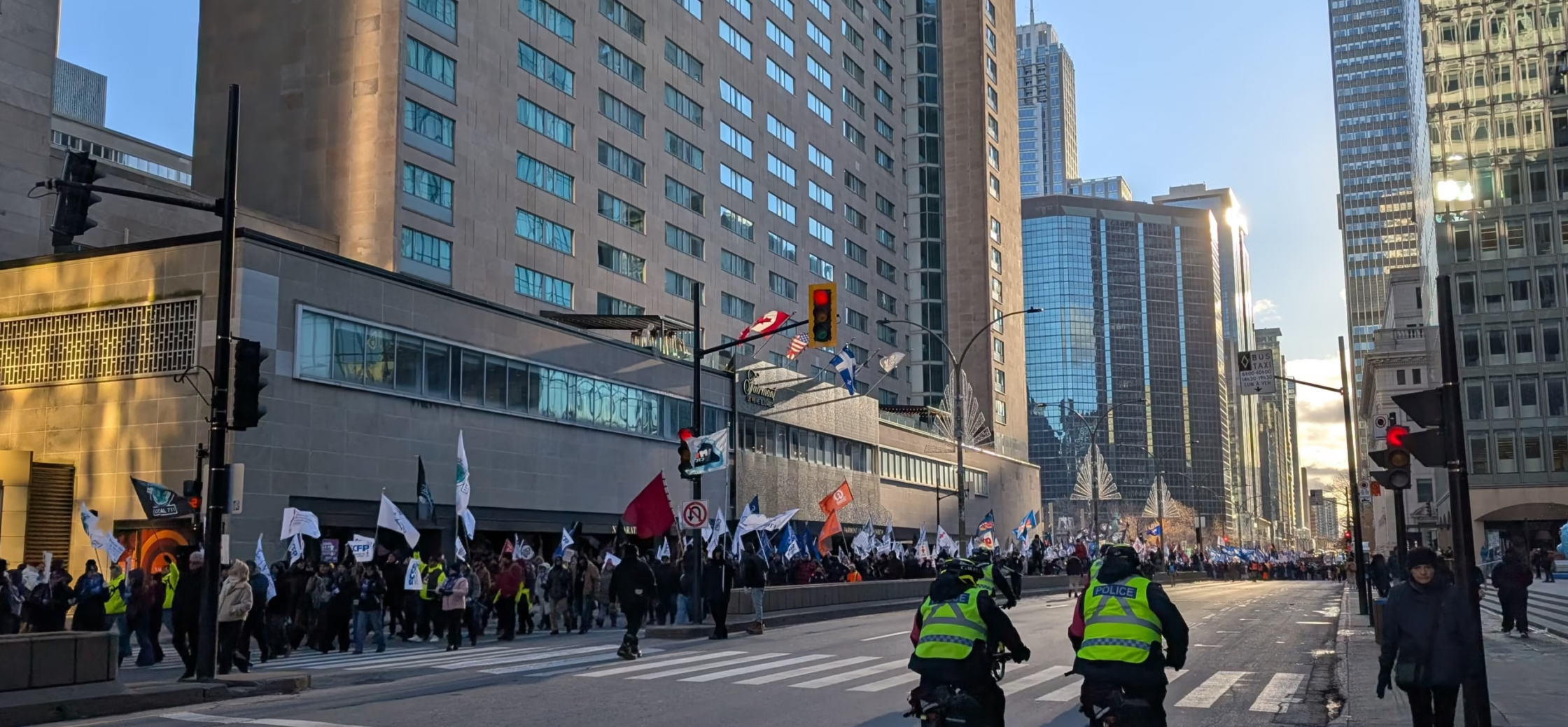
It was the largest union demonstration in the country in years. On Saturday, tens of thousands of people flooded downtown Montreal to launch a movement against the CAQ and its policies. The call came from major labour federations, for whom the recent Bill 3 was the last straw.
What did all these people have to say? The North Star moved through the crowd to give the protesters a voice.

“Handcuffing” workers for the benefit of employers
Bruno Guilmette, affairs manager for the boilermakers’ union, is convinced Bill 3 has nothing to do with transparency, despite the government’s claims. The real issue, he says, is that Quebec wants to control how unions can use their money.
Unions would have to hold a yearly vote on “optional” dues and the budget for it, which they would have to follow to the letter. It’s the only fund that could be used for legal challenges, social movements, advertising, and more. That means they could no longer respond to unexpected events or shifts in the political climate without risking heavy fines.
And in construction, he adds, “when someone gets hurt, in 99% of cases the company contests it. And with this bill, they’re basically stopping us from fighting those challenges in court, from helping a worker prove they were actually injured on the job.”
In short, “with Bill 3, they’re handcuffing us so employers have a free hand to do whatever they want on worksites. That’s why workers are fed up.”

A movement growing tougher and broader
The CAQ had already begun rolling back workers’ rights, but the offensive accelerated this year with a law restricting the right to strike and several labour reforms. With Bill 3, unions say the government has crossed a red line.
“Today is the first building block of a provincial movement,” says Guillaume Dupont-Croteau, secretary-archivist of Montreal’s city workers’ union (CUPE Local 301). For him, the bills tabled by the minister are nothing more than “a way to break social movements, to break strikes.”
“The goal is to create a fracture: it starts with the optional dues, then they keep chipping away, and slowly it becomes a slippery slope toward attacking the Rand formula.”
He believes unions have to unite to win, pointing to the 1972 Common Front. “If we have to shut down all of Quebec, we’ll do it. At Local 301, the executive has already committed to mobilize and, when the time comes, move toward a social strike.”

A movement reaching beyond unions
Many carried union symbols, but plenty came in solidarity: FRAPRU, popular education groups, student associations, OUI-Québec, Workers’ Alliance, the Palestinian Youth Movement, and many others.
For Marie-Claude Archambault, spokesperson for the Blainville citizens’ coalition against Stablex’s cell 6, attending was an obvious choice. “We need a massive movement against the CAQ. Today we’re here to denounce Bill 93, shoved down the throats of Blainville residents and handed on a silver platter to an American multinational.”
Last spring, the CAQ forced a snap vote. Within hours, Blainville was required to authorize Stablex to build a new toxic-waste cell right next to a residential neighbourhood.
“Today’s protest was an invitation to all citizen-led struggles,” she adds, pointing to Northvolt and Mobilisation 6600. For her, the situation reflects a “very authoritarian” system. “It’s looking more and more like authoritarianism.”

And that authoritarian streak is felt in CEGEPs as well. Nour El-Hage, from the Saint-Laurent CEGEP Student Association, denounces $151 million in cuts while “65% of CEGEP buildings are falling apart.” “We have an entire department that’s condemned,” he says, and the student café had to move. The replacement pavilion is more than a 20-minute walk or bus ride away.
But Nour wasn’t there just for the present. “Students, as soon as they finish their studies, they become members of these unions, members of the working class. If these laws hurt unions, eventually they hurt our students too, just a bit later in their lives.”

“We have to move toward civil disobedience”
Axel, a union steward for paramedics in the Estrie region, sums it up clearly. “Boulet says these laws are meant to help unionized workers. But in reality, what he wants is to weaken unions so we have less power. It affects everyone across Quebec, unionized or not.”
Dupont-Croteau believes the fight will have to escalate to defeat a “government losing steam, testing the waters to find something that will stick with the public.”
“I don’t think we’re at a point where we can rely on the courts anymore,” he says. “We have to turn to civil disobedience, return to a fighting-spirit unionism on the ground.”
He concludes: “What I heard from the minister at committee is that he might be interested in going even further in his attack. We can’t tolerate the intolerable.”
Be part of the conversation!
Only subscribers can comment. Subscribe to The North Star to join the conversation under our articles with our journalists and fellow community members. If you’re already subscribed, log in.