
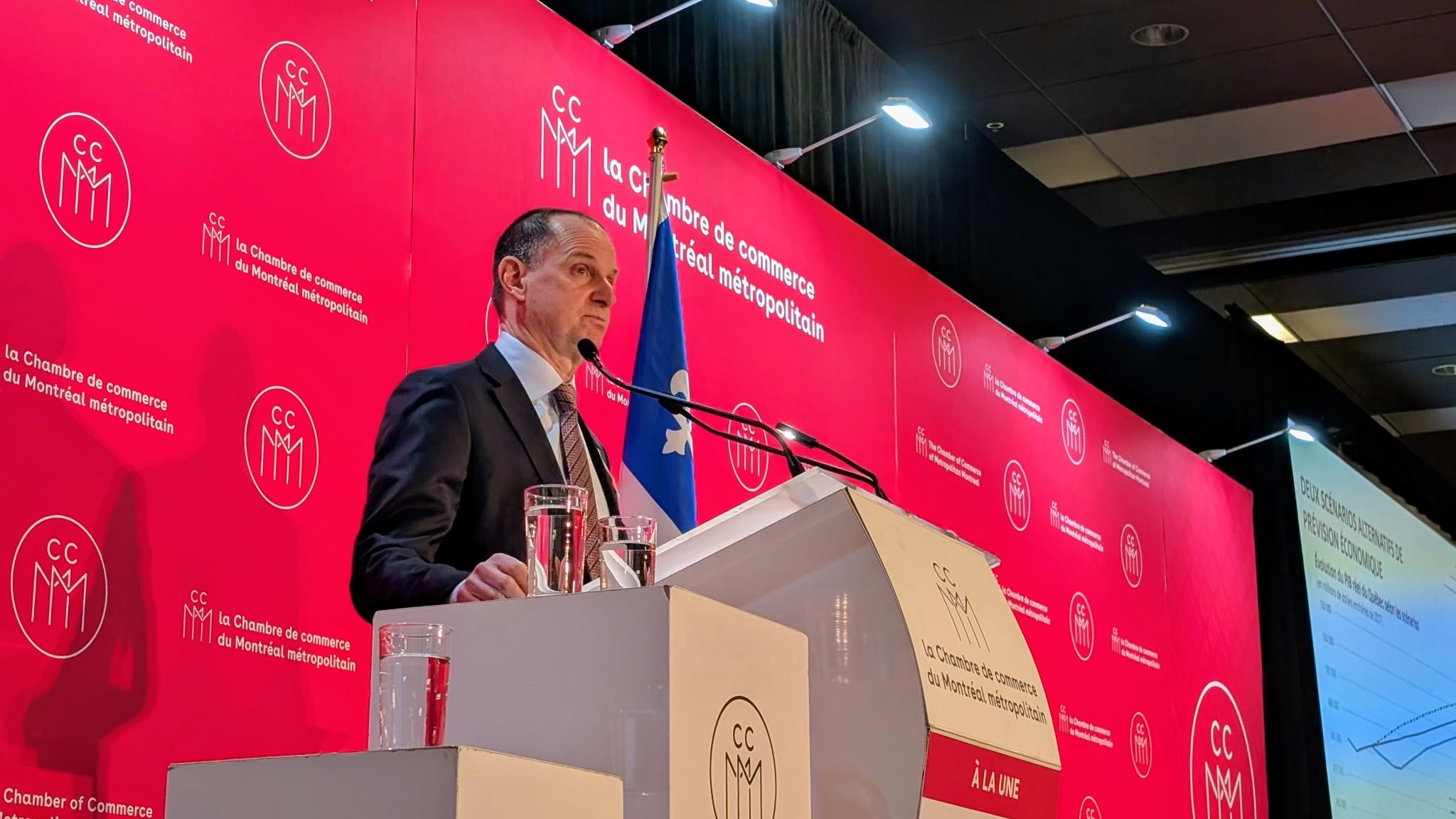
Last Friday, Quebec Finance Minister Éric Girard delivered an economic update at the Chamber of commerce of Montreal. The crowd included CEOs, real estate developers and senior officials, notably the heads of Cogir, Mach and Broccolini. The $180 ticket price made the intended audience clear.
Right from the start, the minister highlighted his management of the debt. At the beginning of the 2025–2026 fiscal year, it stood at $236 billion. According to his own projections, it will reach $286 billion by the end of 2029–2030.
But the government prefers to overlook this $50 billion increase and instead focus on the debt-to-GDP ratio. Girard insists this ratio will fall, even though that does not mean the debt will actually shrink. This indicator simply compares the debt to the size of the economy (GDP), a figure that rises automatically with inflation and population growth.
Just months after announcing major cuts to CEGEPs, public schools and the health system, the minister is now celebrating a budget deficit “slightly below forecasts.” He also congratulated himself for a “standard of living” that, in his view, has grown faster than elsewhere in Canada.
To support this claim, he points to GDP per capita. But that number says nothing about people’s real incomes, cost of living or how wealth is shared. GDP can rise while benefiting only a tiny minority, since it does not specify who receives the income it measures.
Thanksgiving gifts for businesses
The Finance Minister’s presentation left no doubt about the government’s priorities. Quebec is promising $2.5 billion to businesses to “stimulate corporate investment,” “reduce employer payroll contributions,” “support regional economic development” and “create research chairs in strategically important fields.”
The government has also decided to cancel the planned increase to the capital gains tax (income from stocks or other investments). This decision allows the wealthiest taxpayers to keep more than $2 billion in their pockets instead of contributing it to public revenues.

Almost nothing for the working class
For workers, concrete measures are far more limited. Minister Girard announced a small reduction in payroll contributions, worth up to $130 a year. Some social programs will be indexed to inflation, including social assistance, and $52 million will go toward adapting housing for people with reduced mobility.
Questioned by The North Star, Éric Girard acknowledged that one in four Quebecers struggles to cover basic needs. “It’s a Statistics Canada survey, it’s well documented, it’s a fact,” he said. According to Canada’s definition, this means 25% of the population is living in poverty: people “deprived of the resources, means, and power necessary to achieve a basic standard of living.”
Asked about affordability measures, especially in housing, the minister said his government has invested $8 billion since 2018, “nearly half of it for construction.” That is less money for building homes than the combined cost of rebuilding the Île-aux-Tourtes bridge and refurbishing the Ville-Marie tunnel.
Housing conditions remain difficult. In the Montreal region, only 81 of the 1,638 homes whose construction began in October were single-family houses. The vast majority are condo or rental apartment projects. As condo sales slow, many of these projects are later converted into rental units.
But all newly completed projects in recent years have struggled to find tenants or buyers. According to CMHC, these are the most expensive units on the market—often more than $2,000 a month for one or two bedrooms—and their average size keeps shrinking.
Faced with these numbers, Éric Girard maintains that building more new condos, even very expensive ones, will eventually free up more affordable housing elsewhere. The North Star reminded him that, as La Presse reported earlier this year, new units are increasingly hard to sell or rent precisely because their prices are too high.
The minister did not seem convinced: “The real-estate market is composed of new, old, expensive, and affordable units. So if more new units are built, it helps balance the market,” he repeated, without directly answering the question. This theoretical explanation, popular among developers and governments, does not match what is happening on the ground.
Be part of the conversation!
Only subscribers can comment. Subscribe to The North Star to join the conversation under our articles with our journalists and fellow community members. If you’re already subscribed, log in.