
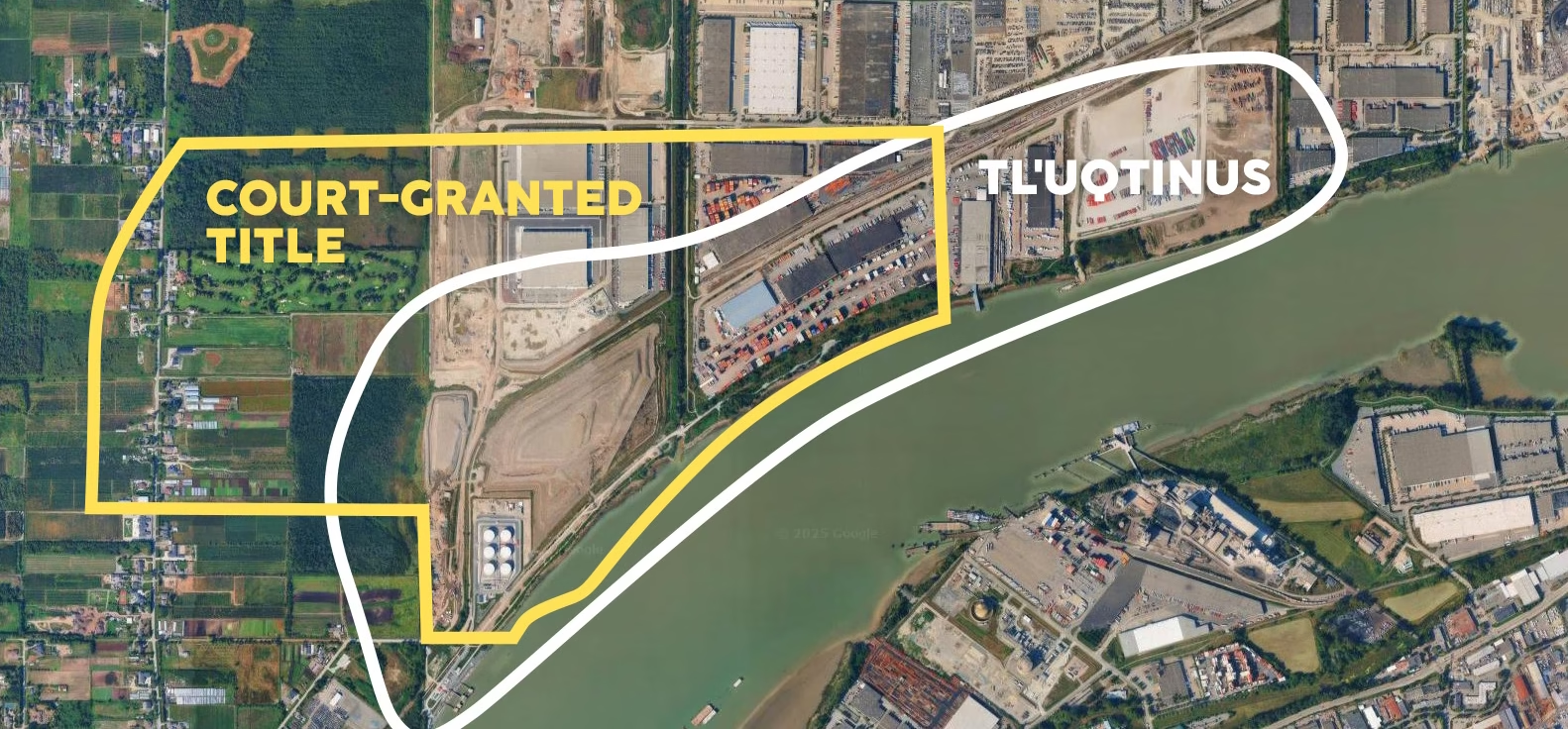
A First Nation says the City of Richmond is fuelling tensions around a land claim, backed by a real estate company who owns nearly half the area. The Cowichan nation lived on this territory before British Columbia joined Confederation. The land was supposed to be set aside as a reserve, but instead, colonial officials sold it illegally in the late 19th century. The Cowichan were then gradually pushed off the land in the early 20th century.
Some context
Historically, large migrations of salmon passed through the southern section of the Fraser River, which surrounds Lulu Island, on which the city of Richmond is built. When conditions allowed, thousands of Cowichan people travelled from Vancouver Island to the claimed land, Tl’uqtinus. The first nation, whose name is Quw’utsun in the Halkomelem language, is now the largest in British Columbia and lived on this territory during most of the year.
Brian Thom, the chair of anthropology at the University of Victoria, describes: “Imagine 100 longhouses all stretched along the bank of the river in rows, with all the dynamics of family and kin, young and the old, weddings, [and] funerals […] with relatives and neighbours from across the lower Fraser region.”

After these lands were designated for the creation of a reserve, Colonel Richard Moody, the official responsible for creating it, sold the land for speculation in 1871. This resulted in the Cowichan people losing control of the area, being definitively forced out at the beginning of the 20th century.
British Columbia joined the confederation on the basis of a promise to build a trans-Canada railway that would terminate in the Vancouver area. At the time, real estate and industrial barons of the new confederation profited greatly from speculation in the region—and the Cowichan people were among the victims.
The First Nation made several attempts to challenge the new land titles, including travelling to England on several occasions to meet with the royal family to appeal. Ultimately, they were denied permission to take legal action.
A historic ruling
After 11 years and 513 days of hearings, making it probably the longest trial in Canadian history, the B.C. Supreme Court ruled that the Cowichan Nation holds Aboriginal title to approximately 40% of the claimed area.
This decision, issued in early August, does not override private property rights, but adds Aboriginal title on top of them. The province has to intervene legally to reconcile the two types of property titles.
Crucially, the nation did not ask the court to take land away from landowners or businesses, and that private titles remain valid, including the 300 hectares of land (nearly half of the claim) owned by Montrose Properties. The company is the owner of the Coca-Cola, Wayfair and Canadian Tire distribution warehouses located on the claim. The decision applies specifically to governments and holds the Crown responsible for past expropriations.

During the trial, there were only two cases of private property titles (“fee simple titles”) being declared “defective and invalid,” both of which were diking and drainage sites belonging to the city of Richmond. These were specifically assessed to be invalid out of numerous titles belonging to the City of Richmond and the Vancouver Port Authority, and were the only ones given back to the Cowichans.
For the rest, the judge simply determined that the Cowichans had the right to negotiations “in good faith”.
“Misleading” and “inflammatory” claims
But now, the First Nation says the Richmond municipal government is publishing press releases and letters about the Cowichan land claim case that are “at best, misleading, and at worst, deliberately inflammatory.”
In late October, Richmond Mayor Malcolm Brodie alleged that the Cowichan land claim area on the south shore of Lulu Island had been long abandoned. He also made statements about the ruling’s potential legal ramifications on landowners in the area in letters and public information sessions.
In a letter sent out to landowners by the municipal government, Mayor Brodie claims “that the plaintiff’s ancestors had abandoned [the area] roughly 150 years [ago].” This falsely implies that the Cowichan abandoned the settlement upon Canada entering confederacy.
The letter goes on to say that “none of the affected private landowners were given formal notice,” and that private property titles are under threat, despite having no proof that this was a risk.

Despite the Cowichan chiefs releasing a statement refuting the claims made by Brodie, mainstream media and large landowners have fed into the misinformation.
Since the court ruling was announced, the case and the misleading statements about it have been plastered over national and local news. Dozens of articles have been published in local papers like the Richmond News and the Times Colonist, owned by media conglomerate Glacier Media. These articles repeat the various statements the mayor or city councillors have made, often outright ignoring the statement put out by the Cowichan addressing these claims.
The City of Richmond, the Province, and Montrose Properties are now seeking to appeal this ruling in the Supreme Court. They aim to establish that private property titles trump aboriginal title, which could have major long-term consequences for future land claim cases between Indigenous peoples and the government.
Montrose CEO Ken Low is registered as a lobbyist in Canada and British Columbia. He has participated in 10 lobbying activities with British Columbia Premier David Eby over the past two months. These efforts have resulted in the province promising to back up to $100 million in loans to Montrose to prevent the ruling from slowing down private real estate development on these lands.
The City of Richmond has stated that it filed a notice of appeal on September 4, while the others have only stated their intention to appeal. In addition to the city of Richmond, both the Musqueam and the Tsawwassen nations have filed appeals. They both argue that the Cowichan land claim area is a core piece of their nations’ respective territories.
At this time, the Kwikwetlem nation is also going through the legal process to assert a land claim on an area of Port Coquitlam. This area would primarily contain what was formerly known as Colony Farm Regional Park.
Be part of the conversation!
Only subscribers can comment. Subscribe to The North Star to join the conversation under our articles with our journalists and fellow community members. If you’re already subscribed, log in.