

This year, François Legault’s CAQ government continued its crusade on behalf of the ruling class at an accelerated pace. Whether through anti-tenant laws, a more expensive life for workers, cuts to public services, bad investments, or even putting citizens’ health at risk, the CAQ is present on all fronts.
The result of “private sector top guns” at the helm of the healthcare system
Quebec’s public sector saw further destruction of the efficiency and accessibility of services. Although the CAQ’s mandate was based on reducing bureaucratic costs and improving the “efficiency and flexibility” of services, it is clearly moving towards the gradual privatization of health care, education, and public transportation.
The consequences of Santé Québec’s reforms were quickly felt. One year after regional health institutions were centralized into a single organization under the authority of the former CEO of a private health company, none of the government’s stated objectives for improving services had been achieved.
The list of disastrous decisions is long—hiring freezes, outsourcing of renovations and maintenance leading to skyrocketing costs, service cuts, overwork and administrative tasks for workers in the field, and the addition of 200 highly paid senior executives, inflating an already absurdly complex bureaucracy.
Schools in ruins
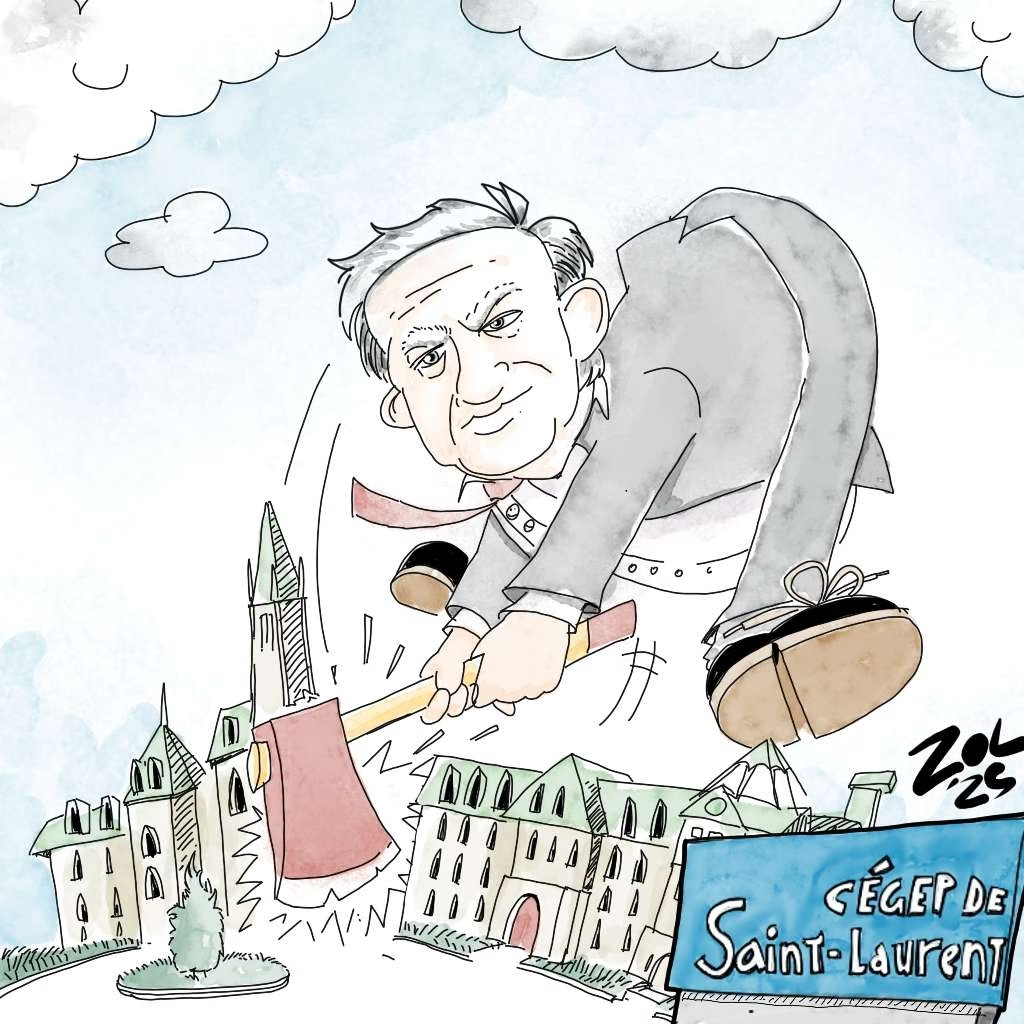
The situation in education is no better. The government cut hundreds of millions of dollars from CEGEP budgets in 2025. Bernard Drainville, Minister of Education before the September cabinet reshuffle, demonstrated his detachment from reality by asking workers to avoid compromising direct services to students.
A year later, the impossibility of meeting this request is evident. For example, at Cégep Saint-Laurent in Montreal, maintenance deficits amount to $20 million, and more than half of its buildings are considered to be in poor condition. The college had to close one of its buildings and rent space in a building two kilometers away.
The STM and accusations of “taking the population hostage”
Cutbacks, privatization, and outsourcing also affected workers at the Société de transport de Montréal (STM). Several strikes took place in 2025 to demand improvements to working conditions, which had been stagnant for years, but also to protest against privatization and poor management of the public transport company.
At the beginning of the year, the STM announced that all paratransit services provided by minibus would be entrusted to private carriers starting in 2026. This is despite an increase in ridership in recent years and a high level of customer satisfaction.
Workers have noticed a sharp increase in the use of external companies, even though the necessary workforce already exists internally. As in health and education, the use of subcontractors has caused costs to skyrocket.
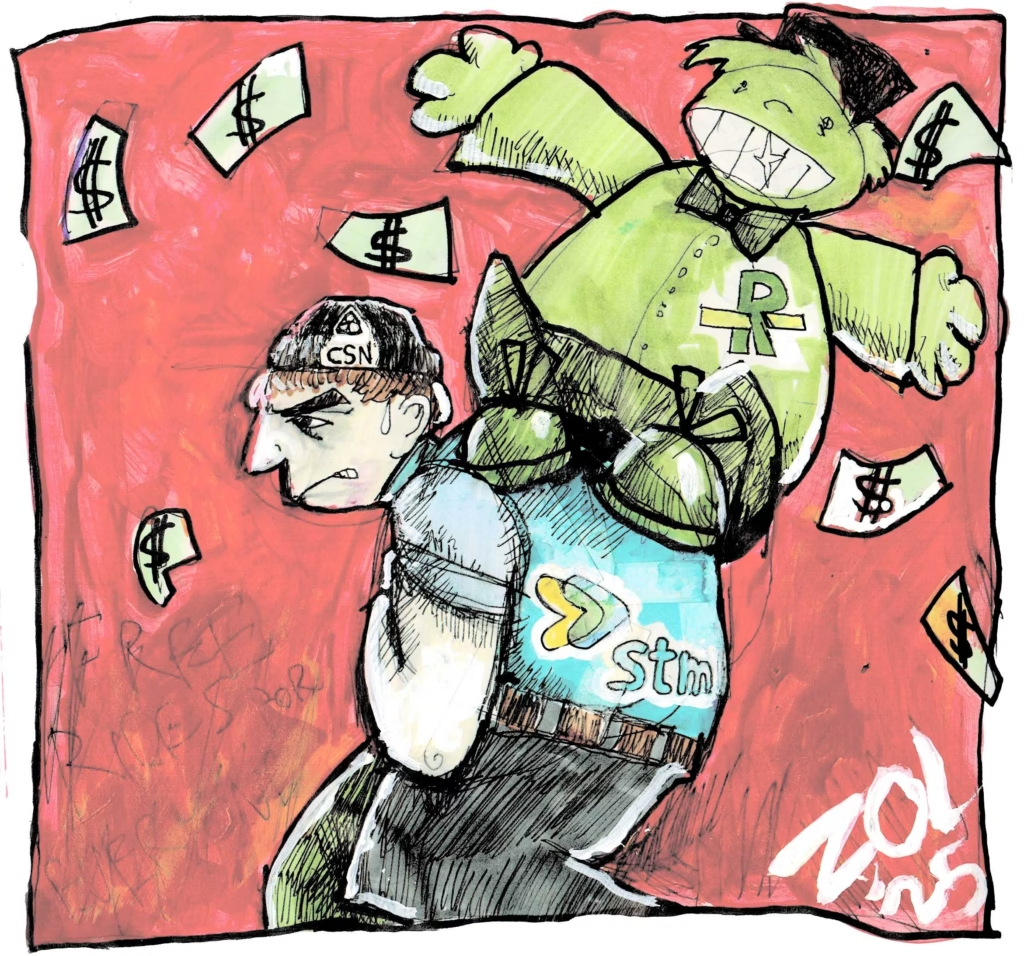
The head of the STM, Marie-Claude Léonard, received a 6.5% raise between 2023 and 2024, with a salary of approximately $475,000 last year. However, according to its 2024 annual report, the company balanced its budget thanks to $36 million in optimization, a $15 million reduction in expenses compared to the initial budget, and $14 million more than expected in commercial revenues.
Despite all this, the STM, in concert with the mainstream media, accused the striking workers of “taking the population hostage,” blaming the company’s financial crisis on their wages. This claim is based on a controversial report by Raymond Chabot Grant Thornton, which essentially recommends privatizing the public transit system.
Labour Minister Jean Boulet threatened to introduce special legislation and tabled a bill that would crush the workers’ ability to strike.
Unionization, strikes, and class struggle
Big bosses in the private sector, on the other hand, enjoy total freedom. In January, Amazon decided to close all its warehouses in Quebec in direct response to the unionization of a warehouse in Laval in 2024. 4,500 people lost their jobs in the winter of 2025.
Despite a boycott movement by the Quebec population, the government’s response was clear: it has no problem with an American multinational directly attacking the Canadian working class.

In August, Air Canada flight attendants went on strike after rejecting an offer they denounced as a pay cut in disguise, in addition to maintaining an average of 35 unpaid hours per week. Air Canada immediately responded with a lockout notice.
Just a few days later, with the support of representatives of the Canadian ruling class, Ottawa asked the Canada Industrial Relations Board to end the strike with special legislation and impose a contract. In response, the flight attendants defied the back-to-work order, and a tentative agreement was negotiated a few hours later.
In the public sector, in addition to wages stagnating in the face of inflation, one of the biggest demands was to end the privatization of services and the use of subcontractors.
In 2025, Canada Post and the City of Montreal’s blue-collar workers went without a collective agreement for several months, even years. A refusal to negotiate on the part of the employer and threats of privatization prompted the two unions to join forces during a solidarity demonstration.
The unions denounce the explosion in costs that outsourcing would entail in the long term, especially in the context of an already weakened service.
Housing is becoming a luxury
In Quebec, the housing crisis was particularly severe in 2025. According to Statistics Canada, average rents in Montreal have increased by 71%, or $800, since 2019. The Minister of Housing until September, France-Élaine Duranceau, introduced a reform to the calculation of rent increases that follows the average inflation rate over the last three years. This reform is virtually identical to the proposal made by Quebec’s largest real estate owners’ lobby, CORPIQ.
According to Statistics Canada, homelessness has increased dramatically in recent years. From 2018 to 2024, the number of people experiencing homelessness outdoors quadrupled.
Encampments in parks have exploded. Violent evictions of homeless encampments are also becoming more frequent.
In a familiar refrain, the CAQ and the APCHQ employers’ association accused striking residential construction workers of earning too much and claimed that their demands for higher wages would increase house prices by about $55,000. However, since 2020, the price of a single-family home has increased by 73%, but workers’ wages have only increased by 8.2% since 2021.
Even real estate construction projects have raised eyebrows among tenant advocacy organizations and are likely to exacerbate the housing crisis for the working class.
A glaring example is the Molson neighbourhood project by real estate developers Montoni Group. They want to build offices, shops, a hotel, and residential buildings on the site of the former brewery in Ville-Marie, the poorest neighbourhood on the island. One in five households there must spend 80% of their income on housing.
The plan does not include a school, daycare, or community services. The Montreal School Service Center has evicted eight community organizations (including a daycare, a food bank, and the Comité BAILS) from one of its buildings to take back the premises.

Direct attack on the people
One of the recurring themes since the CAQ took office has been direct attacks on the population’s power to intervene in politics and democratic institutions such as unions.
A prime example is the expansion of the Stablex plant in Blainville. A citizens’ movement has highlighted the risks to public health, the BAPE has published a report detailing the disastrous environmental impact, and several community and scientific organizations have described the Blainville peat bog as an environment that must be protected.
Despite all this, the Quebec government allowed the American company to use the land as it sees fit by rushing through a clotured law in the middle of the night.
In rural areas, Indigenous blockades have also multiplied. Since the government has failed to act to resolve conflicts between logging companies and the communities that live there, forest defenders blocked logging trucks for several days to prevent deforestation on their territory.
Another glaring example of the CAQ’s preference for employers is its attacks on the right to strike and unions. In February 2025, Jean Boulet, Minister of Labor, introduced Bill 89. This law gives the government the right to force a return to work in sectors that are considered non-essential, whether in the private or public sector.
Following the STM strike in the fall of 2025, Jean Boulet went on the offensive once again and introduced Bill 3. This reform directly targets the freedom of unions to challenge existing laws, slashes their funding, and adds a layer of bureaucracy through the new administrative procedures that this reform entails.During the public hearings on the bill, several employer lobbying groups were heard. This reform led to an inter-union demonstration of approximately 50,000 people in the streets of downtown Montreal.
Be part of the conversation!
Only subscribers can comment. Subscribe to The North Star to join the conversation under our articles with our journalists and fellow community members. If you’re already subscribed, log in.