
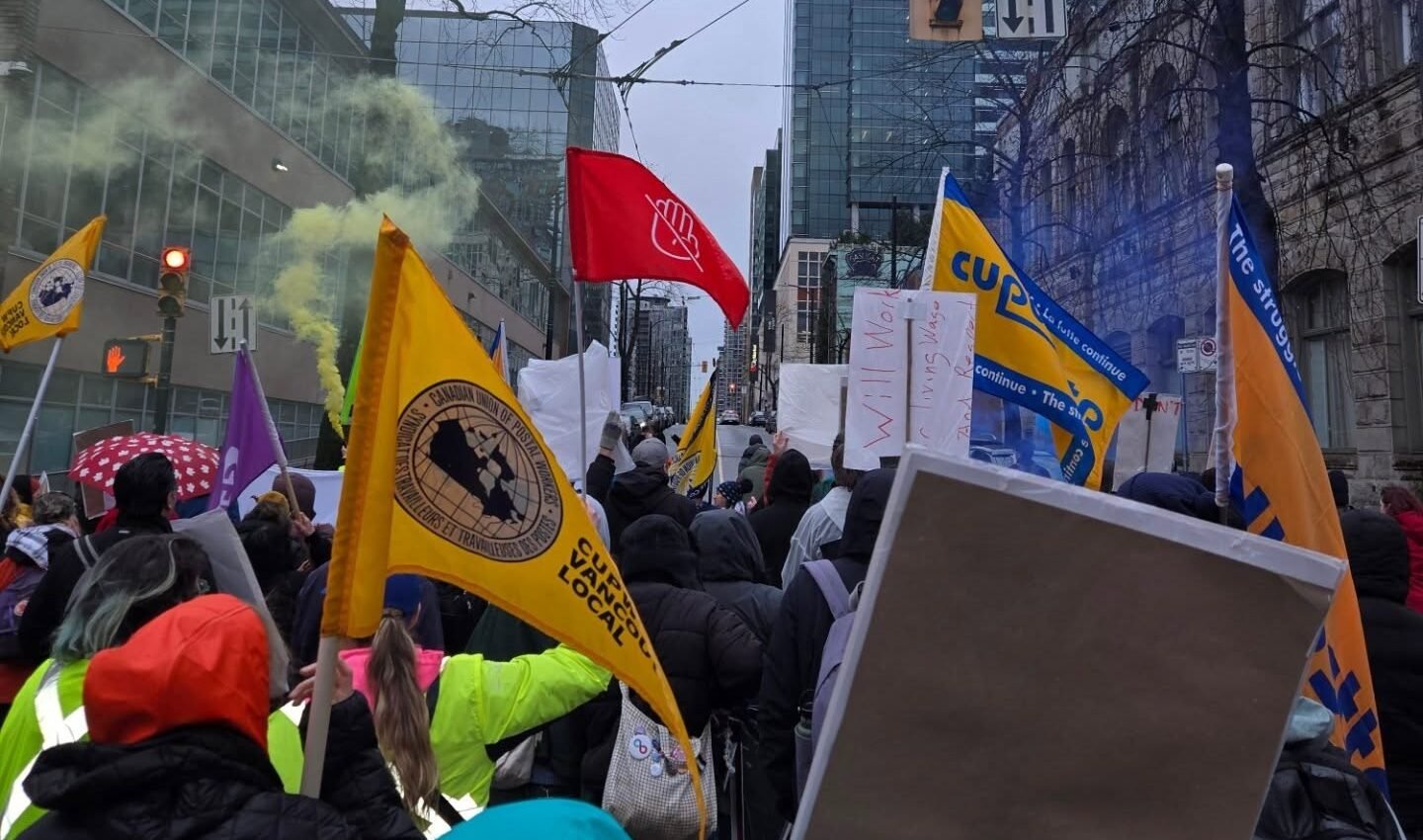
One year after being forced back to work by the federal government, postal workers still do not have a ratified collective agreement and are calling for action. Their fight against Section 107 and to save their service has become symbolic of the struggle to preserve workers’ bargaining power against companies, as well as the increasingly complex contradictions between rank-and-file members and their union leaders.
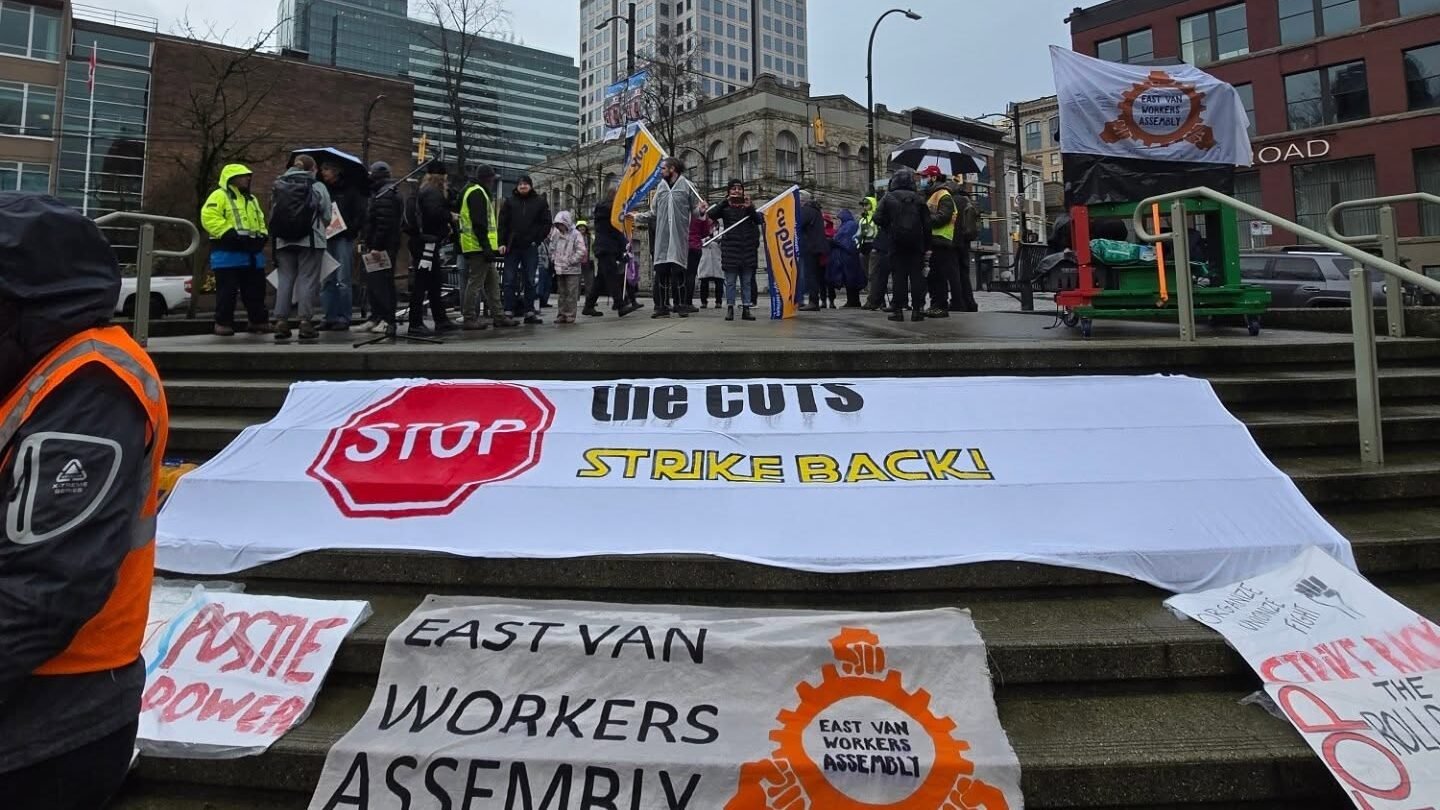
On December 20, members of the Canadian Union of Postal Workers (CUPW) and other workers from across the labour movement rallied in Vancouver to mark the anniversary of the back-to-work order and to denounce ongoing state interference in workers’ right to strike. The event was co-hosted by CUPW Local 846’s Organizing Committee and the East Van Workers Assembly (EVWA). Similar rallies were held the same day by locals in Toronto and Saskatoon, where postal workers and supporters gathered despite brutally cold weather.
The North Star interviewed organizers and attendees in Vancouver amidst the heavy rain. Speakers addressed the political consequences of back-to-work orders and the continued lack of a ratified contract. They drew attention to a perceived erosion of workers’ power due to collaboration between the government and employers, as well as inadequate leadership from national union executives.
Section 107
“When our strike ended with a government order, it felt like we were marching back into our defeat,” said Alex Bernstein, a Canada Post worker and Organizing Committee Director. Since being ordered back to work under Section 107 of the Canada Labour Code, he explained, management has routinely violated the collective agreement, confident that workers’ leverage has been blunted.
Section 107 was used against postal workers during their nationwide work stoppage in 2024, while CUPW was negotiating with the Canadian government for an updated collective agreement. At the time of writing, CUPW’s official collective agreement has not been updated since it expired in 2022.
At the rally, Dustin Saunders, a rail worker and member of Teamsters 945, gave a passionate speech. Saunders says Section 107 has been used against rail workers, too, resonating with several postal workers’ calls for resistance against anti-worker legislation to cross provincial and industrial lines.
Posties stressed that workers’ response to Section 107 cannot be passive. “The biggest challenge for workers now is to continue to agitate, educate, and organize the rank and file,” said Skadi, a postal worker and member of the East Van Workers’ Assembly, calling for deeper cooperation across locals and unions.
Bernstein agrees. “If we’re ever going to push our employer and win big, the rank and file membership of the union must demonstrate ownership of where we’re going,” he said.
EVWA organizers framed the rally as part of a broader call to labour solidarity beyond Canada Post. They say Section 107 is part of a wider pattern of state intervention used to discipline workers across sectors.
Lindsey Michie, a member of both the EVWA and CUPW, described the back-to-work order as “the perfect way to illustrate what happens when we rely on bourgeois institutions to play fair.”
That message was echoed by speakers from other unions and regions, including representatives from the International Longshore and Warehouse Union, the BC Federation of Labour, health care workers, and a letter carrier from the National Association of Letter Carriers in Seattle.
“The government used Section 107 against us [in 2024]. They used it to collude with their corporate overlords in order to suppress our right to strike and to keep us down,” said Dustin Saunders, a worker at CN Rail and member of Teamsters 945.
Collective agreements and demands for transparency
“I live and die by the collective agreement,” Bernstein said, describing it as the product of hard-fought victories “written in stone.” Yet those gains, he explained, are undermined by management’s habitual violations, with supervisors openly daring workers to “grieve it,” knowing the process can take months or even years.
This dynamic, Bernstein argues, turns the grievance system into a tool of delay rather than accountability, leaving workers exhausted and demoralized while the corporation continues to break the rules with impunity.
CUPW leadership announced that they had reached an agreement in principle with Canada Post on November 21 after more than two years of negotiations. However, the details of the agreement were not made public.
Miguel, a postal worker and member of EVWA, expressed confusion about the fact that the agreement in principle was announced, but the agreement itself was not released to members.
Postal workers were told to “pause” all job actions, including the months-long strike that had started on September 25 last year.
At the time of the rally, the tentative agreement had not been shared with the rank-and-file. For many rank-and-file workers, the absence of details has deepened a sense of alienation from the bargaining process.
Skadi described the moment bluntly: “We are sitting on our hands because we allegedly have an ‘agreement in principle.’ When pressed on the issue, our national executives refuse to elaborate. But what have we even agreed on?”
“When [the announcement of the agreement in principle] came out, they said a tentative agreement would be reached and presented in the same week. Nothing had progressed until our rally on December 20th,” says Miguel, “And on the 22nd they released a statement saying that they had reached tentative agreements”.
In a press release about the tentative agreement, CUPW promised “a more detailed summary of all changes to the collective agreements”. However, these updates have not been made available to workers to this day, and the full tentative agreement has not been released.
“In my experience, unions either announce a full contract, or they don’t announce anything. That was a month ago, and there’s still no full tentative agreement.”
Miguel feels that CUPW’s national executive is attempting to “prevent decentralized action by locals and militant rank-and-filers”, such as the postal workers who organised the rally on the 20th.
He says that many workers are losing confidence in the union’s leadership. “Everyone just wants an offer to vote yes on and stabilize their lives … Many suffered financially, only to face this uncertainty.”
Postal workers are a “lifeline” for communities
Speakers and postal workers in attendance repeatedly emphasized that postal work is a public service with deep social importance. “We’re a lifeline for many rural areas, and an integral part across the country of helping build community,” Skadi said. “There are countless stories of posties helping out the community and literally saving lives.”
Michie echoed this sentiment, arguing that postal services could play an even larger role if not constrained by privatization and austerity. “Our civil service could provide everything from postal banking to wellness checks,” he said, “if the government had more imagination and less desire to defund everything.”
Several speakers highlighted how these public service roles became especially visible during crises. Holly Isaac, a relief letter carrier in the Fraser Valley, pointed to the COVID-19 pandemic as a stark example: “We were literally the only connection point people had to another human being during their day”.
She warned that intensifying routes and productivity demands threaten this role by stripping workers of the time needed to look out for their communities.
Naomi Allen, a retired letter carrier of 27 years, described postal work as inseparable from the communities they serve. She cited the “endless stories” of informal support that she and her coworkers would provide to seniors along their routes. Formalizing these supports pioneered by workers is part of the strategy proposed by CUPW to reshape Canada Post for the benefit of both postal workers and the broad public.
“I get really emotional when I think about the people I cared for every day… It is a public service that we need to fight for.”
The rally closed with an open challenge. Postal workers are still without a contract, still facing management violations, and still confronting a legal framework that undermines their collective strength.
Whether 2026 marks a turning point will depend on whether the anger and clarity on display can be transformed into the “new waves of struggle” organizers say are necessary to defend both workers’ rights and the public services they provide.
Be part of the conversation!
Only subscribers can comment. Subscribe to The North Star to join the conversation under our articles with our journalists and fellow community members. If you’re already subscribed, log in.