
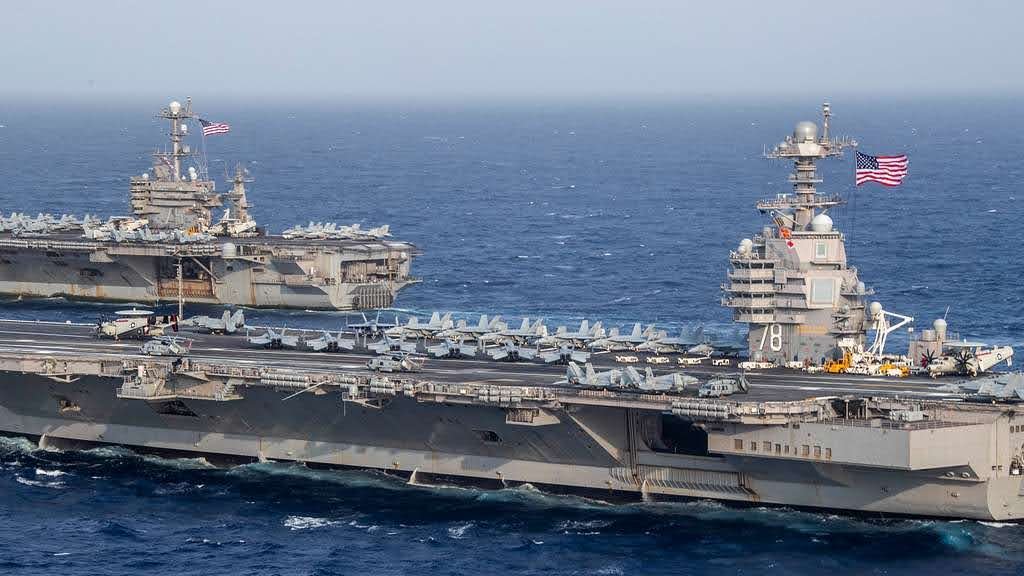
On Thursday, the United States ordered the deployment of two carrier groups to the Strait of Hormuz, off the coast of Iran, including the USS Gerald R. Ford, the largest aircraft carrier in the world—previously stationed off the coast of Venezuela.
These carriers, alongside numerous aircraft and missile batteries stationed at American military bases around the besieged country, mark the largest American military build up in the Middle East since the 2003 invasion of Iraq. Strikes on Iran could occur in the coming days.
Military build up outside Iran has been openly touted by the White House as a measure of intimidation, or gunboat diplomacy, amidst ongoing nuclear development talks in Geneva, Switzerland. Washington sent a clear threat to Tehran. President Donald Trump has said, “We may have to take it a step further, or we may not.” Trump further suggests that Tehran will have up to 10 days to make a deal.
The Iranian government has previously denied that it has enriched uranium for the development of nuclear weapons, a claim corroborated by America’s own spies in the country.
While officially, U.S. military buildup in the region is a pressure tactic to cause Tehran to make a nuclear deal, discussion of regime change has been brought up by politicians and broadcasted by mainstream media. Trump says regime change “seems like that would be the best thing that could happen”.
In Canada, Foreign Minister Anita Anand stated “we will not open diplomatic relationships with Iran unless there is a regime change. Period.” The Canadian government has not outright stated whether or not it will support American military action in the region.
The editorial board for the Wall Street Journal published an editorial on February second titled “The ‘Deal’ in Iran Is Regime Change”, which argues that any deal that comes to pass with the Iranian government would be undermined by Tehran, thus the only viable option is regime change. WaPo further argues that the U.S. must “help the protesters topple the Ayatollah and his enforcers”.
The protesters in question are the Iranians who have taken to the streets in every major city to demonstrate against the deepening economic crisis and inflation, decades of strict theocratic rule, and widespread corruption. NATO aligned government officials have used last month’s protests as a vessel to promote their own interests in Iran.
After decades of an intense regime of sanctions levied by the U.S. and its allies as a mode of economic warfare, military strikes by U.S.-Israeli forces last summer, and deep economic and social crisis, Iranians are poised to experience yet another escalation of tensions in the region—this time to a potential boiling point.
Be part of the conversation!
Only subscribers can comment. Subscribe to The North Star to join the conversation under our articles with our journalists and fellow community members. If you’re already subscribed, log in.