
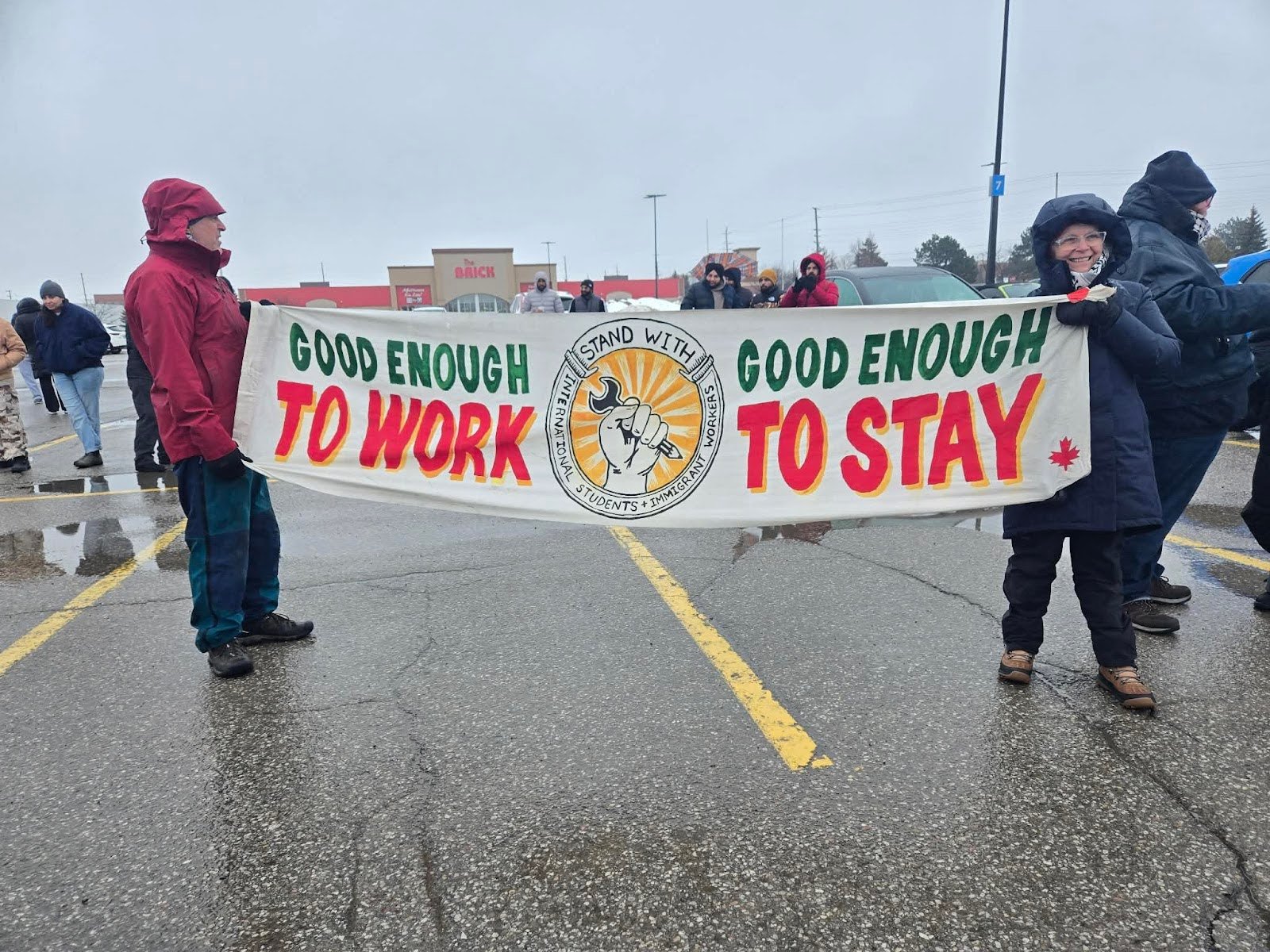
Despite the heavy wind and rain in Brampton last Friday, dozens rallied outside the office of MP and Minister of International Trade, Maninder Sidhu, to demand immigration pathways in general that are predictable and transparent. The United Immigrant Workers Front (UIWF) members gave speeches, as workers who see this fight as inseparable from labour justice more broadly.
The UWIF presented a list of demands: extension and renewal of the 2 million temporary visas set to expire this year, increased yearly allocation for Canadian Experience Class (an express entry pathway to permanent residency), and immigration pathways in general that are predictable and transparent.
Given the record-breaking number of temporary migrant visas set to expire in the coming months, the urgency of organizing immigrant labour in the GTA was identified at a meeting organized by the Naujawan Support Network’s PGWP (Post Graduate Work Permit) Committee in December. The United Immigrant Workers Front consists of immigrant workers, students, and labour groups including Naujawan Support Network, Workers Alliance, Migrante, and Migrant Workers Alliance for Change.
The decision to hold Friday’s rally in front of the office of the Liberal’s Minister of International Trade was intentional in this regard, a member of UIWF and of the Executive Committee of CUPE Ontario, Katherine G., shares with The North Star. “[This office] is directly related to the trade that happens in human beings. [People are] coming to the country to be exploitable labour under terms that do not apply to Canadian workers.”
Demanding fair pathways and an end to scapegoating
Since the beginning of his term as Canada’s Prime Minister in April 2025, Mark Carney’s Liberal government has introduced several legislations that increase and accelerate deportations in Canada. Bill C-12 (Strengthening Canada’s Immigration System and Borders Act, which passed in the House of Commons in December 2025) introduced asylum restrictions that impose a one-year bar on refugee claims for migrants who have been in Canada for over one year.
International student permits were cut by nearly 50% in the first federal budget. Canada stopped accepting applications under the Home Child Care Provider and Home Support Worker pilots in December 2025. These programs had for years provided pathways to permanent residency.
Temporary residents, including foreign workers, international students, and asylum seekers have been a particular target of the Carney government’s new omnibus bills and Immigration Levels Plans. Temporary foreign workers, who have no guaranteed path to permanent residency, are among the most vulnerable and precarious in the country. The UN and Amnesty International have likened the conditions of temporary foreign workers to “modern-day slavery”,
“They are changing policies overnight,” says Mehakdeep Singh of Naujawan Support Network. “People are left in limbo…If I am a work permit holder right now, I don’t know which pathway I should follow to get permanent residency. Come 2027 [for example], I don’t know which options will be available to me anymore.”
Singh points as well to the cruel precarity imposed so suddenly, and harshly, on migrants in Canada: “Back home, parents are depending on their children. They have put a lot of investment into sending them to Canada. But here, we are getting exploited at every single stage of our life, from colleges to employers to landlords to the government.”
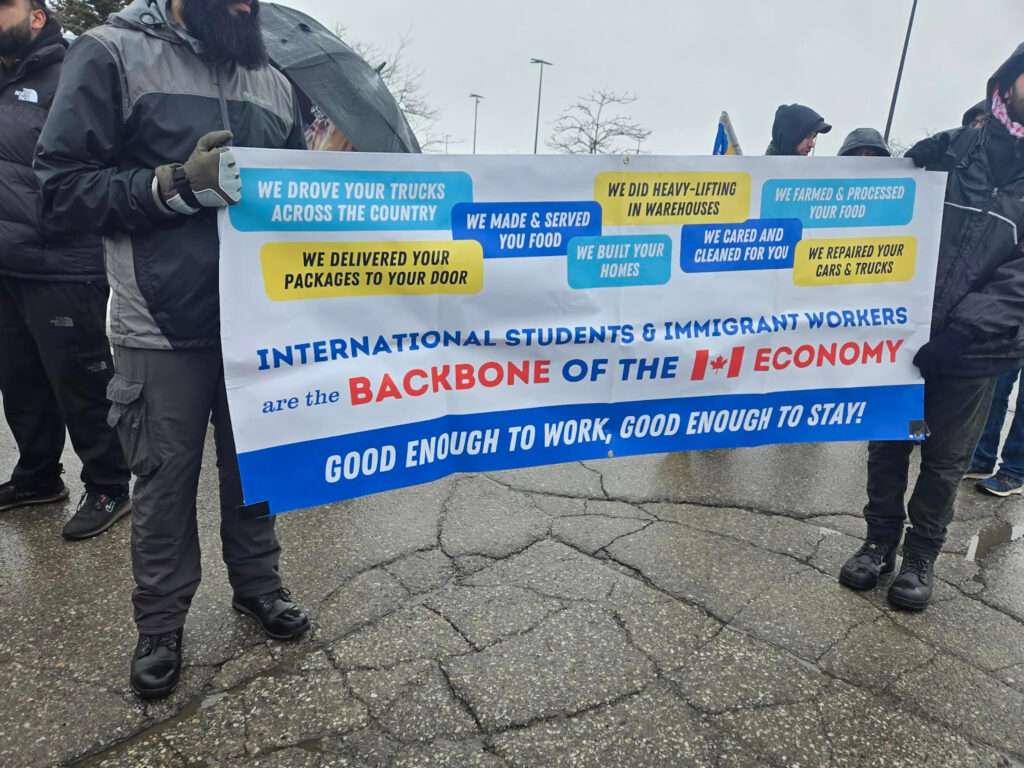
Liberal and Conservative politicians, both provincially and federally, have long blamed temporary migrants for the sharp economic downturn and declining living conditions average workers are increasingly experiencing. The anti-immigrant sentiments this scapegoating feeds, adds Katherine, are useful in dividing workers at a time where it is critical to work in solidarity for collective gains.
“The struggle for immigration status is fundamentally a workers’ rights struggle,” she explains. “When immigrant workers are a hyper-exploitable source of labour, that drags down the working conditions for all workers in a particular country.”
A common front for immigrant and non-immigrant workers
Katherine notes that precarious immigrant workers often accept jobs where they are paid less than minimum wage or do not receive overtime wages because they are afraid of upsetting the employer on whom they are relying to secure permanent status. In Canada, politicians, employers and landlords are making record-breaking profits year after year while pushing narratives that blame the most exploited layers of the working class.
Katherine points out the far right circulates ideas among workers that deporting immigrants leads to better conditions for Canadian workers. She suggests the attack on temporary migrants in Canada is better understood as an attack on the working class in general.
“The global economic elite that are responsible for our deteriorating living and working conditions want us fighting a culture war, not a class war,” she says, “and as long as we continue to be divided along lines like gender identity, race, immigration status, we will never be able to materially improve our conditions. For that to happen, we need the broadest workers’ movement possible.”
Be part of the conversation!
Only subscribers can comment. Subscribe to The North Star to join the conversation under our articles with our journalists and fellow community members. If you’re already subscribed, log in.