
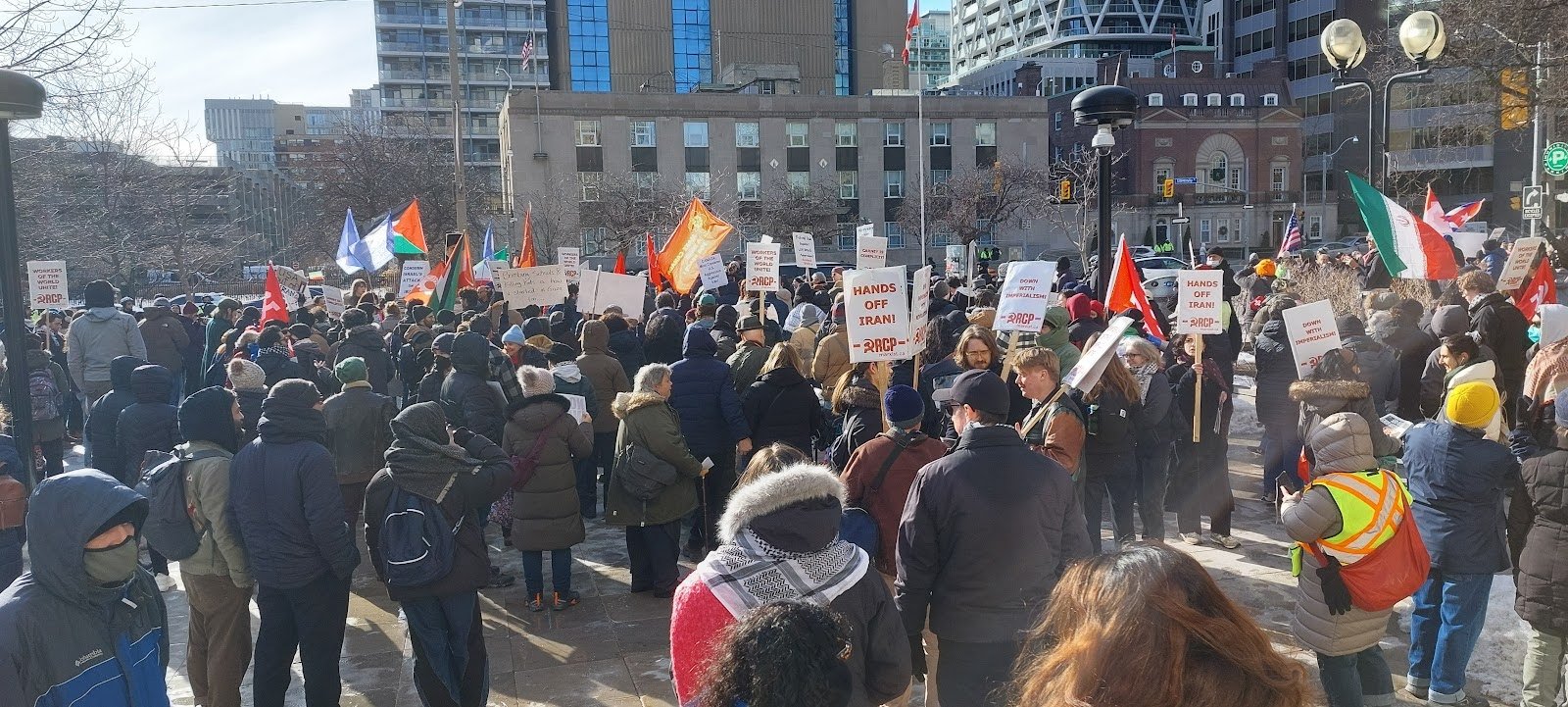
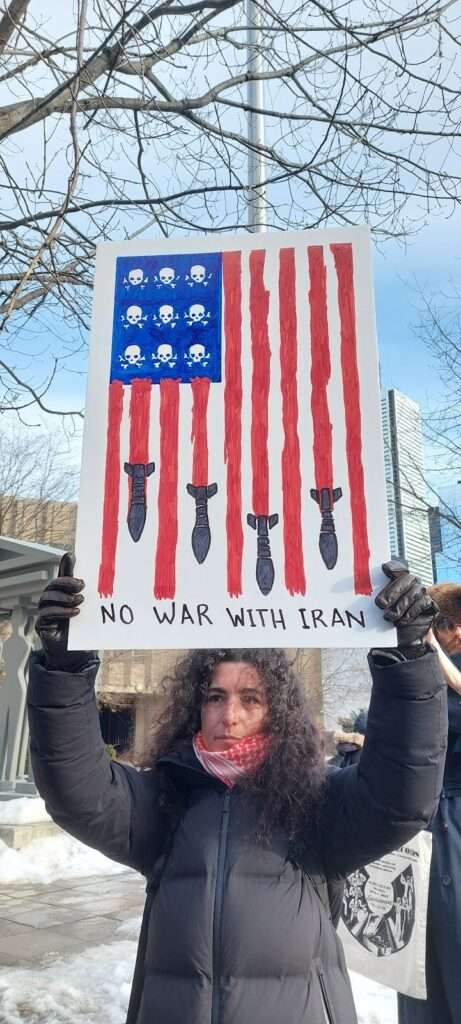
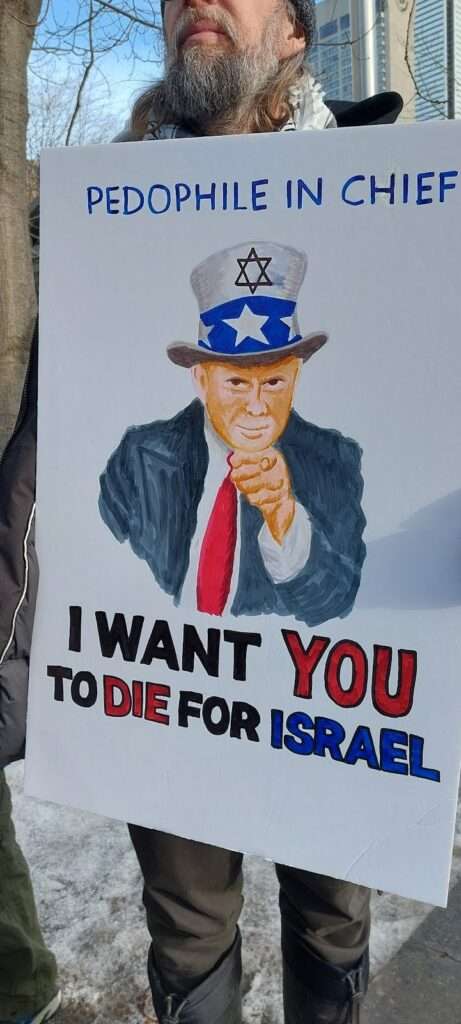
Mere hours after the first bombs landed on Tehran, protesters all over Canada rallied around the country to demonstrate against the unprovoked joint US-Israeli strikes against Iran. Some protesters demonstrated for their families in the pummeled country, while others emphasised solidarity with Iranians against imperialist aggression. The North Star was on the ground at the U.S. consulate on University Ave. in Toronto.
“My country of birth is being bombed,” says Talia, a member of Iranians United For Palestine, “that’s why I’m here to oppose U.S. imperialism and hegemony”. Talia states that she cannot get through to her family in Iran, but “heard from [her] cousin who resides in Germany that she was able to get in touch with them using what little internet they had. My cousin was able to hear bombs in the background as she was speaking with her family”.
Tensions have reached a boiling point since the massive US military build up in the region. Arran, a participant at the protest who had been following the situation, told The North Star “I laid out at night for four hours after the bombing started”.
“This war in Iran is an extension of the genocide in Gaza,” says Amir from the Palestinian Youth Movement (PYM), “it is an extension of imperialism that has been in our region for over hundreds of years now”. Iran has provided material support to factions in Palestine, Syria, Iraq, and Yemen. These groups have found themselves at odds with Daesh (ISIS), American, and Israeli forces.
The Context of Aggression
“Just look at history”, says Amir, “Iran was under the Shah (king) for a long time. They fought a revolution in 1952. They got [Mohammad Mosaddegh] elected who fought for their sovereignty, then the U.S. and Britain took him out and put someone else in place until the 1979 revolution. The U.S., in our region, their goal is similar to all around the world. Any country that doesn’t fall with its economic block, its order, a country that it can’t exploit its resources for, that has a different power in the region that fights for its sovereignty [the U.S.] wants out of business”.
Amir is referring to the 1952 election of Mohammed Mosaddegh to the position of Prime Minister of Iran. Mosaddegh was removed from power in a 1953 coup, which saw the CIA and M16 consolidate power in the Pahlavani dynasty. The coup was a response to the Mosaddegh government nationalizing Iranian oil. Pahlavani reigned as a pro-west monarch of Iran until the 1979 revolution, in which the dynasty was ousted over charges of corruption and putting the interests of the west before the interests of Iranians.
The 1979 revolution saw the creation of the current, Islamic Republic of Iran. which has been competing for influence in west Asia since its inception, and aligned itself with the Chinese and Russian power blocs in recent history. This has put it in the crosshairs of American imperial interests. This follows the recent trend of the United States neutralization of Venezuela and Cuba — key Chinese/Russian allies.
Arran looks to internal U.S. politics as another cause for America’s latest spree of violence. “The geopolitical analysis is complicated. Supposedly, Trump doesn’t have an out. You know, he attacks, he satisfies Netanyahu. He doesn’t, he helps MAGA. If he attacks, MAGA won’t like him because they don’t want these forever wars”.
The Conflict Unfolding
“It is really a case of an unstoppable force meeting an immovable object,” explains Marlnur, “it’s going to take at the very least weeks, but there is a potential for this to turn into a long, drawn out, bloody war, another war where the U.S. gets itself into a quagmire and has no way to pull out like we saw in Iraq, Afghanistan, and now Ukraine.”
Some have argued that the difference between this conflict and interventions in Iraq and Afghanistan is the level of popular support in the United States. When questioned about her thoughts on rumours of sabotage and mutiny on the Gerald R. Ford supercarrier, Talia has “heard many different sources confirming that sort of scenario. This war actually has apparently somewhere around twenty percent of popular support in the United States. It’s not like 23 years ago when seventy percent of Americans approved of the US attacks on Iraq”. According to a Reuters poll conducted on the day of the attacks, only 27% of all those questions supported military action against Iran.
While demonstrators rallied against the war at the US consulate, many members of the Iranian diaspora in Canada rallied in Richmond Hill to support intervention, a city north of Toronto with a high Iranian population. Arran comments “the Iranian monarchists are incredibly naive. [The US] wants to balkanize it, like Syria, or destroy it like Libya”. With regards to the exiled Crown Prince Riza Pahvalani, president Donald Trump has stated “I don’t know whether or not his country would accept his leadership. Most of the people we had in mind are dead”.
Intervention has been touted by its supporters as a way of liberating Iranians from the Shia theocracy and Iranian government that was very recently cracking down on widespread public unrest. “These are just statements by the US and Israel to try to destabilize Iran to take it over. Whether the people want their government or not, that’s a question for their people. Not a question for the US or Israel”, says Amir, who elaborates on what he believes the people living in western countries such as Canada should be doing to support Iranians against imperialism:
“We fight the elites that fund it, we fight the narrative that funds it, and we fight it by building the power of the people. That only gets built by organizing on the ground, by uniting as a people, and understanding who our real enemy is, which is Zionism, which is US imperialism, which is the Canadian imperialists that also fund and help with this genocide.”
Be part of the conversation!
Only subscribers can comment. Subscribe to The North Star to join the conversation under our articles with our journalists and fellow community members. If you’re already subscribed, log in.