
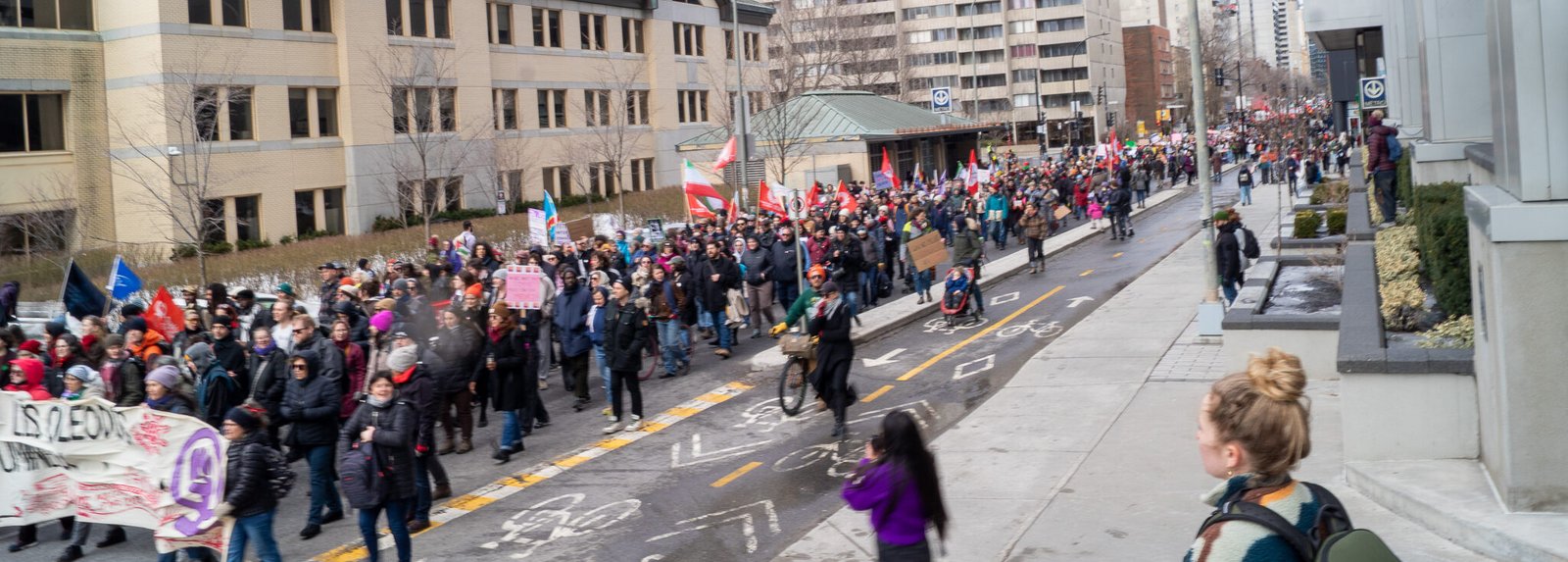
Last Sunday, several thousand individuals and activists and community groups gathered in downtown Montreal, in front of the statue of Dr. Norman Bethune, to mark International Women’s Day. This year, the organizing group Women of Diverse Origins called for a demonstration under the theme: “Against austerity, fascism, imperialism, and militarism.”
Several groups from various communities were present at the demonstration, including Anakbayan Montreal, Disinvest 4 Palestine, International Women’s Alliance, as well as workers’ associations such as Alliance Ouvrière, the Immigrant Workers Centre, and several unions.
In a press release from the organizing group Women of Diverse Origins, concrete links are made between the struggle for women’s rights and the multiple political, social, and economic crises internationally and in Canada in 2026.
In Canada, Mark Carney’s war budget and the austerity measures of the CAQ government in Quebec are being denounced:
“Mark Carney’s war budget and the austerity of the CAQ accelerate the decay of our public services. Public institutions of childcare, health care, and education were won through the struggles of working-class women in Quebec and Canada in the 20th century. And it is mainly women who are affected by the destruction of these services.”
The attacks by the Quebec and Canadian governments are severely affecting the freedom of the entire working class. But it is often women who will be directly affected by wage cuts, loss of rights, and job cuts through cuts in health care, education, and daycare centres, where the majority of workers are women.
“This austerity is accompanied by a new wave of repressive and freedom-destroying laws. The Quebec government is waging an all-out offensive on organized labour. Meanwhile, the governments of Canada and Quebec have torn off their masks and begun new assaults on the rights of migrants.”
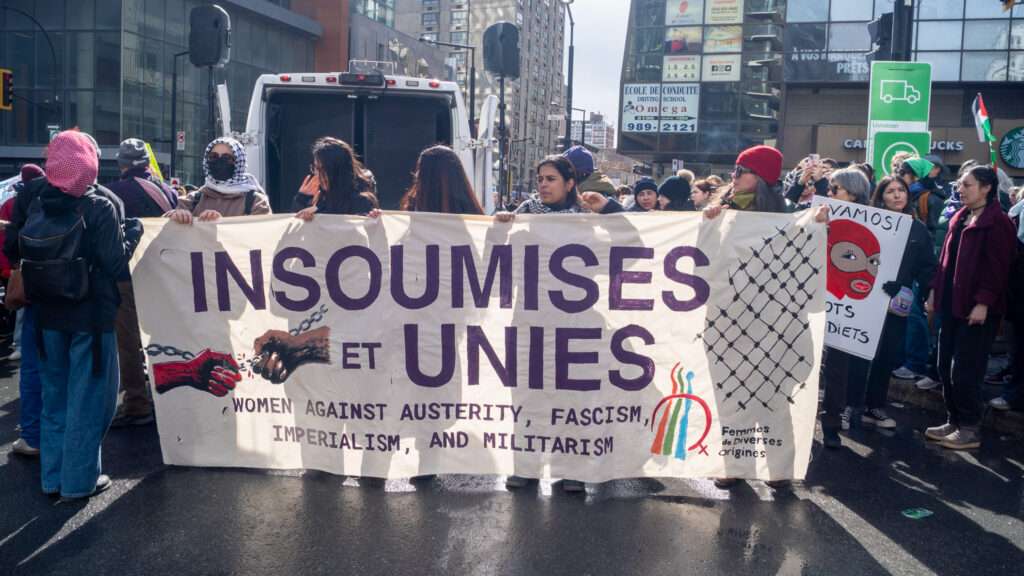
They also denounce the provincial government’s Bill 9, which bans Muslim teachers from wearing headscarves under the guise of secularism, as well as the huge cut in funding for community organizations, another workplace where women are in the majority.
These waves of austerity measures, which particularly target public institutions, stand in stark contrast to the new federal budget, which includes a drastic increase in subsidies to military companies.
“Today, honour the women whose labour holds together our society—in factories and fields, in daycares and schools, in warehouses and greenhouses, in hospitals and homes. […] We stand united with working and oppressed women of all nations and promise to struggle alongside them against our collective oppression.”
Internationally, the intensification of military interventions by imperialist forces such as the United States and its allies has also been singled out as one of the main causes of the decline in women’s rights around the world:
“In 2026, monopoly capital continues to lead the world to the brink of war. The imperial powers are ramping up their military interventions and state repression in every continent of the world. This new era of fascism and war will awaken new struggles amongst the women of the world, and it will intensify the old ones. […] We extend our solidarity to the women, and the populations, of Iran, Latin America and the Caribbean, including Haiti, Venezuela, and Cuba, who are threatened by new waves of Western interference.”
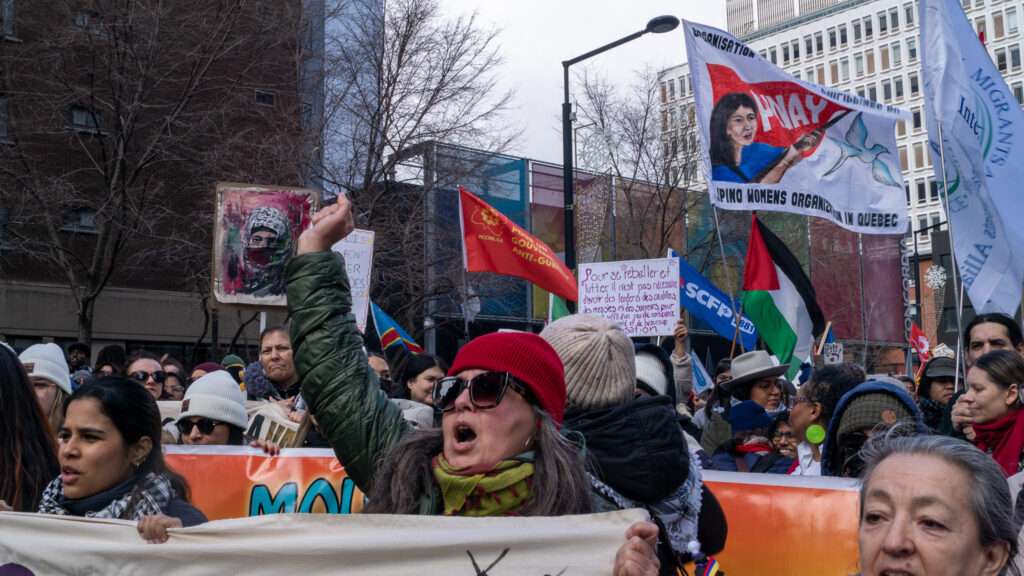
Other messages of solidarity with peoples and against colonialism were also sent to the women of Palestine, the indigenous peoples of America, Lebanon, Yemen, Syria, Kurdistan, and the Philippines in their struggles for self-determination, sovereignty, and popular power.
“In workplaces, in the trenches, and in the streets, women are at the forefront of popular struggles. Women in many parts of the world struggle against subjugation, dehumanization, sanctions and the weight of odious debts that keep their people in positions of economic subordination and dependence. […] Let 2026 be a year of organizing, of solidarity, and of resistance.”
Be part of the conversation!
Only subscribers can comment. Subscribe to The North Star to join the conversation under our articles with our journalists and fellow community members. If you’re already subscribed, log in.