
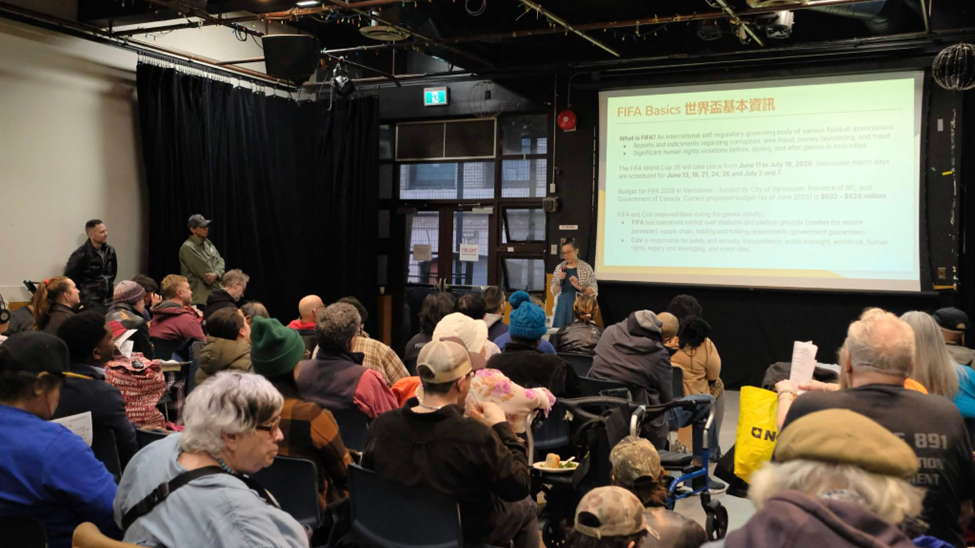
At a FIFA town hall community event, Vancouver-based organizations and members of the community expressed worry and mistrust towards the municipal government. They fear that the public, especially those in precarious living conditions, will be most affected by the World Cup events hosted in Vancouver this June.
The event was held on February 26 at the Carnegie Community Centre in Vancouver’s Downtown Eastside, and endorsed by the Carnegie Housing Project. Community groups and people in attendance discussed how the seven matches hosted in Vancouver will affect the neighbourhood.
“Cleaning up the City”
Members of the research group Police Oversight With Evidence and Research (POWER) spoke about policing trends they say are escalating, including the destruction of homeless encampments and the forced relocation of people living on the street.
A tactic employed by law enforcement is “red zoning,” which means that once someone is relocated, they are barred from returning to that particular spot for a specified period and threatened with arrest if they do not comply.
This practice is especially dangerous for those who rely on the multitude of social services that are concentrated in the Downtown Eastside. Those services include single-room occupancies, medical services, safe consumption sites, drug checking, free meals, and ways to stay in touch with their family and friends.
Laura Macintyre, a staff lawyer with the Pivot Legal Society, raised the issue of new bylaws that seek to “beautify” the city, which law enforcement can use as legal precedent for street sweeps. This beautification is a contractual obligation which FIFA imposes on the city.
A key issue with the recent bylaws is their vagueness. It is unclear to the community how they will be enforced, leaving a lot of discretion to police and bylaw officers to enforce them as they see fit.
Additionally, B.C. courts are set to make “scheduling adjustments,” including at the Vancouver Criminal Court at 222 Main and the Civil Court at Robson Square.
Because the city is requiring more police to patrol the streets, “all criminal trials that require police attendance will be cancelled, bylaw enforcement proceedings paused, some proceedings that normally happen in person will be moved to hybrid, or will be moved to a different court location.”
“Basically [the courts are] increasing the avenues for which people can enter the legal system, and then [they’re] pausing all the ways that they can get out of it, all the viable pathways out,” explained Macintyre.
“If you are waiting for months on end between bail hearings, which is already a common experience, and this is already only going to make it worse, your whole life is on pause.”
Exploitation and Displacement
Also in attendance were Kelly Go and Crystal Laderas of SWAN, an organization that provides frontline services (including contraceptives, PPE, and mobile STBBI testing) and advocates for the rights, health, and safety of migrant and immigrant women engaged in prostitution.
Go informed the room about the conditions of sex workers. “This community is highly criminalized, highly stigmatized, and many of the people that we support have precarious immigration status, and also face language barriers.”
Laderas noted, “[It] is well evidenced, [that during major sporting events] we do see a spike in labour trafficking, exploitation of migrant work. We also see an increase in gender-based violence and sexual violence. And that includes violence against sex workers.”
As the event went on, it became clear that the majority of attendees were agitated and expressed dissatisfaction with the city’s lack of communication in the lead-up to the games coming to Vancouver.
Recurring concerns among residents were about how public transit would accommodate existing residents and the influx of visitors attending the matches. Some worried that people already facing mobility issues or displacement could struggle even more to access essential services through public transportation.
Many in the room reflected on their experiences from when the city hosted Expo 86 and the 2010 Winter Olympics. A community pamphlet distributed at the event by the DTES-based group Ayx Community Bus, those events brought “large-scale displacement, increased policing, and long-term harm to people living in poverty.”
While the community is weary of once again facing these issues, it is also trying to organize itself as times are expected to get tougher.
“Mega events like FIFA risk turning our communities into controlled entertainment zones,” said Gal Lee of Chinatown Together. “If the city truly wants to care for its people, it needs to give agency back to the neighbourhoods and hand the microphone to the communities who have long been clear about what we need.”
Their words seemed to resonate with everyone in the room, and their sentiments were echoed throughout the evening.
“We are here. We will not be silenced, ignored, or treated like less than. We will continue to speak up for ourselves, each other, and for our communities.”
Be part of the conversation!
Only subscribers can comment. Subscribe to The North Star to join the conversation under our articles with our journalists and fellow community members. If you’re already subscribed, log in.