

Since the start of their term, budget cuts and restructuring by the CAQ in Quebec’s public sector have pushed public services to the brink of collapse. While several student associations went on strike against this wave of austerity this week, several health and education unions are also on the verge of following suit.
The North Star spoke with Philippe Soucy, a member of Alliance Ouvrière and president of the Syndicat des professionnels du Cégep de Saint-Laurent. The consequences of the Quebec government’s actions directly affect him in his workplace. For him and many others, the situation is not likely to improve anytime soon:
“For example, here at Cégep de Saint-Laurent, we’re really feeling the effects of the dilapidated state of the facilities right now. One building is closed, and another is at risk of being closed. The facade is in danger of collapsing, so it needs to be completely renovated to meet building codes.”
Soucy adds that demand for health and education services continues to rise. There are more and more students, and wait times for healthcare are getting longer and longer. Yet staff numbers aren’t increasing; on the contrary, they’re being cut back more and more:
“The government’s solution, as we’re seeing it, is to rely more on the private sector to make up for public sector shortfalls, and that results in an education system that’s less accessible, since it’s easier to succeed if you’re from a well-off family that can afford private schools. In health care, this means a poorer public service with lower-quality care. The private sector is therefore forced to compensate by opening new private clinics.”
According to Soucy, workers are thus forced either to lose their jobs and not be replaced—knowing that services to the public will be affected—or to see their colleagues lose their jobs while their own workload increases.
The Montreal chapter of the workers’ organization Alliance Ouvrière (Workers’ Alliance), of which Soucy is a member, is responding by launching the “Our Jobs, Our Services” campaign.
In a press release issued by the organization, Alliance Ouvrière condemns the deterioration of public services and job cuts across the entire public sector, particularly in health care, education, and community services:
“With these cuts, the CAQ is attacking Quebec’s workers. While lining the pockets of unelected high-ranking officials, the government is degrading our public services and has already scrapped thousands of good jobs. Legault, Boulet, Duranceau, and company are sacrificing our quality of life to protect the profits of their gang of oligarchs.”
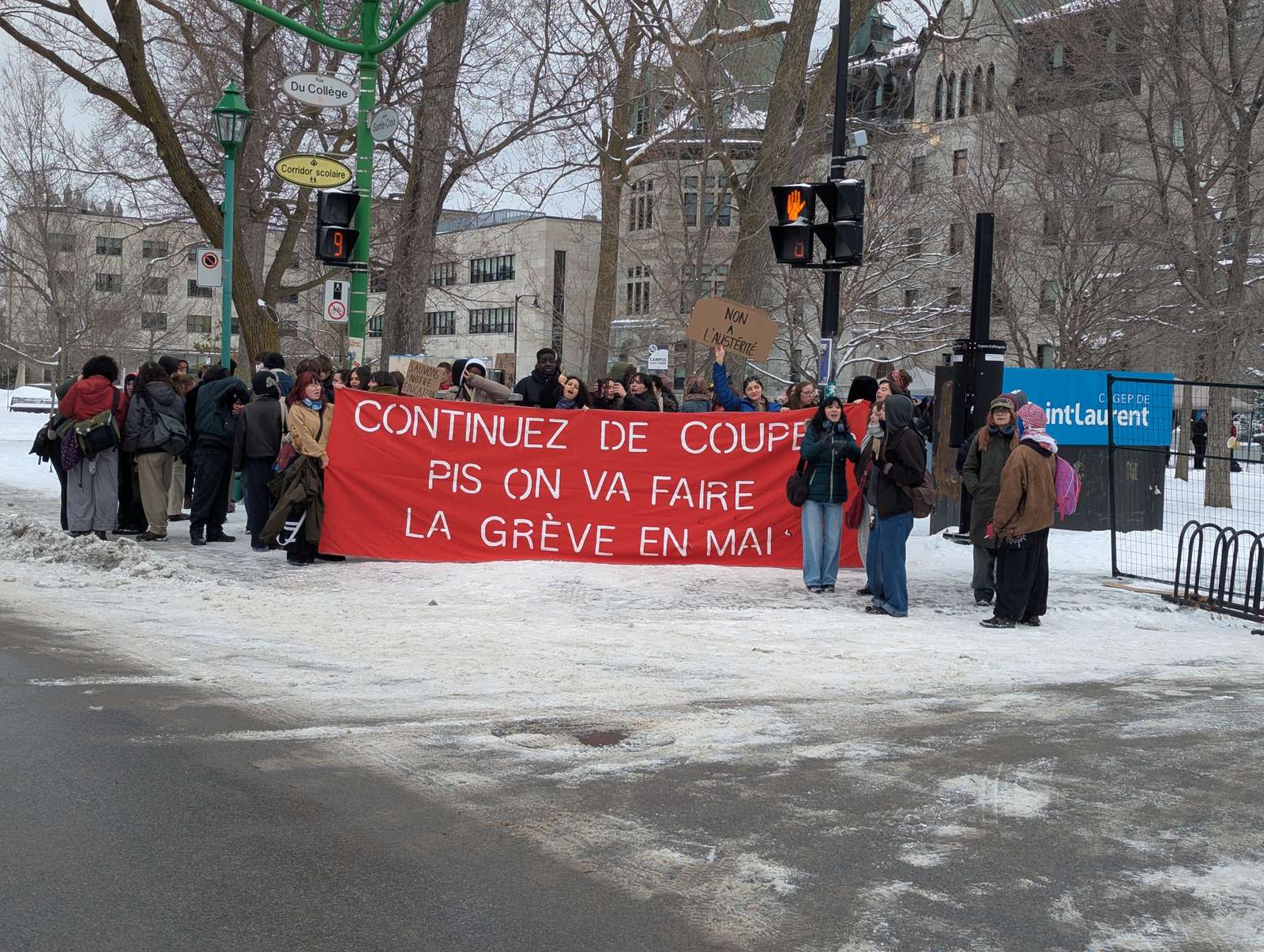
The “Our Jobs, Our Services!” campaign therefore aims to organize a response from workers to defend their interests:
“To win, we must create local campaigns around concrete issues of job cuts and mobilize the affected workers to put pressure on local and government leaders. We propose linking these local struggles together in a broad front to escalate workplace pressure tactics leading up to the symbolic date of May 1.”
Their demands are divided into five main points:
- the preservation of all jobs in the public and community sectors, as well as increased funding for the community sector,
- the reinstatement of all eliminated jobs,
- an end to the hiring freeze,
- faster posting of vacant positions, and
- the reinstatement of the Quebec Experience Program (PEQ).
In addition to the deplorable state of infrastructure, job cuts and the hiring freeze are leading to a significant overload on public sector workers, as highlighted in the labor organization’s press release:
“More than 20 positions are at risk of being cut in 2026 [at Cégep de Saint-Laurent]. ” These positions provide student support, perform maintenance, and more. More than 20 people who [according to the government] “cost too much,” but whose work is essential and whose duties will have to be taken over by their already overburdened colleagues. Workers from three CEGEP unions, along with the student association, are therefore now organizing to save these precarious jobs.
According to the workers’ organization, the Cégep administration is employing underhanded tactics to save money:
“Our finance director at Cégep de Saint-Laurent shamelessly claimed during a board meeting that he was able to save money from the remaining funds because it took longer to replace staff. It’s a deliberate strategy,” explains Soucy.
“When someone goes on disability, resigns, or changes positions, the position is left vacant. It takes months to post the opening. During all that time, no one is paid for that position, and the rest of the team ends up taking on the extra workload.”

Soucy also states that a worker lost her job due to the abolition of the Quebec Experience Program (PEQ). This government program was created in 2010 to facilitate access to permanent residency for immigrants. The cancellation of this program adds another layer of instability to the public sector.
According to Alliance Ouvrière, it is an economic crisis that is driving Quebec’s oligarchs to seek more revenue from the public sector’s coffers.
“The economic elites have long had the wind in their sails and haven’t paid much attention to spending. Compared to their billions, a few tens of millions invested here and there to fund hospitals and schools in exchange for cheap labor was nothing. The economic crises of recent decades have, however, forced them to think more carefully about these crumbs they leave for the public. So, here they are now in ‘austerity’ mode—that is, seeking to maximize their profits.”
The government is therefore now giving as little as possible to the public sector in order to invest instead in more profitable sectors:
“For schools and community services, they now give as little as possible to fund more lucrative industries, such as the arms industry. In CEGEPs and hospitals, the strategy is instead to turn these institutions into profit-making machines: they privatize, cut jobs, and squeeze every last drop out of the remaining employees.”
Alliance Ouvrière therefore aims to mobilize the workers directly affected by the government’s cuts:
“By organizing local campaigns, we aim to mobilize workers directly affected by the cuts. Their motivation will then be deeply personal and immediate. They will be able to fight to protect their own jobs, or those of their colleagues. We believe that the militant labor movement must build on these immediate connections to construct, on this basis, a broader movement of workers. ”
Finally, the Alliance Ouvrière press release highlights examples of actions by public sector workers that have led to gains in recent years. In January 2023, nurses at Maisonneuve-Rosemont Hospital threatened to resign en masse and staged a sit-in, among other things, against mandatory overtime causing burnout.
“Through their struggle, they demonstrated that this type of mobilization can lead to gains at the local level. By threatening to resign en masse and maintaining their sit-in, they exerted real pressure on management and the government.”
On the blue-collar side in the City of Montreal, in June 2025, about fifty workers in the Southwest organized a six-hour sit-in against a threat by management to dock half a day’s pay from those who refused to attend an employee appreciation barbecue. The city eventually backed down and withdrew this threat.
“This refusal was part of a broader labour dispute, which led CUPE Local 301 to call a 24-hour strike in February 2026, its first since 2009. These recent examples show that direct action in the workplace can quickly bring about concrete changes and improve conditions for workers.”
Be part of the conversation!
Only subscribers can comment. Subscribe to The North Star to join the conversation under our articles with our journalists and fellow community members. If you’re already subscribed, log in.