
Ontario students face a lifetime of debt as the Ford government replaces grants with loans, effectively destroying prospects of social mobility for the working class.
The province is capping student grants at 25% and ending the seven-year tuition freeze By forcing students to shoulder 75% of their aid as debt, the government is balancing its budget on the backs of low-income families.
While the number of grant recipients rose by 8.5% last year, the total value of grants plummeted by 21.5%. Simultaneously, the total value of loans disbursed skyrocketed by 71%, reaching $2.56 billion.
Ontario is now a predatory outlier. While six provinces, including British Columbia and Manitoba, have moved to 0% interest models, Ontario continues to collect interest on provincial loans. This interest now accrues even during the six-month post-graduation grace period,creating a monster of debt that began with 2019 policy changes.
While Minister Nolan Quinn has labeled the new $6.4-billion funding model as “historic,” critics argue it remains insufficient for a sector pushed to the brink of collapse. Alex Usher of Higher Education Strategy Associates previously noted that the government’s prior “sustainability” injections covered only roughly 20% of the sector’s $2 billion due to inflation and international student caps.
Instead of fully closing this gap with provincial funds, the government is “balancing the books on the backs of students” by ending the tuition freeze. Students must now bridge remaining institutional deficits through 2% annual tuition increases for the next three years. This financial pressure is compounded by an OSAP restructuring that drastically reduces non-repayable grants in favor of a mounting pile of debt.
The cost of these policies is revealed in the daily struggles of students who receive zero support from their families. Mathew, a 21-year-old finance student who pays for every living expense himself, argues the 85% loan model makes him question if college is even feasible.
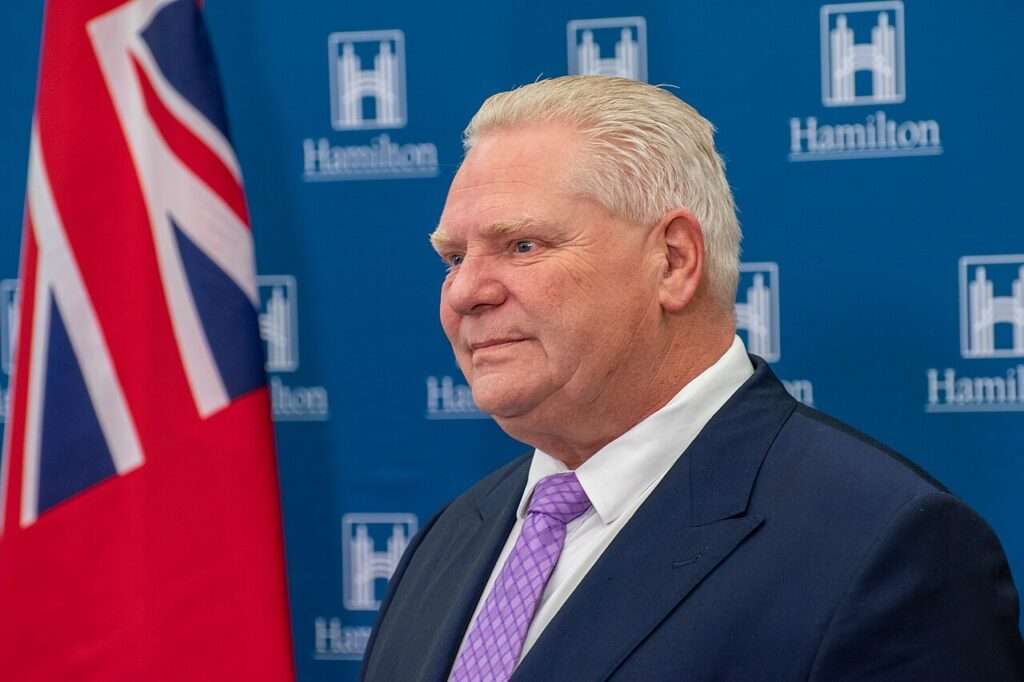
Mathew expressed frustration with Premier Doug Ford‘s claim to the press that Ontario students are “buying fancy watches and cologne” with OSAP funds, calling the rhetoric “bull”.
For Tina, 19, a first-generation immigrant, the financial burden is compounded by her role as the eldest daughter responsible for household chores and a 13-year-old sister. Her hour-long commute alone costs over $1,000 per year.
“It’s already hard enough taking five courses a semester, and now I kind of feel forced to maybe even take six a semester because I want to accelerate my learning,” she told The North Star.
This drive to finish early is fueled by her fear that the traditional milestones of adulthood are slipping out of reach.
“A house is genuinely unreachable at this point,” Tina admitted, doubting that anyone in her generation will ever afford one. Tina questions why she is paying thousands in tuition if it fails to provide the success it’s promised: “If the whole reason for post-secondary education is to set you up for success, why in reality is it not doing that? Why in a first-world country do I have to worry about my education?”
RJ, an 18-year-old UofT student, describes the rising costs as a “slow burn,” comparing students to “a frog in a pot” where the water is being turned up slowly. She revealed that her single mother is considering taking equity out of their home just to keep RJ and her sibling in school. She mentioned, “My mom is the most impacted, I would say, by this because luckily I’ve been able to just have these grants from U of T that help combat the OSAP cuts.”
RJ also shared that her mother “has an autoimmune disorder that stress severely impacts. […] I can tell you right now, since all this news has been talk going on about Ford and this OSAP cut, she’s been in a massive flare up.”
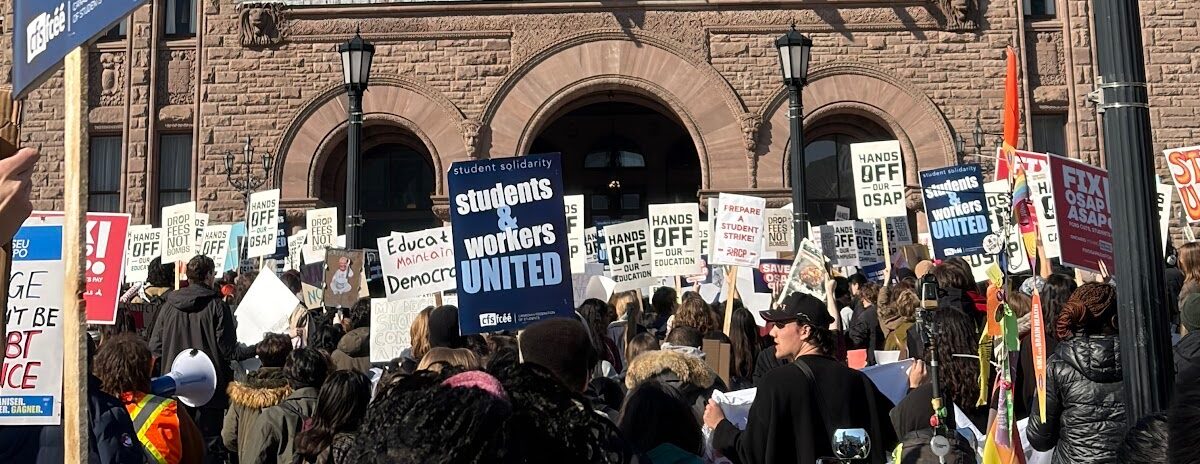
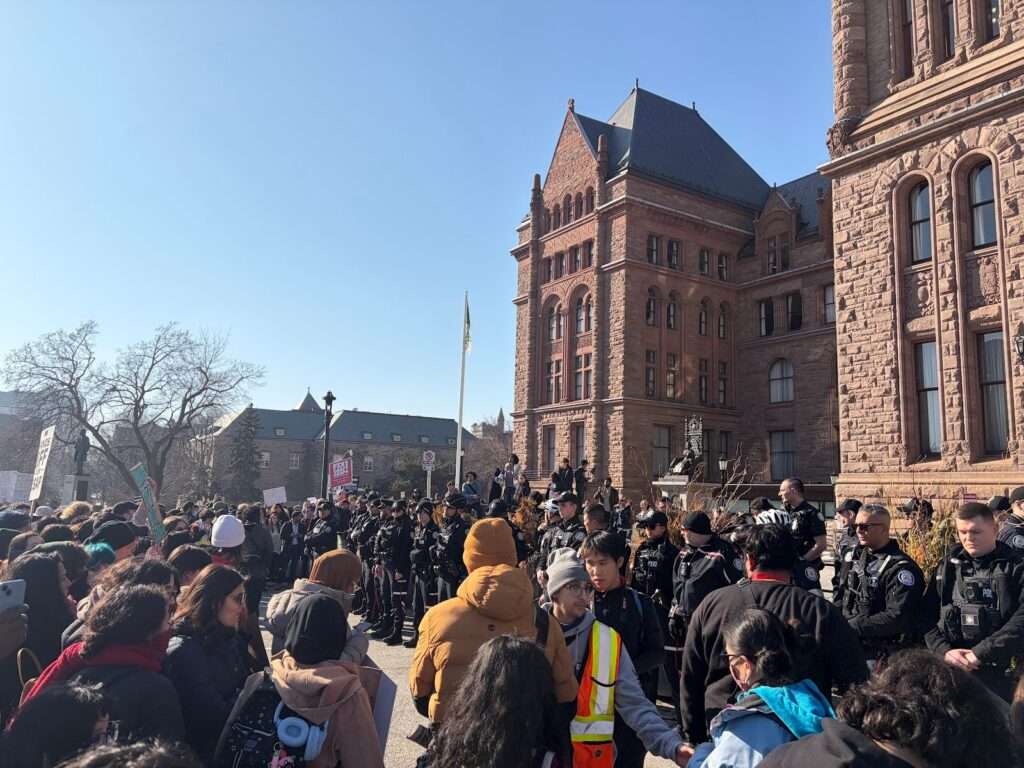
Students are fighting back against this “devastating blow”. On March 4, hundreds rallied at Queen’s Park, where a statue of George Brown was defaced with slogans such as “Fuck Ford” and “Shut Up Doug”. The state met this peaceful demonstration with force. Two protesters were arrested and charged. RJ, who was amongst the protesters, stated that the police were “lining the castle with soldiers” and ruling with an “iron fist”.
Milo Clark, an 18-year-old grade 12 student, argues that the current disconnect between “ticked” youth and political engagement must be bridged through collective struggle. He rejects the Premier’s dismissal of “niche” subjects as “basket-weaving courses,” noting that he plans to study economics, a field Ford is unlikely to call niche.
Clark bridges this disconnect through active political pressure and advocacy. As an NDP Youth representative, he actively participated in the NDP’s Save OSAP campaign and contacted several MPPs in Brampton to voice his “extreme disagreement” with what he calls a “very stupid plan”.
For Clark, the goal of collective struggle is to challenge a system that is “making a lot of people really stressed out” and instead prioritize a decent education over a “mountain of debt”. Organizing against these barriers, students aim to reclaim their education as a pathway to stability and success for their future rather than a lifelong financial shackle.
Be part of the conversation!
Only subscribers can comment. Subscribe to The North Star to join the conversation under our articles with our journalists and fellow community members. If you’re already subscribed, log in.