

The strike by Quebec government engineers, which has affected 127 construction sites since July 6, is causing unemployment among construction workers who would have been working on those same sites. Nevertheless, these workers are not blaming the engineers for using the strike as a bargaining tactic, but rather the government—their employer—for being stingy at the negotiating table. The Union of Heavy Machinery Operators has even launched a petition to support the strike.
Since 2023, engineers employed by the Quebec government have been negotiating a collective bargaining agreement. On July 6, 2026, these negotiations escalated into an indefinite general strike, which is still ongoing.
Unlike employees of the public service Common Front or other civil service unions negotiating independently—most of whom reached a settlement in 2024—members of the Professional Association of Engineers of Quebec (APIGQ) have still not accepted any offer from the government.
At the heart of the dispute is pay. Including benefits, the Treasury Board Secretariat, which negotiates on behalf of the government, is offering engineers an 18.5% increase in total compensation over five years (an average of 3.7% per year). The engineers refuse to accept this offer because other public service professions were able to secure nearly a 25% increase over the same period.
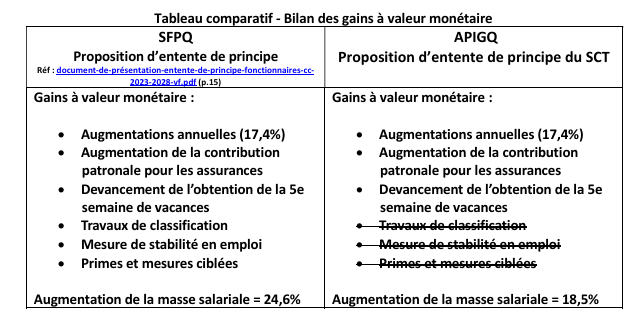
The strike is currently paralyzing some 60 construction sites in Quebec, in addition to another 60 that have slowed to a crawl. Some of the stalled construction sites are critical for remote regions—particularly for road repair work—but others are critical for the profits of certain monopolies. This is the case with the Davie Shipyard in Lévis, which is set to be converted for submarine construction following the drastic increase in Canada’s military budget.
For many construction workers, this situation means unemployment. This is particularly true for heavy equipment operators, 80–85% of whom work in civil engineering. In an interview with The North Star, Marc-André Blanchette, technical representative for the Union of Heavy Machinery Operators (Local 791), noted that members have “repeatedly reported slowdowns in their home regions. “I’m thinking of our people in Saguenay-Lac-St-Jean, on the south shore of Quebec City, and on the Côte-Nord.”
In response to this alarming situation of unemployment during the peak season, Local 791 has decided to stand in solidarity with the engineers, unlike other political actors who have called on the government to designate more construction projects as “essential.”
A petition calling on the government to stop dragging out negotiations
On August 6, Local 791 launched a petition calling on the government to negotiate in good faith with the engineers it employs. The text of the petition makes it clear from the very first lines where the union stands: “Let’s be clear. Construction sites in Quebec are not paralyzed by engineers. They are paralyzed by three years of inaction and bad faith on the part of the CAQ government.”
The petition then calls on the government “to give its negotiators a genuine mandate to reach a settlement and to end an impasse that penalizes government engineers as much as it does construction workers and the general public.” It specifically points out that the province’s Administrative Labor Tribunal ruled against the government in mid-July for negotiating in bad faith.
Marc-André Blanchette explains that his union “has a mandate from [its] members to represent them at every possible opportunity and to defend their livelihoods.” If it is the government that is negotiating in bad faith, then it is the government that must be targeted so that workers forced into unemployment can find jobs again in their region.
As for the tactical decision to use a petition to try to bring about change, the technical representative of Local 791 explains that this approach has worked in the past. Together with three other construction unions (AMI, Local 9, and Local 717), his union launched a petition in 2025 calling for an investigation into fatalities at construction sites in Quebec. The mobilization and the petition ultimately prompted the government to launch that investigation.
“If we’re able to get them to act by calling for a public inquiry—the first in 40 years—maybe we’ll be able to get them to negotiate,” Blanchette concludes.

Being divided against the Quebec government out of the question
When asked if there are people who are reluctant to support the 791 petition—who would rather blame the engineers—Marc-André Blanchette rejects this divisive rhetoric. Instead, he points to the broader picture of relations between Quebec workers and the current government.
He speaks of “systemic discrimination against every worker in Quebec,” citing the CAQ’s recent bills that broadly undermine the rights of the Quebec people. “Bill 3, the draft Quebec constitution, Bill 27, the end of joint committees, the end of this, the end of that… They’re attacking the same people: workers, union members.”
He adds that Minister Jean Boulet’s recent reforms to limit the role of unions—“the little tricks they’re putting in place to stop us from acting”—affect the APIGQ just as much as they do other Quebec unions. “Just because you have a college degree or a heavy equipment operator’s certificate doesn’t mean you’re not oppressed. ”
The petition by the Heavy Equipment Operators’ Union is nearing 3,000 signatures. Construction workers and supportive citizens can sign it here: https://local791.ca/le-local-791-lance-une-petition-en-appui-aux-ingenieurs-de-letat-en-greve-linaction-gouvernementale-doit-cesser-le-conseil-du-tresor-doit-negocier-de-bonne-foi/
1 Commentaire
[…] Construction workers try to force Quebec to negotiate with its engineers […]
Be part of the conversation!
Only subscribers can comment. Subscribe to The North Star to join the conversation under our articles with our journalists and fellow community members. If you’re already subscribed, log in.