
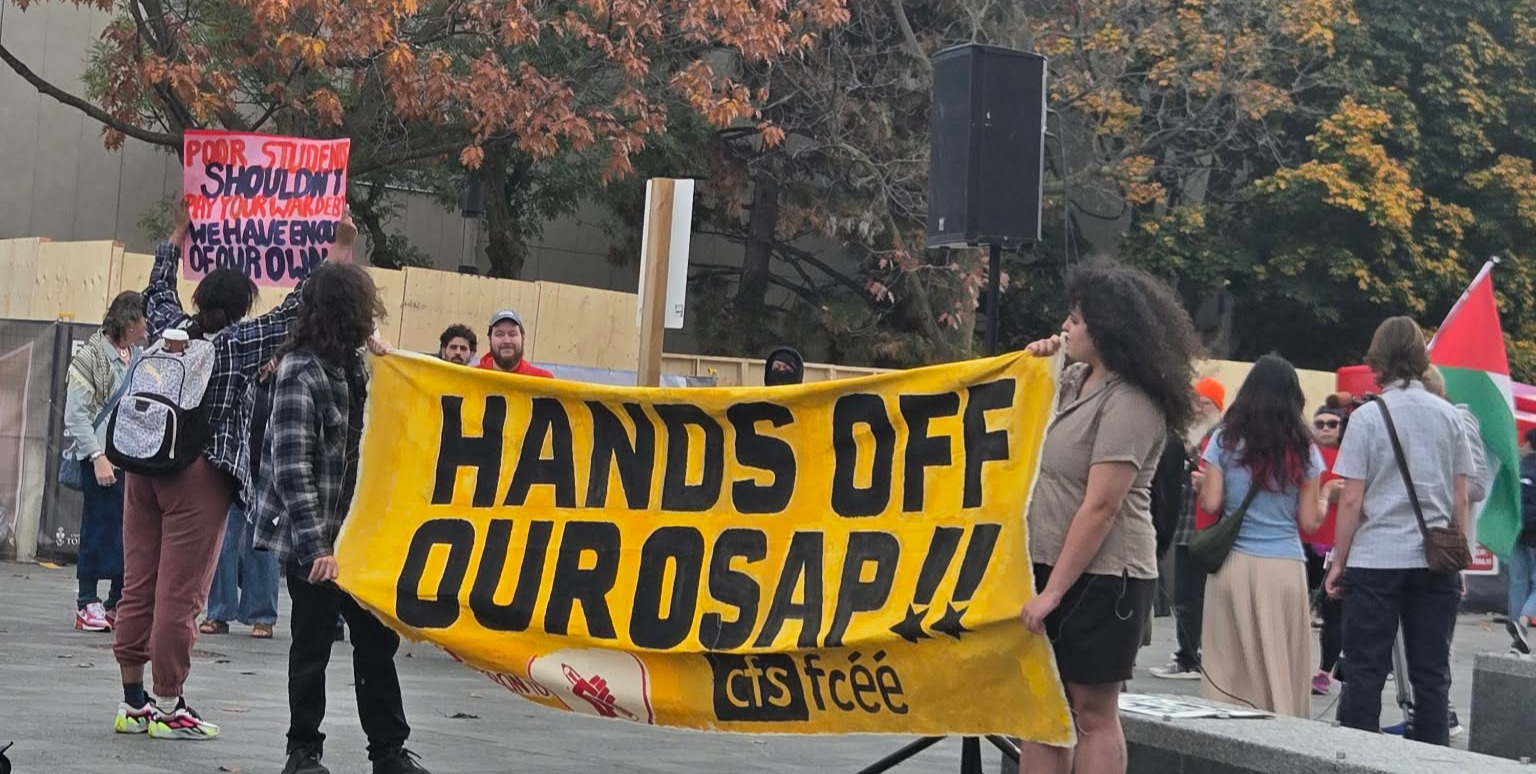
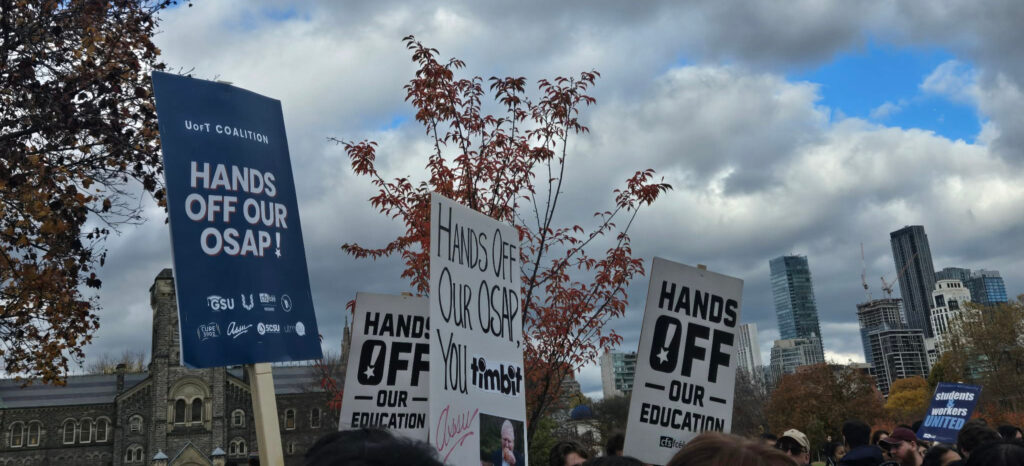
Organizations uniting students and workers led a walkout and rally at the University of Toronto on the afternoon of November 5. Demonstrators protested the Ford government’s cuts to all levels of education and the undervaluing of education across the country. Rallies also took place at other universities including York University, Toronto Metropolitan University, and McMaster University.
Hundreds of students and workers gathered to express fury at cuts to the Ontario Student Assistance Program (OSAP) and public education. The strike and rally were organized by Students Against Austerity. Students Against Austerity has several chapters at Ontario universities and high schools.
The province-wide day of action was called for by the Canadian Federation of Students – Ontario. Participants read speeches and chanted outside of Simcoe Hall, which houses the University of Toronto’s central administration and offices of the university’s Governing Council and its president, Melanie Woodin.
Demonstrators marched across campus on St. George street, ending the rally outside the Ontario legislature. Members of CUPE 3902, which represents precarious contract academic workers at the University of Toronto, were also present in large numbers at Thursday’s rally.
“I’m a lower-income student. I was almost homeless a couple times during my undergrad. I’ve really struggled with the tuition increases,” Melissa Dale Davis, a UofT student, told The North Star. “I think education shouldn’t just be for the rich. It should be for everyone.”
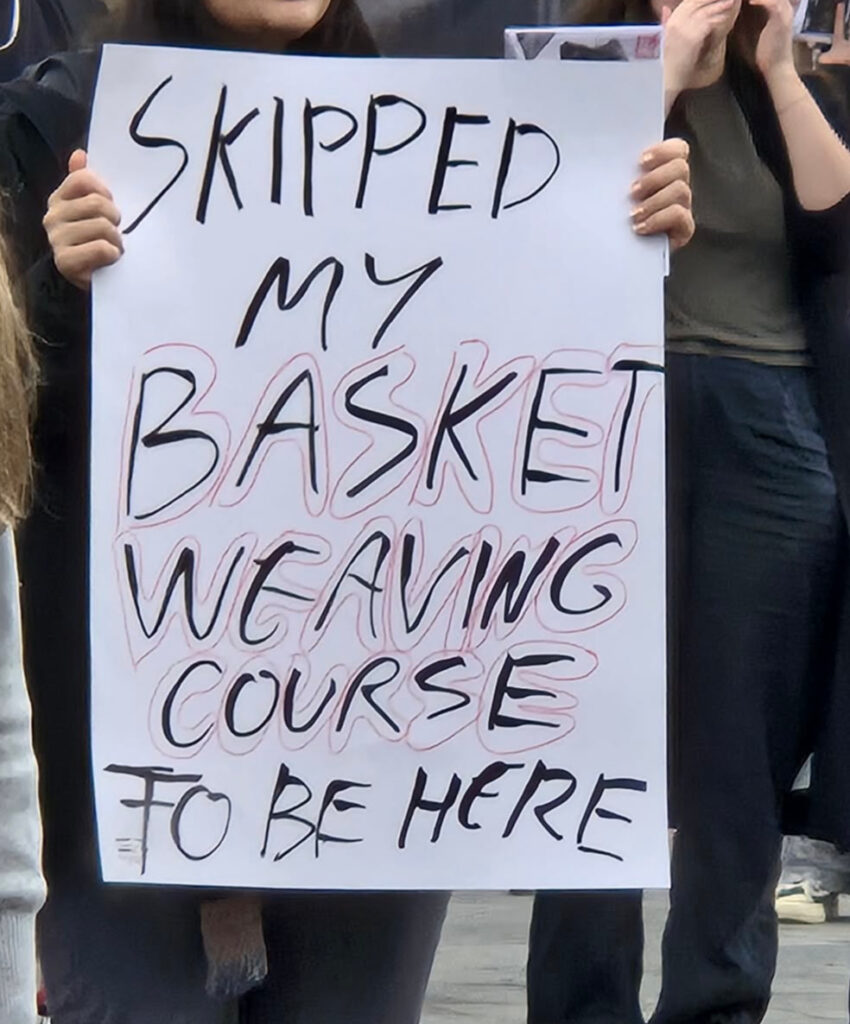
Five major Ontario unions representing over 255,000 education workers, currently in contract negotiations, are holding strike votes between November 4 and 18. This includes OSSTF, CUPE, ETFO, AEFO and OECTA. In their speeches, students and workers urged union members to vote to strike, but also to take further measures than they have in the past when confronting Doug Ford’s government.
“We can’t keep doing the same thing over and over again,” urged Ilan Jadran, a high school student and member of High School Students Against Austerity. “We need a strategy that will create a crisis for Ford. The last teacher’s strike [in 2022], which demoralized many teachers, deliberately stayed within bounds that were acceptable to the elites. Instead of shutting down the schools, they engaged in partial or rotating strikes. This time, the teachers need to shut down the schools and stand with the students fighting against Ford.”
Organizers also emphasized the connection between austerity measures at home and increased spending in the private and defence sectors, as well as Canada’s investment and complicity in foreign wars.
A speaker from Climate Justice UofT drew the crowd’s attention to the University of Toronto’s sponsorship, last spring, of CANSEC, North America’s largest military and weapons trade show. This was the first time in Canada’s history that a public university sponsored such an event.
“Our strike today is centred around OSAP, yes, but we are also striking against Canadian imperialism and the slow violence of neoliberalism that decides who may live and who must die,” the speaker from CJ UofT declared, to an agitated crowd.
“Over the next decade, $1 trillion will be spent to create a permanent warfare state, Canada’s own military industrial complex. This comes at a time where Canadians cannot afford to live and those least responsible for the climate crisis [globally] are marked for death.”
The federal government‘s 2026 budget, tabled on the same day as the rally, promises $36 billion in corporate tax breaks, particularly for the mining and oil and gas sectors. It also includes a 60% increase in the budget for Canada Security Intelligence Service (CSIS).
This past May, when Mark Carney delivered the keynote speech at CANSEC, he proudly confirmed Canada’s achievement of NATO’s 2% of GDP defence expenditure target, and pledged to aim for an expanded target of investing 5% of GDP in core defence and security-related areas by 2035.
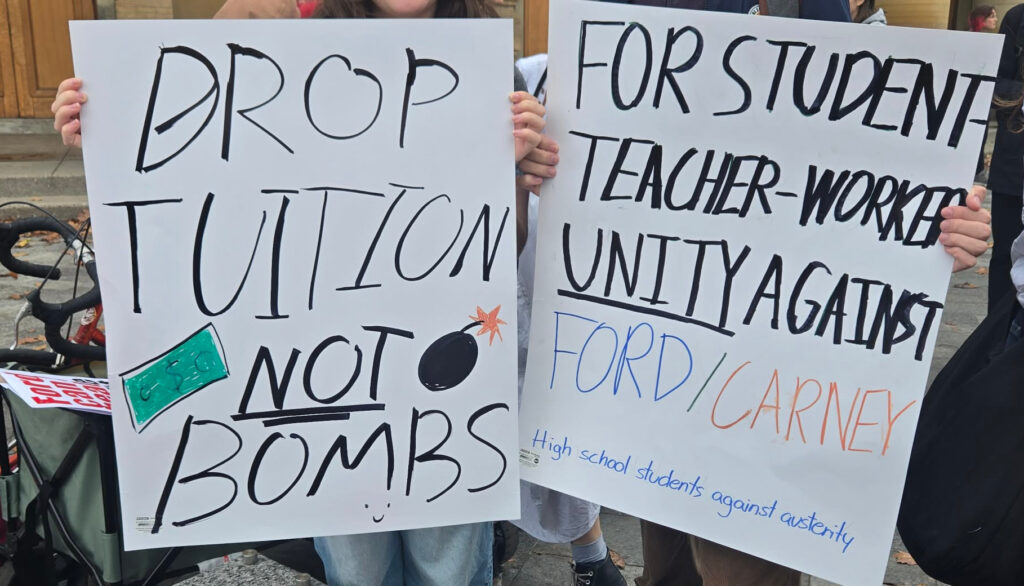
Demonstrators also commented on the importance of resisting the attempts of the university as well as the government in sewing divisions between students and workers. Speaking with The North Star, Claudia Vásquez-Caicedo, the General Vice President of CUPE 3902, commented:
“We come here as both students and workers to highlight the connection between those two groups that the university really likes to separate,” she explained. “It is shameful that when we fought Bill 124, we ended up with wage adjustments that cover less than inflation. Meanwhile, the head of labour relations got a 17% increase in their salary.” Bill 124 was a proposed law that would have limited salary increases in the public sector.
Like other organizers, Vasquez made connections between the cuts to public education and the increased investment in defence and AI, on the part of the Canadian government as well as public institutions themselves, including the University of Toronto.
“The university has billions in assets. They keep saying that they are hitting the goal marks of the Defy Gravity [fundraising] campaign, yet they are still raising tuition … and the connections are not accidental. It is not accidental that the [same] university raising our tuition is sponsoring CANSEC. Those things are connected,” Vasquez insists.
“The University of Toronto recently announced in one of their business board meetings that they have a deal with Cohere, which is a massive Canadian AI company. But what does it mean to be a living lab for AI at UofT? I wasn’t asked for consent. I don’t know what they’re doing with my data.”
“As for the unions at UofT, we have an important year ahead of us,” she says, “and we will be making noise in the name of the students and in the name of the workers.” Her tone is bold and confident when she declares, “We will not let the university pit us against each other.”
Be part of the conversation!
Only subscribers can comment. Subscribe to The North Star to join the conversation under our articles with our journalists and fellow community members. If you’re already subscribed, log in.