
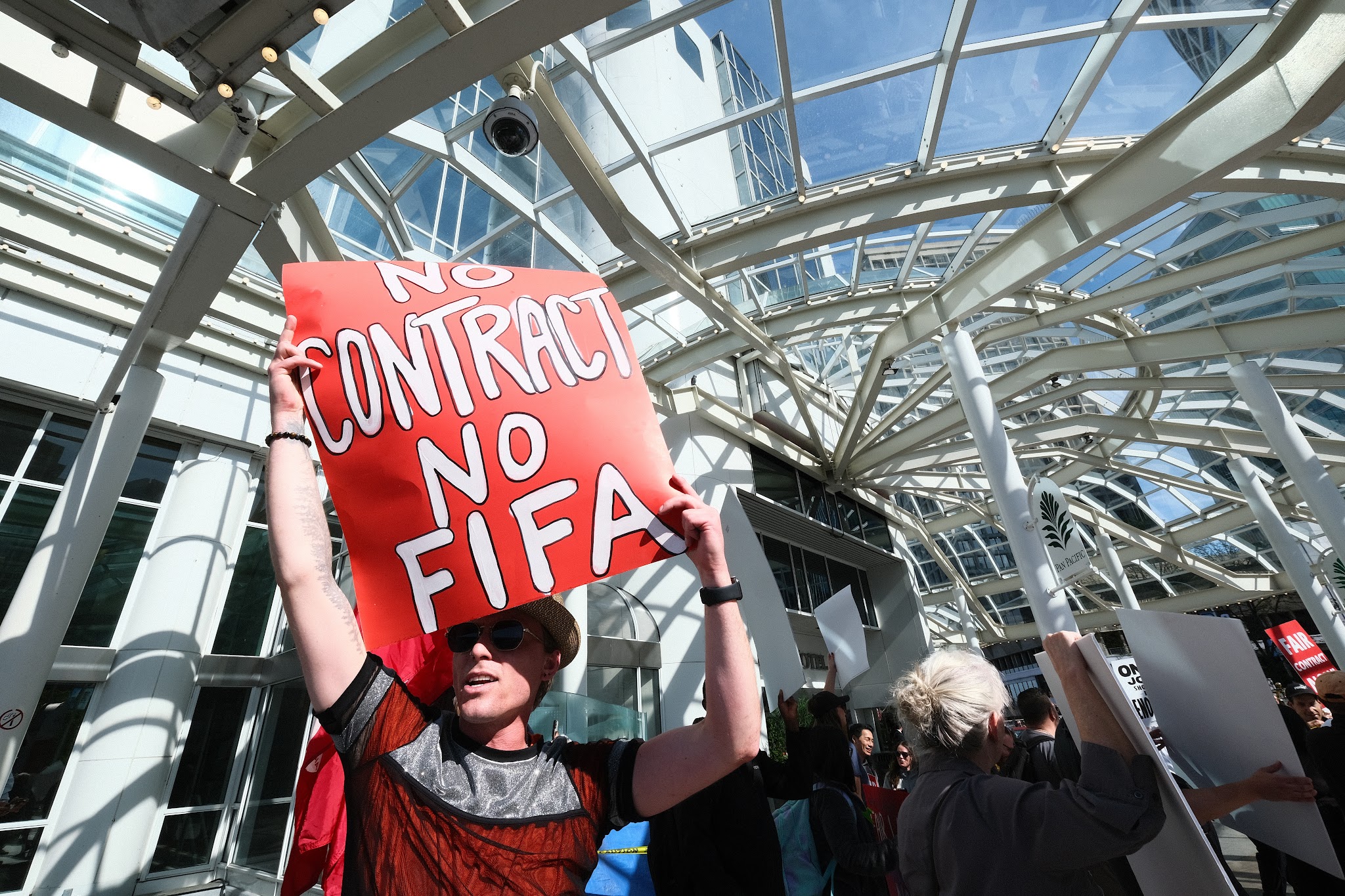
Every four years, the FIFA World Cup has millions of soccer fans in working-class neighborhoods around the world glued to their screens. But as with every international sporting event, the festivities mask a darker reality: groups in B.C. are criticizing the $729 million in public funds spent on an event they say benefits only wealthy tourists and FIFA sponsors, while also accusing authorities of using a celebration of sport advance real estate interests and displace homeless people. Hospitality workers are at the forefront of this opposition, bearing the brunt of the event.
A slew of strike votes, rallies, campaigns, and actions have taken place in the months leading up to the 2026 FIFA World Cup. The growing urban poor community in Vancouver‘s Downtown Eastside, along with hospitality and service workers, have been denouncing institutional hypocrisy behind the event while pushing for better pay and working conditions.
In total, for the 13 games set to be hosted in Toronto and Vancouver, the Canadian public will foot the bill for over a billion dollars in related public spending. If FIFA, Canada Soccer, provincial and municipal governments, as well as World Cup corporate sponsors are to be believed, these investments are expected to bring economic benefits to Canada. But historical evidence tells a different story.
Economic research, like this study published in 2022, has shown that the main beneficiaries of the World Cup are FIFA and its associated national football federations. Host cities and countries rarely turn a profit from the tournament. And in the rare case profits are generated, activists and international organizations have repeatedly pointed out that the gains flow primarily to the country’s economic and political elites rather than to the broader population.
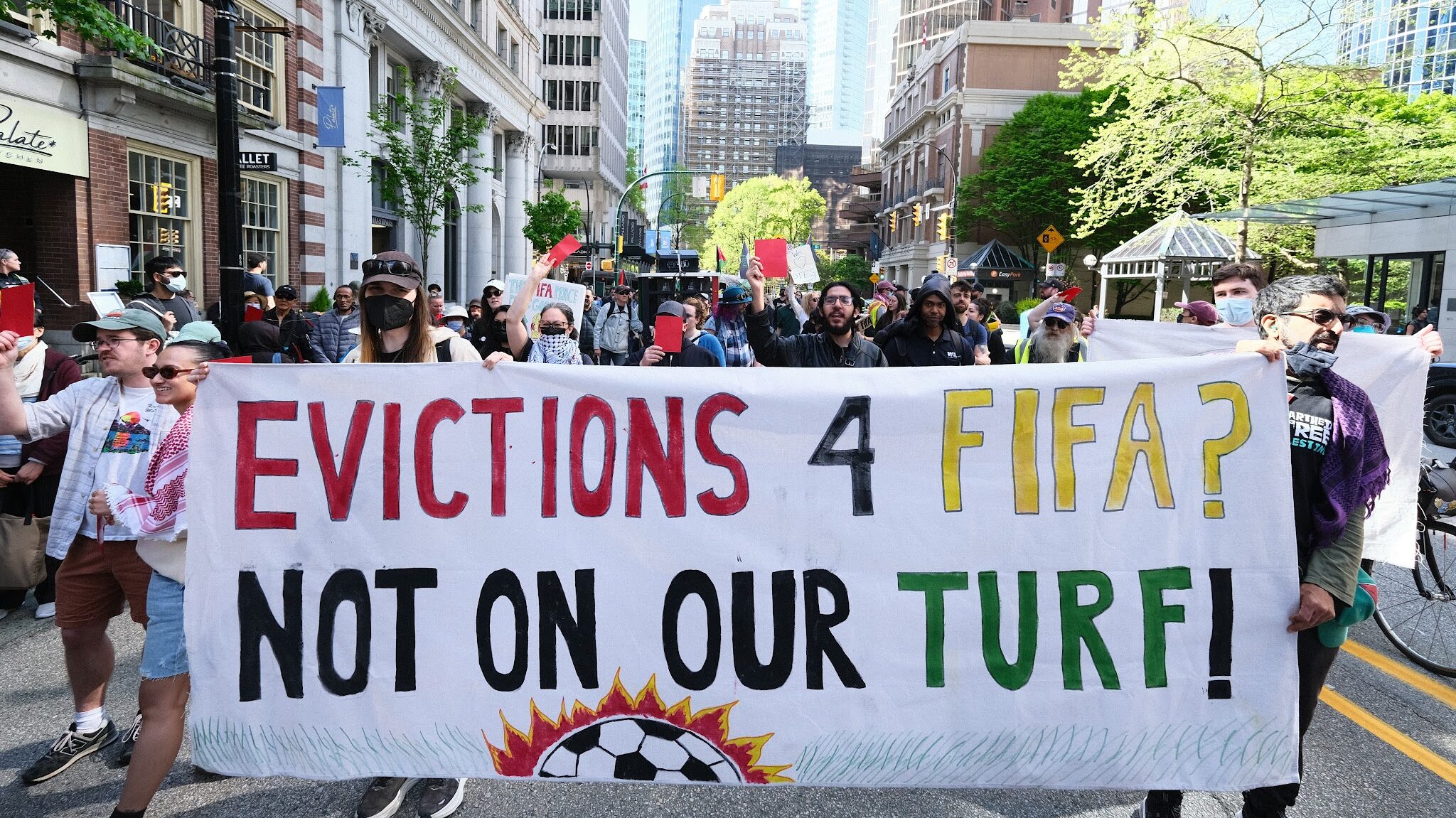
Resistance from hospitality, logistics, and public service workers
Revenue from the World Cup is expected to flow not only into FIFA’s coffers, but also into the hands of large hospitality and services conglomerates. In the face of this, unionized hospitality workers in Vancouver have emerged as a central force in organized resistance against what they describe as a large-scale transfer of public funds into private profit.
The city projects an additional 350,000 visitors during the World Cup, which is expected to place immense pressure on hospitality workers’ workloads. At the same time, these workers appear increasingly prepared to resist, as since the pandemic and the mass layoffs that followed, the sector has seen a sharp uptick in unionization. 2024 saw multiple militant strike actions for better wages and working conditions.
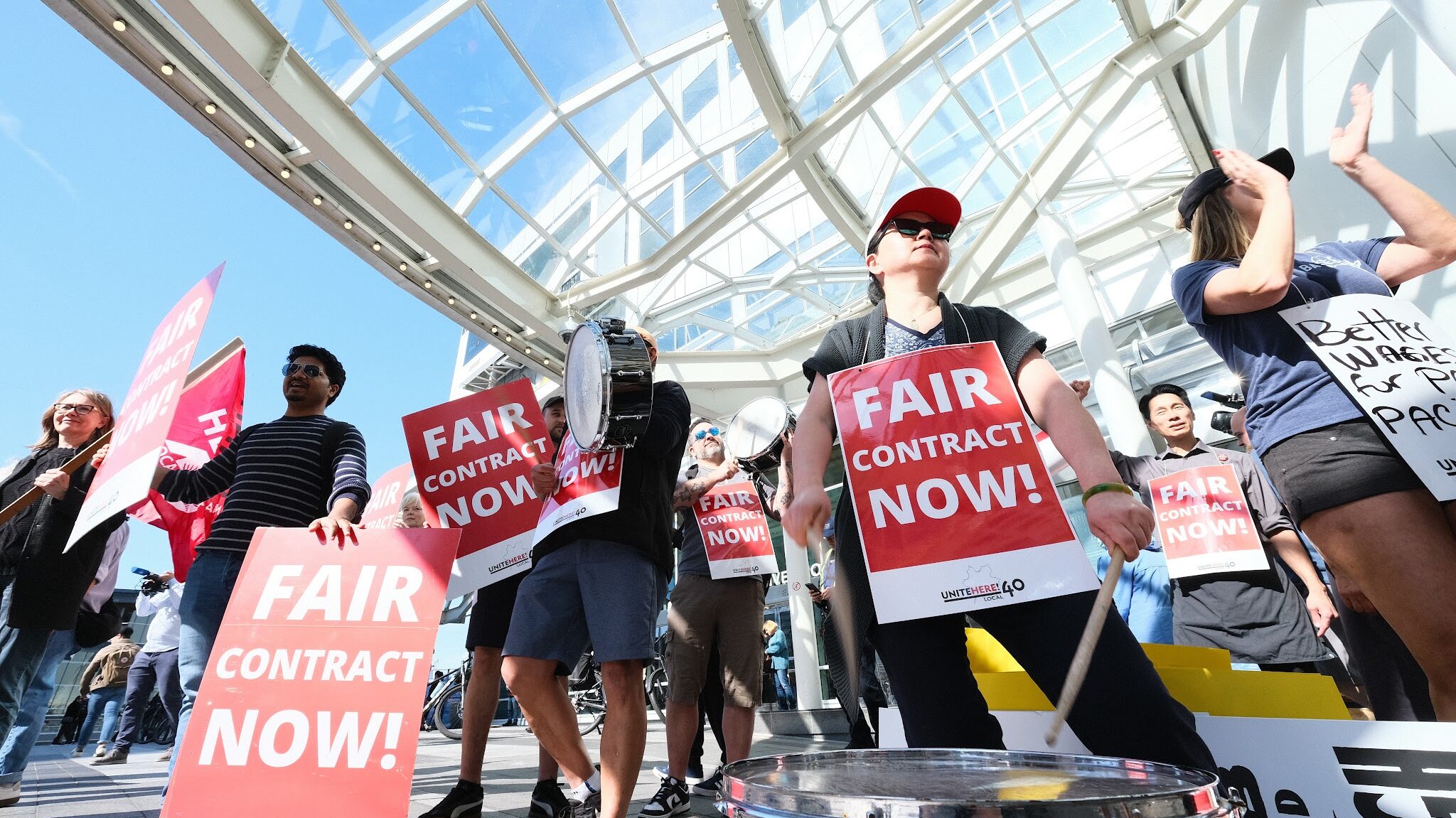
Since then, unionized hotel workers have secured major gains, but others continue to fight for better pay and working conditions.
At a protest against the FIFA Congress at the Vancouver Convention Center on April 30, an anti-FIFA coalition and hospitality workers represented by Unite Here Local 40 highlighted that the negative impacts of hosting the world cup will be mainly felt by residents facing a cost of living crisis. Meanwhile, their employers will earn massive profits on the backs of overexploited staff whose wages are too low to live in the city where they work.
Michelle Travis, research director for Unite Here Local 40, told The North Star that workers at Vancouver’s Pan Pacific Hotel have been bargaining for months with the hotel owner, Westmon Hospitality Group. She says that, while the hotel will be raking in huge profit during the World Cup, workers are barely making ends meet. They get paid several dollars less per hour than the average for local hotel staff, despite taking double or triple workload.
“People are just getting squeezed,” she explained. Pan Pacific hotel, sitting beside Canada Place, is experiencing extreme staff shortage while anticipating a sharp rise in the number of tourists due to the World Cup.
Travis said the hotel workers are fighting for fair wage and a contract that will guarantee them a safer working condition. However, negotiations are taking longer than they should due to the lack of resources in the massive hotel chain.
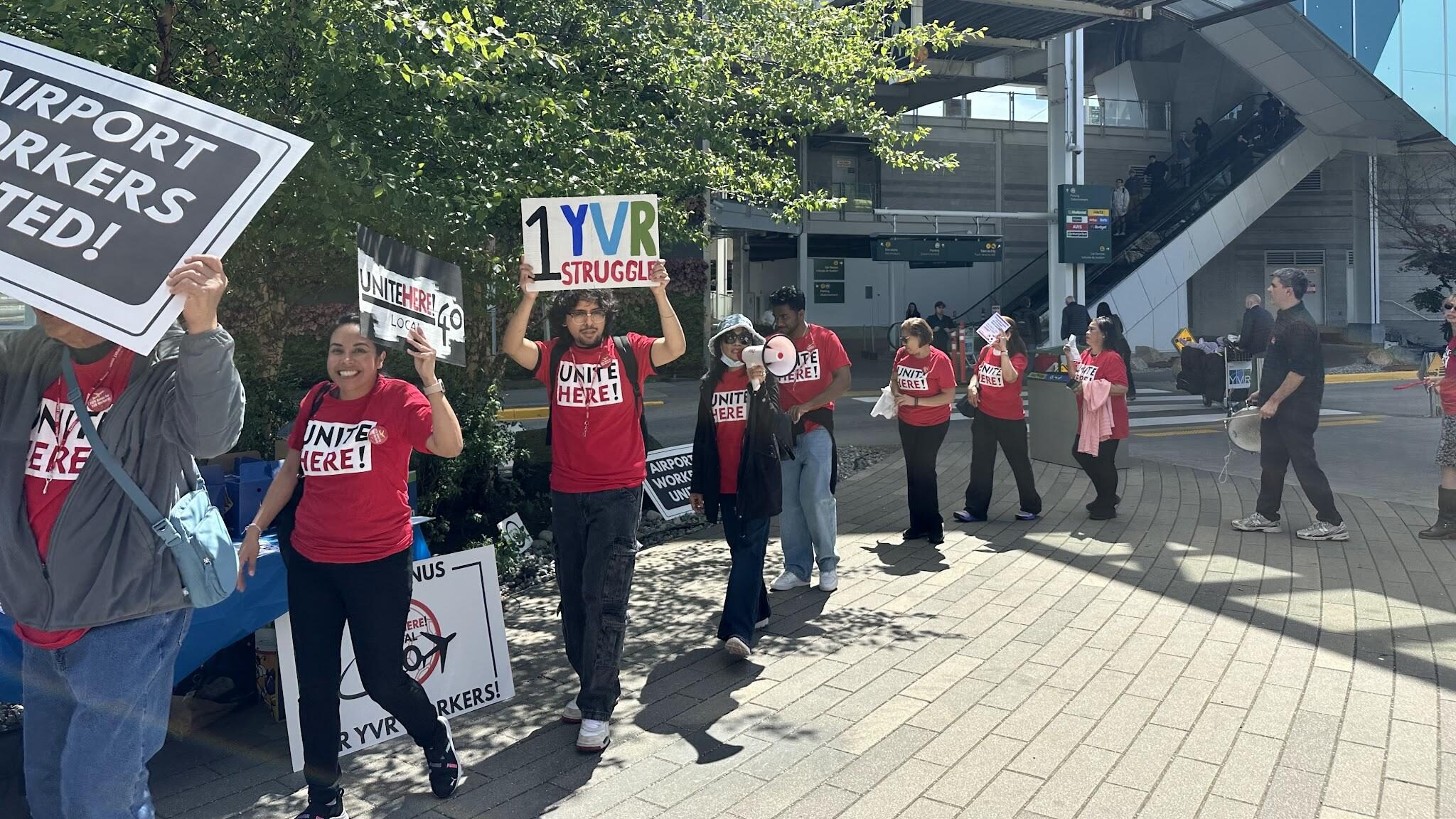
On June 4, warehouse, food service, and concessions workers at YVR (also unionized by Unite Here Local 40), rallied for a $30 wage, a $1000 bonus for the increased workload during FIFA, and stronger job protections. The airport is handling record passenger volumes and $717 million in annual revenues while the multinational corporations contracted to run the concessions make nine-figure profits.
150 newly unionized workers at Paradies Lagardere, which operates 12 concessions stores and two wine bars in the airport, are fighting for their first contract. Currently, they make the minimum wage of $18 per hour, $10 less than what’s considered to be the livable wage in the Lower Mainland.
Workers’ struggles in these public-private workplaces that are vital arteries of the regional and national economies have been some of the most hotly contested this year so far.
Unite Here Local 40 has also been present at public hearings at Vancouver’s city hall, condemning Council’s motions to give developers handouts and the erosion of resources available to tenants facing displacement from huge rezoning initiatives. The ABC party which dominates the City Council has used FIFA as an excuse to waive restrictions on hotel developers in order to address the city’s supposed “shortage” of rooms.
Cleaning workers who maintain the city’s SkyTrain stations, the official transportation partner of the World Cup in Vancouver, are also fighting their respective transit authority and contractor. Unionized by SEIU Local 2, these workers have denounced union busting, layoffs, and unsafe working conditions by the government-appointed TransLink Board and their new employer, Dexterra Group. This comes just as the SkyTrain network, which already handles 427,000 trips a day, is expected to see a major increase in ridership.
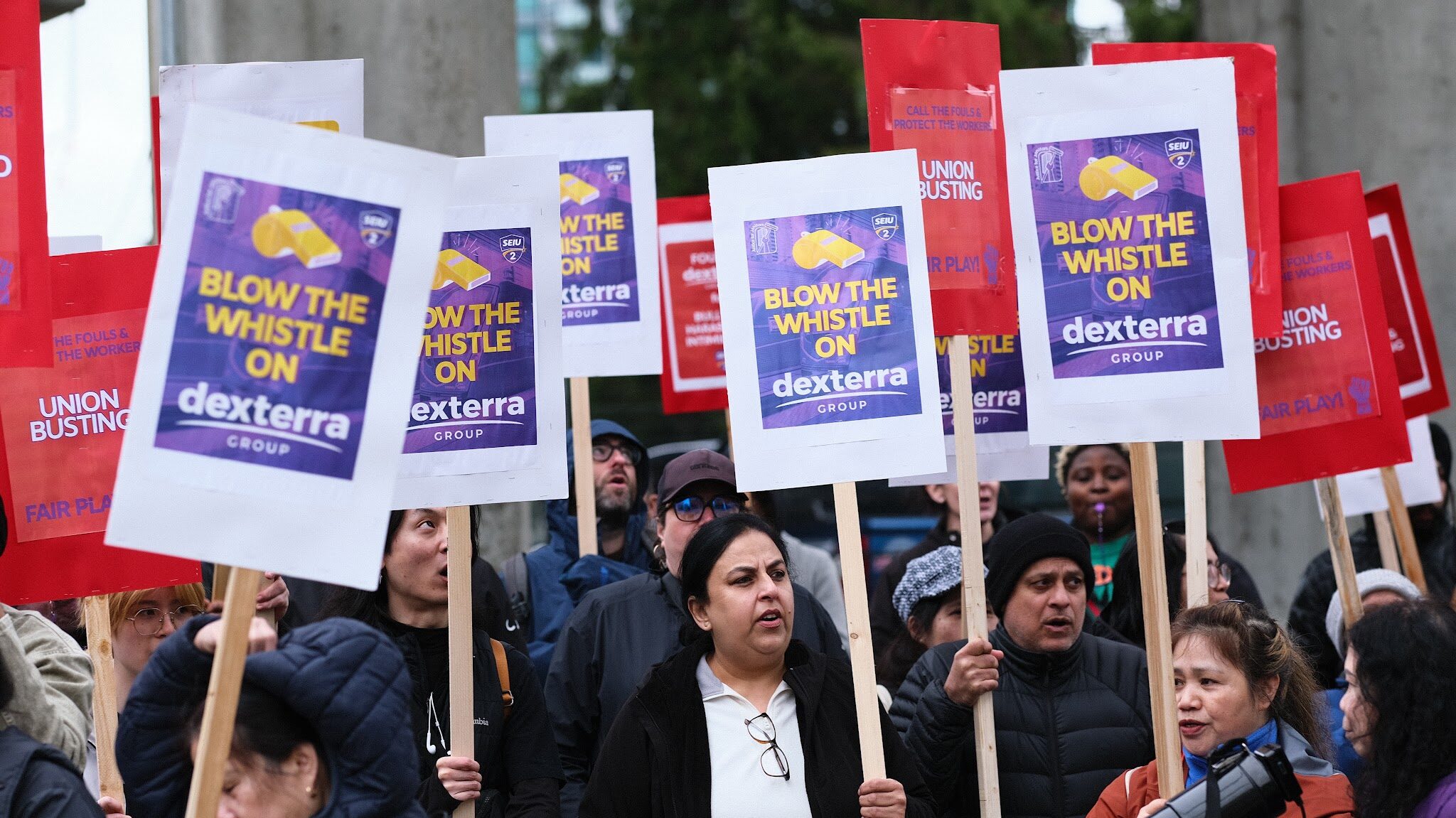
Five thousand more unionized transit workers across Metro Vancouver have voted 99% in favour of strike action against the Coast Mountain Bus Company which contract operates the region’s bus services under TransLink. The bus network carries even more daily riders than SkyTrain, with over 700,000 trips taken daily.
Their contract expired March 31. Mediated bargaining is underway, but workers have a mandate which would allow them to walk off the job in the coming days and weeks while the World Cup spotlight is on the city.
The shared opposition to government austerity measures and the use of public funds to enrich private companies has drawn some labour unions into closer alignment with the organized sections of the city’s most precarious residents living in conditions of homelessness and struggling with the increasingly deadly consequences of an out-of-control toxic drug crisis.
Sanitizing the city for tourists and paving the way for developers
Residents and workers in the neighbourhood are on the front lines of the unemployment, housing, mental health, and toxic drug crises. They are also staring down the barrel of an increasingly empowered and enriched Vancouver Police Department.
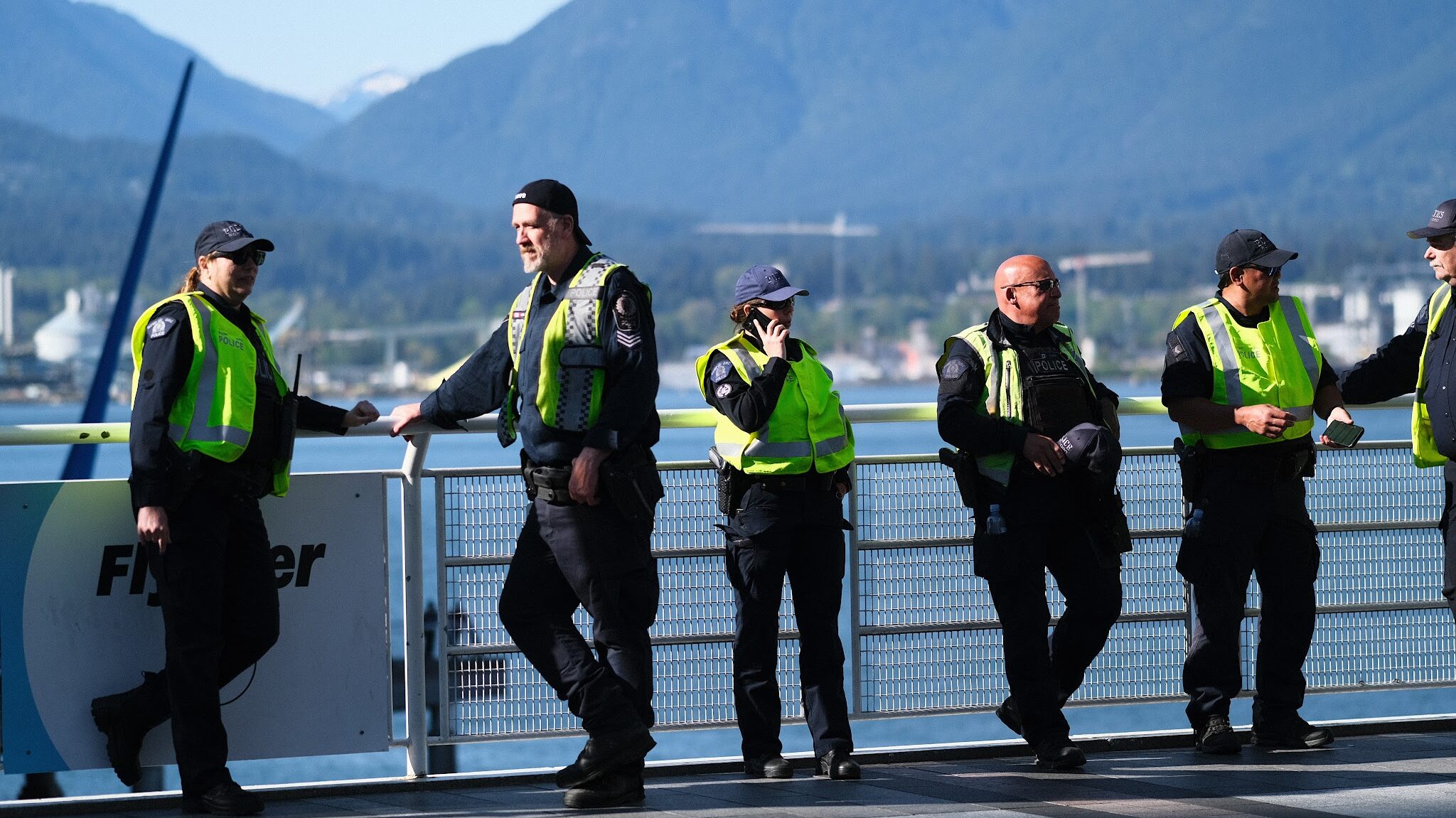
A town hall event in March brought together many of the neighbourhood’s residents and community organizations, where organizers spoke on the issues surrounding the World Cup. FIFA’s beautification policies have provided a legal mandate for street sweeps that force people away from the increasingly scarce social services that they have relied upon to stay alive. Meanwhile, as housing prices and evictions drive an increase in homelessness, community clinics, overdose prevention sites and shelters are overwhelmed.
Many of these same organizers and residents made up the core of the Anti-FIFA coalition which protested the FIFA congress alongside Pan-Pacific hospitality workers on April 30, where they spoke out against the tournament organizers and the government policies supporting them.
Demonstrators pointed out that the $729 million dollars the province will be spending on hosting the World Cup would be better spent on expanding the social services that workers are increasingly relying on as overall wages stagnate and living costs go up.

Athena, a Downtown Eastside resident who spoke at the protest, called out the city’s mayor for his council’s spending on FIFA after years of motions cutting services for her and her neighbours asking, “Mayor Ken Sim, where’s your priorities?”
“An astronomical [amount of money] materialized out of nowhere to beautify Vancouver and beef up security with no plans but ousting vulnerable people before housing homeless and keeping people housed,” she observed.
Be part of the conversation!
Only subscribers can comment. Subscribe to The North Star to join the conversation under our articles with our journalists and fellow community members. If you’re already subscribed, log in.