
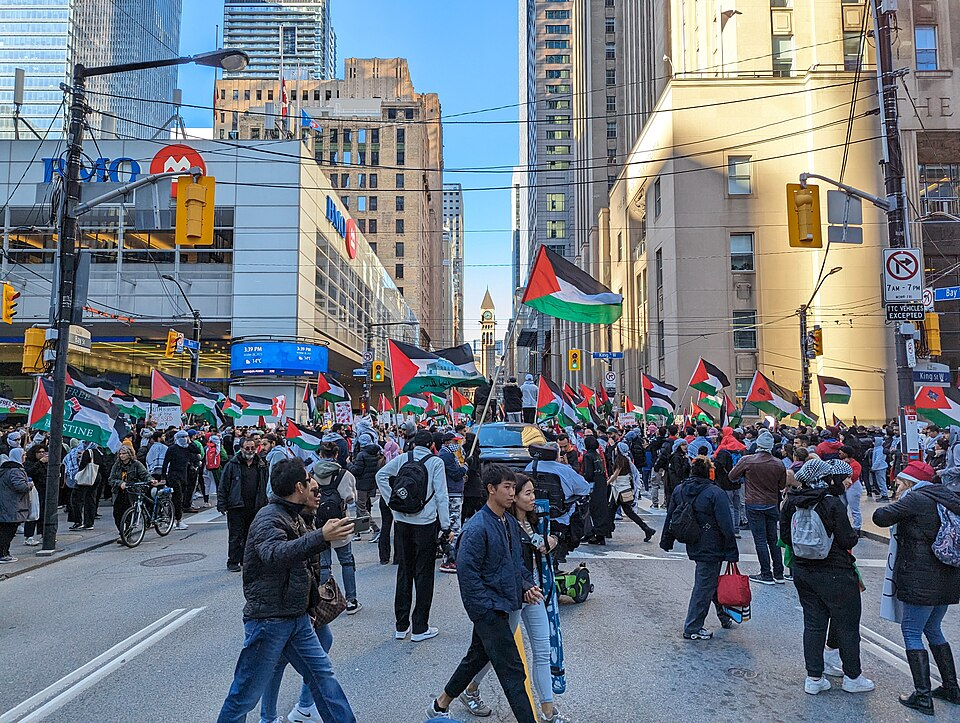
The Toronto Police Service (TPS) Hate Crimes Unit arrested and charged Ahmad Hassan Hajahmad with “participation or contribution to activities of a terrorist group”—namely Hamas. In their media release, TPS indicated that Hajahmad was under investigation for over two years due to his participation in a Palestinian solidarity rally against the Gaza genocide being perpetrated by Israel.
“Mr. Hajahmad is presumed innocent and has no connection to Hamas or any other foreign group. He faces a single charge arising from speaking at public demonstrations”, explains Mohamed El Rashidy, counsel for Hajahmad.
“No violence, no weapon, no one harmed. Speaking out at a protest about the killing of civilians is protected expression, not terrorism. The police told the media he advocated hatred and harm but he is not charged with that. We’ll be looking closely at how and why this case came to be, and we’re confident it won’t hold up when measured against the law.”
TPS collaborated with the RCMP’s Integrated National Security Enforcement Team (INSET), the security task force charged with investigating national security, terrorism, and foreign influence. In the TPS media release, Chief Myron Demkiw affirms the police’s commitment to targeting activists:
“Investigations into criminal offences committed at demonstrations do not end when the event is over. As this investigation progressed, we worked closely with our INSET partners to pursue the terrorism charge warranted by the investigation. These complex investigations underscore the importance of continuing to strengthen our Counter Terrorism Security Unit so we can identify and investigate evolving threats to public safety. We will continue to hold those who break the law accountable, no matter how long it takes.”

Indeed, TPS has made it an official mandate to target Palestinian solidarity activists under Project Resolute—a project that was initiated at the behest of Indigo CEO Heather Reisman. Nearly one year ago, labour organizer Tynan Leibert was convicted in a Toronto court for his solidarity with Palestine.
The following is the complete statement from Hajahmad’s legal counsel, Rashidy & Associates:
Let us be clear about what this case is not. The police have told the media that Mr. Hajahmad ‘advocated for detestation and harm’ against members of the Israeli and Jewish communities, but he is not charged with that. He is not charged with promoting hatred, or with any hate offence at all. He is not charged with committing any act of violence. He is not alleged to have possessed any weapon. He is not charged with acting on behalf of, at the direction of, or in contact with any organization. No person is alleged to have been harmed. The public should ask why the police describe a case in the media that they did not bring in court. Mr. Hajahmad has no connection to Hamas or any other foreign group. The single charge concerns his participation in public demonstrations in Toronto about the conflict in the Middle East.
Mr. Hajahmad attended and spoke at those demonstrations because, like many people in this country and around the world, he was moved by what he was watching happen to civilians, especially children, in a conflict the whole world is witnessing in real time. Speaking out against the mass killing of innocent people is not terrorism. Condemning what one believes to be grave violations of human rights and international law is not terrorism. It is political expression of the most fundamental kind, protected by the Canadian Charter of Rights and Freedoms, and it is what people of conscience have always done. He believes he was bearing witness to atrocities, not committing a crime, and a free country should be able to tell the difference.
So the public is entitled to ask: when did speaking out against the killing of civilians at a peaceful protest become a terrorism offence? Where is the line between conscience and criminality, and who decided to draw it here? What does it mean for every Canadian who marches and speaks out if that line is left where it now stands?
These are questions that belong in a courtroom, to be answered on evidence and on the law, not on social media, and not by anonymous accounts. We intend to examine closely how and why this case came to be. We are confident that when it is measured against the law, the presumption of innocence will be borne out.
Be part of the conversation!
Only subscribers can comment. Subscribe to The North Star to join the conversation under our articles with our journalists and fellow community members. If you’re already subscribed, log in.