
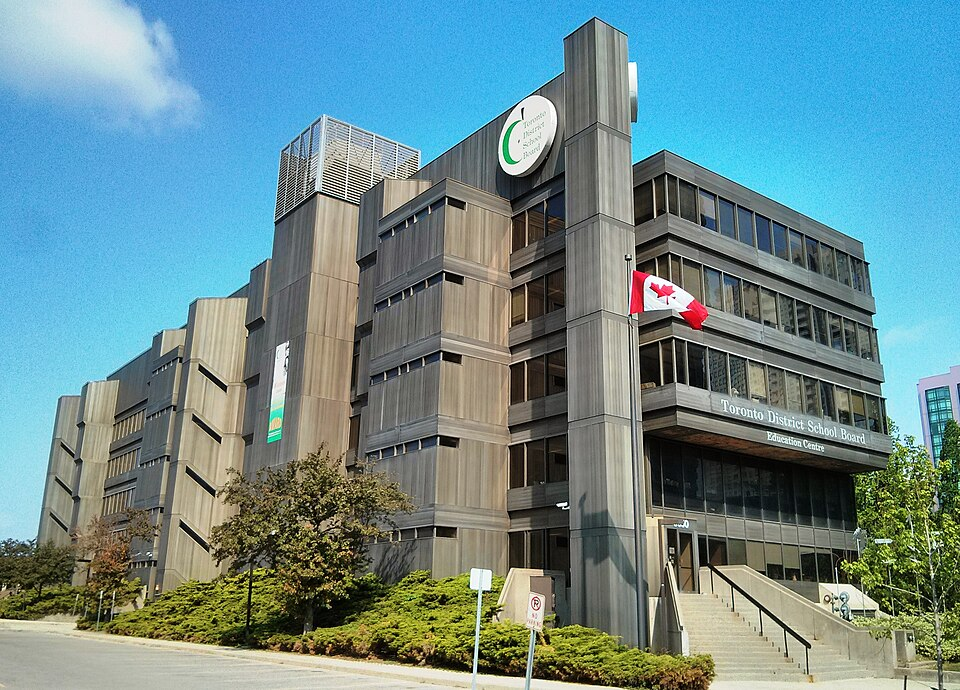
Beginning in June 2025, Ontario’s Minister of Education put eight school boards (750,000 students) under the control of provincial supervisors, sidelining elected trustees. Since this takeover, sweeping legislative changes have been implemented and denounced by teachers, parents and students alike. The North Star spoke with education workers across Toronto to discuss the impacts of these changes.
Education workers across Ontario entered summer 2026 in a state of anxiety and uncertainty. The final months of the school year, between culminating exams and graduation ceremonies, brought news of significant job cuts. Among them were nearly 800 employees of the province’s largest school board, the Toronto District School Board, including teachers, teaching assistants, custodians, mental health professionals, IT technicians, and administrative and secretarial staff.
The announcement of job cuts came amid several other concerning changes in the eight school boards that were taken over by the Ministry of Education last year. These include:
- the closing of outdoor education programs,
- suspension of enrollment and potential closure of two high schools serving disabled students,
- reduction of English as a Second Language funding, the phasing out of literacy programs, and
- the closure of summer schools.
Ministry takeover of school boards
“There seems to be a lack of communication about what’s really going on between the school boards and the ministry,” notes Ms. N, an elementary school teacher in Toronto, commenting on the state of anxiety she and her colleagues have been left in.
She says that the fear of what’s coming is palpable in staff rooms and staff meetings. “And what’s their vision? It’s been heartbreaking hearing a lot of the changes, and the creation of this corporatization of something that’s supposed to be a public service.”
It has now been a little over a year since Doug Ford‘s Ministry of Education took unprecedented and direct control of school boards in Ontario. The takeover began with the Toronto District School Board (TDSB) and Toronto Catholic District School Board in June 2025 and expanded to other provincial boards, such as the Peel District School Board and York Catholic District School Board, by early 2026.
School boards include superintendent roles and mandatory school councils consisting of committees of parents, teachers, students (in the case of high schools), non-teaching staff members, and community representatives who provide advice and guidance to the principal and school board. Since the passing of Bill 33: Supporting Children and Students Act in 2025, the Minister of Education appointed supervisors to take control of local boards. For example, the supervisor for TDSB is Rohita Gupta, who takes home an annual salary of $350,000.
It is under these conditions that so many massive and sweeping changes have passed so quickly. Before the takeover, school boards, composed of elected members of a school’s community, would be responsible for consulting, discussing, and voting on changes in schools. In the words of Sarah, who works for the provincial government:
“These policies reflect a broader political choice about the role of public services and programs… We are seeing education be commodified, like healthcare. These are not isolated incidents. Rather than strengthening public institutions through stable or long-term investment, many of these decisions are centralized, authoritative decisions. And it’s just expecting schools to do more with less resources, which we know is not sustainable.”
Lack of transparency
The Ministry of Education cited financial mismanagement and lack of organization within boards as its justification for the takeover. However, according to some teachers, this justification doesn’t make sense when viewed in the context of the Ministry of Education’s other budget decisions.
Ms. N. pointed out, for example, that while simultaneously citing the need to make major cuts, more funds are being spent to create new, high-paying positions, such as an appointed chief executive officer directing school boards.
The cuts to jobs and support programs are being justified by a drop in enrollment attributed to declining immigration numbers in the province. But this, too, raised eyebrows among the education workers The North Star spoke to. Some pointed to the closure of Eastdale Collegiate Institute—one of two TDSB high schools that had their enrollment halted by the government in February. The use of low enrollment as justification for budget cuts, while the Ministry shuts down schools, raises concerns about the provincial government’s plans for education.
The lack of transparency, Sarah points out, is by design:
“As far as I know, educators don’t even have details about how the board takeover is going to be rolled out. And it’s because [the Ministry] doesn’t have a plan. That’s why… they go backwards and they say, ‘Well, we want X, so we’re going to announce Y, and then we’ll figure out the details later.'”
Regardless of their roles within the education sector, all the education workers The North Star spoke with agreed that the urgency of this moment demands organization and action from everyone in their sector.
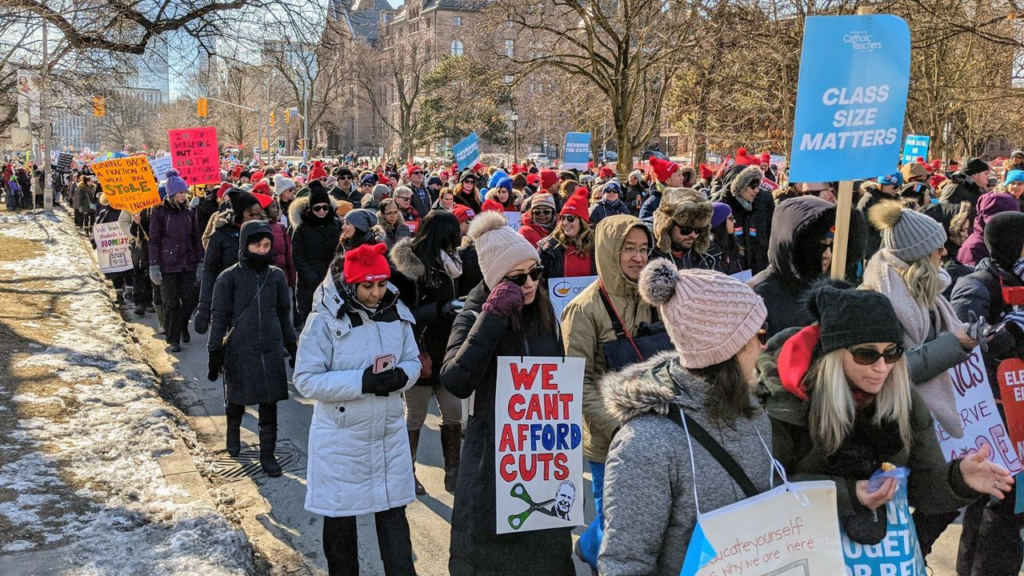
“I think this is the first time where a lot of teachers are hoping that there will be a strike because they’re so upset and so angry at the way the government has treated this whole process, at how demeaning it’s been,” says Ms. N. She explains that teachers haven’t always been very eager to go on strike. But this time, she says, she’s hearing a lot of, “Let’s start September. Let’s strike. Let’s do this now.”
Need for collective action
The current four-year contracts of several major unions in the education sector all expire at the same time—August 31, 2026. These include the Elementary Teachers’ Federation of Ontario, the Ontario Secondary School Teachers’ Federation, the Education Workers’ Alliance of Ontario, and the Ontario English Catholic Teachers’ Association. This offers a chance for unions to work together, says Ms. N.
“The unions across Toronto need to, essentially, shut down Toronto. Maybe Ford needs to understand that you can’t destroy public services. These are things that are owed to people and you can’t dismantle them because you’re trying to make an extra buck.”
In 2022, custodians, educational assistants, and early childhood educators represented by CUPE threatened a general strike. That strike forced the Ford government to repeal legislation that sought to impose a contract and ban strikes in the sector. Education workers today look to lessons from that movement.
“A big reason why they were successful,” comments Sarah, “was because they got the general public behind them, not just organizing around one key issue, but creating linkages between what’s happening with public education that’s also happening in public health that’s also related to housing or homelessness or even international issues.”
As education workers and unions grapple with growing uncertainty about the future of education in the province, workers continue to organize and build collective power ahead of the school year. They say continued public support will be critical when students and staff return to classrooms in September.
Be part of the conversation!
Only subscribers can comment. Subscribe to The North Star to join the conversation under our articles with our journalists and fellow community members. If you’re already subscribed, log in.