
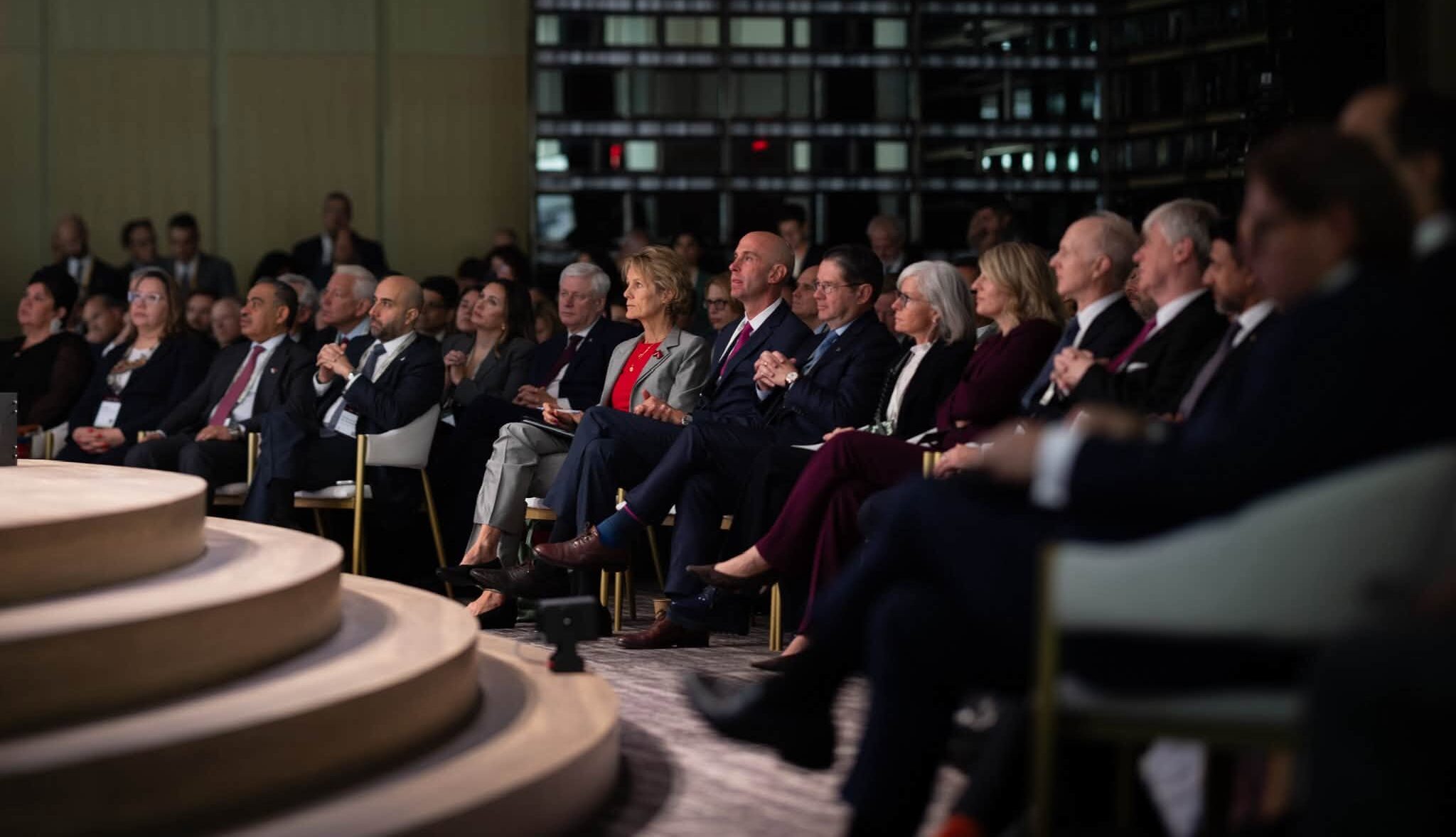
Last week, the Canada Investment Summit was held in Toronto. On September 14 and 15, the federal government invited the largest oligarchs from around the world to invest in Canada. In their media release, the prime minister’s office boasts that “Canada is a top global destination for investment” for the likes of BlackRock’s Larry Fink and Blackstone president Jon Gray—executives of two of America’s largest private equity firms—amongst many others.
On the menu for investors was access to Canada’s natural resources and critical minerals, pipelines, AI data centres, and largest airports, neatly tied up in a portfolio of 167 total projects. Over the weekend at the Royal Ontario Museum, Mark Carney stated the summit was a chance for oligarchs controlling over $120 trillion in assets to “peer into our shop window.” The infrastructure projects presented to prospective investors were projects that are already underway or completed—not brand-new projects.
Listed in the 67-page catalogue that the government presented to investors were items such as the Crawford Nickel Sulphide project, one of the world’s largest open-pit mining projects, located north of Timmins, Ontario. Minerals extracted from this mine are to be refined for use in electric vehicle batteries.
Another project is the West Coast Oil Pipeline, a proposed $35 billion project that integrates completed parts of the Keystone XL pipeline. Keystone XL was cancelled by the Biden administration in 2021 and faced major opposition from environmental and indigenous groups on both sides of the U.S.-Canadian border.
Notably, the federal government claimed in its media release that it is inviting private investors “through long-term concessions to operate Canada’s four largest airports,” i.e., privatization via long-term leases that will allow private investors to manage Toronto Pearson, Vancouver International, Montreal Trudeau, and Calgary International airports under a for-profit model.
A similar model of airport privatization was introduced in Australia in 1997 and was criticized for increasing ticket costs and reducing travel along less-profitable, smaller air routes, while cutting jobs and increasing workloads.
Currently, the federal government owns the land that airports are built on and employs not-for-profit organizations to run the airports. Of all the airports presented to investors, Calgary is the only one not reporting a fiscal surplus under the current model. Toronto Pearson and Montreal Trudeau reported fiscal surpluses for 2025 of $366 million, and $159 million, respectively. In 2024, Vancouver international reported a fiscal surplus of $16 million.
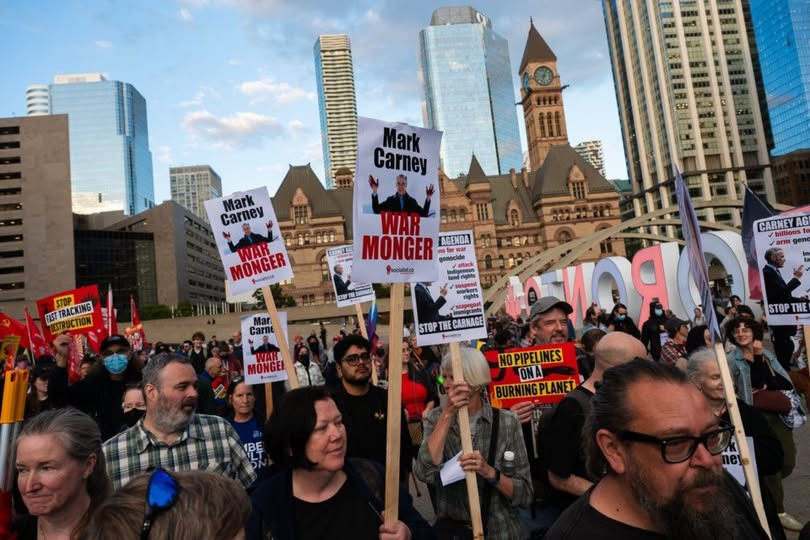
The summit was met with opposition by reportedly over a thousand protesters in downtown Toronto. Two were arrested. Protesters gathered in Nathan Phillips Square and marched to the Art Gallery of Ontario where the summit was held. The demonstration was confronted by over 200 officers from Toronto Police Service.
Amongst the demonstrators were indigenous peoples from across the country, labour unions, climate advocates, and housing organizers. Protesters raised concerns about the privatization of public services, environmental destruction and climate change, arms manufacturing, AI data centres, and the trampling of indigenous rights.
Recently, provincial governments have passed bills to accelerate the development of resource extraction. For example, Ontario’s “Protect Ontario by Unleashing Our Economy Act,” passed last year, opened up several regions in Northern Ontario for mining. Also in 2025, Nova Scotia passed a bill that lifted moratoria on fracking and uranium mining in the province. Both of these laws have been opposed by indigenous peoples in their respective provinces.
Apart from the U.S.’s biggest private equity funds, attendees to the summit included representatives from the Canada Pension Plan and from public sector pension funds from Norway, Saudi Arabia, and Abu Dhabi; banking and private equity CEOs such as Christian Sewing of Deutsche Banke and Camilla Languille of the Mubadala Investment Company; and CEO of Canadian AI developer Cohere, Aidan Gomez.
Be part of the conversation!
Only subscribers can comment. Subscribe to The North Star to join the conversation under our articles with our journalists and fellow community members. If you’re already subscribed, log in.