
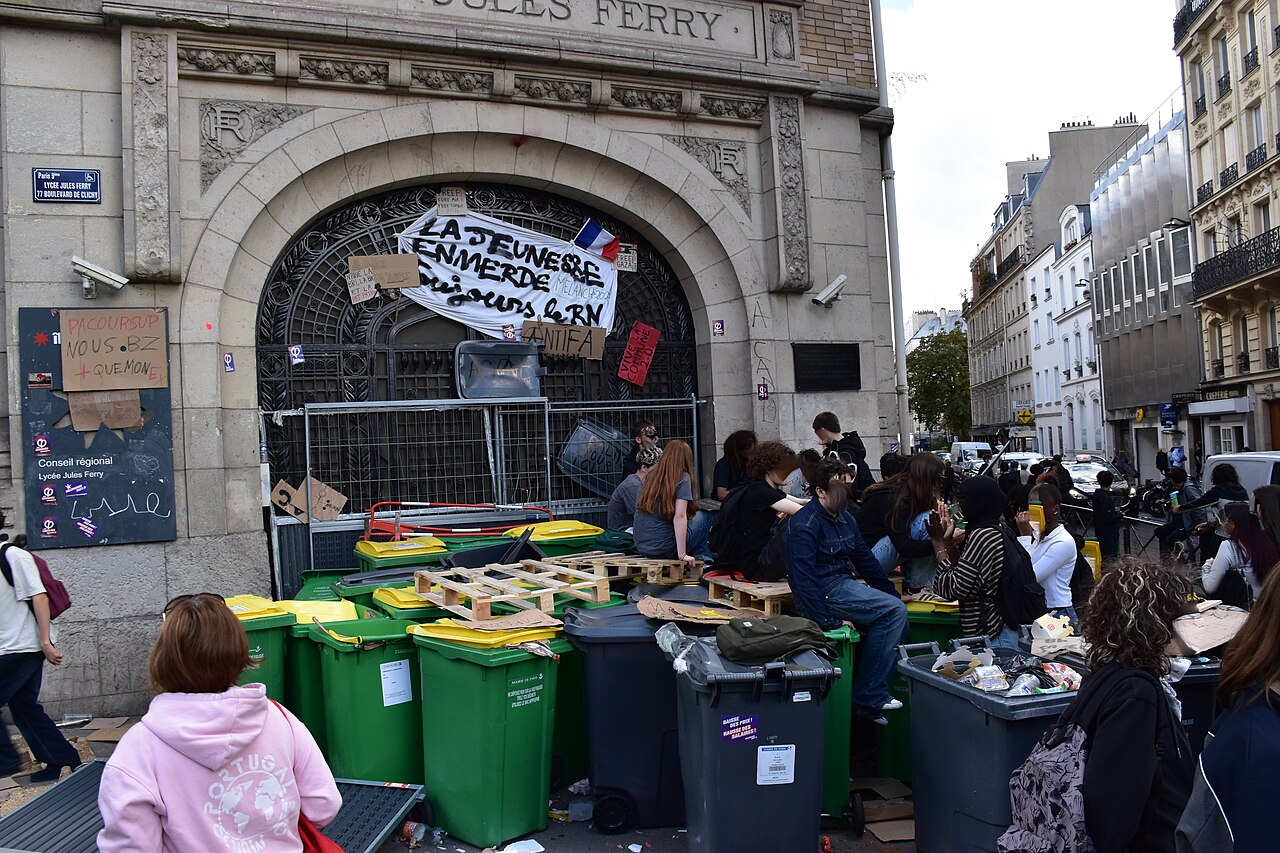
Over the past month, a full-fledged social movement has erupted in France. More than a thousand high schools have been blockaded by groups of students protesting — among other things — staff shortages, the deplorable condition of school buildings, and overcrowded classrooms.
The first protests at high schools took place in late August and early September in France’s overseas territories. At the Lycée de la Cité du Nord in Mayotte, parents, students, and school staff rallied against the deplorable conditions at their school. At the Félix Eboué High School in French Guyana, students denounced unsanitary conditions, high cafeteria prices, and a lack of staff.
The movement soon spread to the suburbs of metropolitan France, often described as modern-day ghettos. The unemployment rate there is twice the national average. At the Saint-Exupéry High School in Créteil, a suburb of Paris, teachers protesting their working conditions were joined by students frustrated by the pronounced lack of resources allocated to their school.
After spreading rapidly to several high schools across France, labor unions such as the CGT and the USS called on workers from various sectors to join the movement. Among others, firefighters, hospital staff, and agricultural workers participated in the protests. The movement has now spread to other European countries such as Belgium, Italy, and Germany.
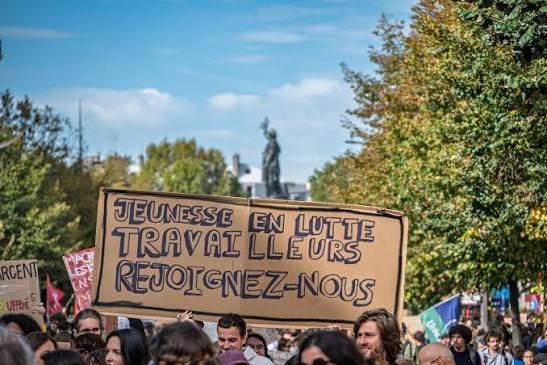
A Positive Response in Quebec
The demands of French high school students have resonated as far as Quebec, where students at Jean-Jacques Rousseau High School, on Montreal‘s South Shore, attempted to organize a blockade. Their demands were, in part, similar to those of their French counterparts. A poster circulating on social media calls, in particular, for “a complete overhaul of the education system.”
Parallels can also be drawn with the CEGEPs. Indeed, nearly a dozen colleges were on strike on May 1. The students were protesting the dilapidated condition of the buildings and the lack of staff. Similarly, the Coalition de résistance pour l’unité étudiante syndicale (CRUES) is currently calling on student associations to stage a strike from November 9th to 13th to protest austerity measures.
For student organizers at Cégep Saint-Laurent interviewed by The North Star, the French high school student movement is a source of inspiration and admiration: “From an activist perspective, what is happening over there is absolutely amazing,” says Marc*, a member of the Cégep’s student association.
“The student movement in Quebec is mainly something that happens among students. Often, it doesn’t have the scope it should, and the general public isn’t mobilized. So I find that aspect—that all of civil society in France has decided to join this movement—quite impactful.”
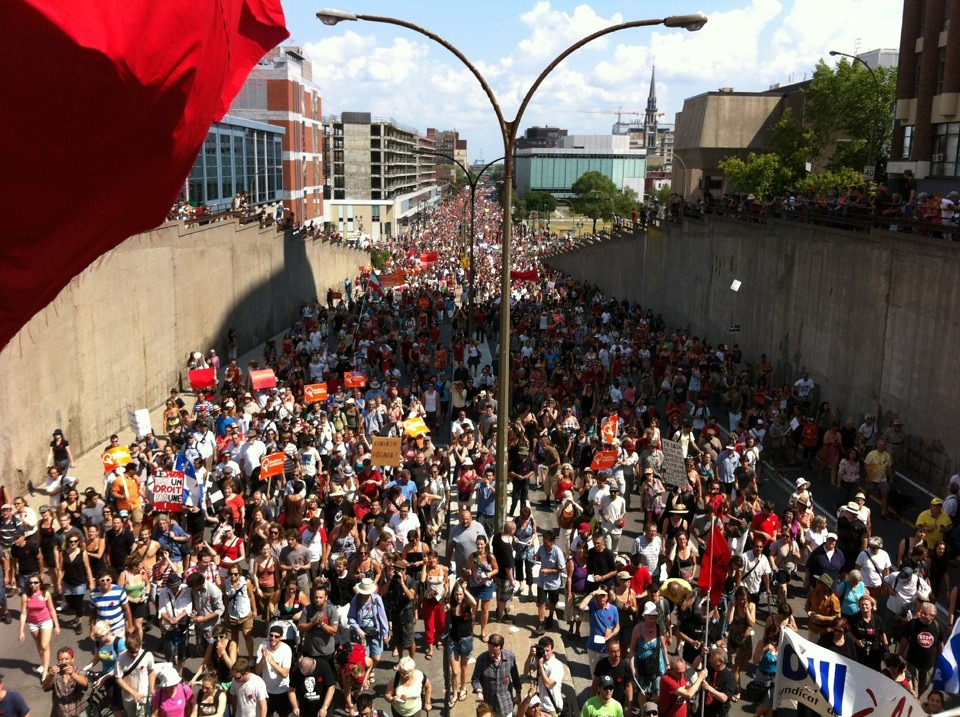
According to Marc, who helped organize the strike on May 1st, the conditions that led to the high school student movement in France certainly exist here: “All of this didn’t come out of nowhere; just look at any public school in Montreal North or Montreal East—[they have] classes of 35 students, crumbling walls, and asbestos.”
In March 2026, 61% of Quebec’s public high schools were described as being “in an advanced state of disrepair” in the Annual Public Infrastructure Investment Management Plan.
A Different Political Context
According to Nour El-Hage, also an organizer with the student association of Cégep Saint-Laurent, the political context in France allows this kind of social movement to gain traction. He cites the history of uprisings in France and believes that the role played by La France insoumise (LFI) in relation to social movements in France contrasts with that of Québec solidaire (QS), which claims to be the province’s sole left-wing party.
“When LFI lawmakers show up at roadblocks or join protests, the young people from the projects—who didn’t give a damn about politicians […]—cheer them on and protect them. […] They shout their names,” he says.
“But QS doesn’t position itself the same way as LFI. [QS says] that we have to work with the political machine, that it’s the machine that gives us the means.” Conversely, El-Hage believes that LFI puts its resources at the service of the protests. “[They are] there to support the struggles, […] to be shaped and used by the struggles.”
According to an Elabe poll for BFMTV, published on October 7, 55% of French people approve of the movement, while 72% consider the students’ demands to be legitimate.
What are the prospects for Quebec students?
Marc believes that building this kind of movement in Quebec must first involve long-term grassroots organizing:
“If we want this to take root here, it might require a little more effort to build connections, and probably some solid networking.” He adds that it will be necessary to “go out and talk to people, whether through handing out flyers, conducting surveys, or mobilizing via social media.”
The next major wave of student protests in France is scheduled for October 17th. Student organizations in Montreal are calling a solidarity rally on the same date, which will take place at 3 p.m. at Phillips Square.
*A pseudonym was used at the interviewee’s request.
Be part of the conversation!
Only subscribers can comment. Subscribe to The North Star to join the conversation under our articles with our journalists and fellow community members. If you’re already subscribed, log in.