
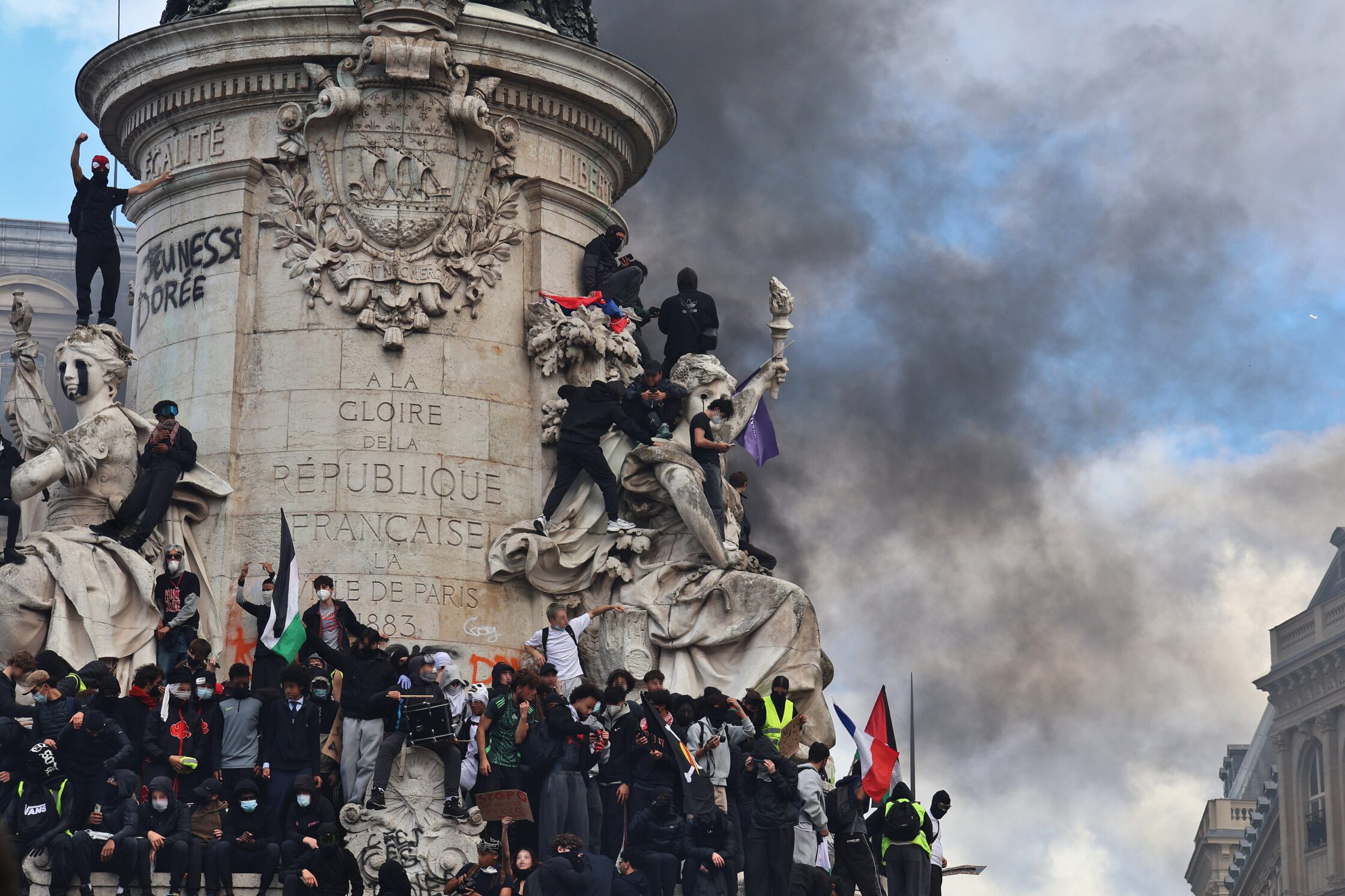
In most of the media coverage of the French protests in recent weeks, a clear narrative emerges: the rioters are the bad guys, while the peaceful protesters are the good guys. The so-called violent protesters are said to be harming the movement rather than helping it. However, according to a political history expert, this isn’t really the case.
Alexis Lafleur-Paiement is a lecturer in political philosophy at the University of Montreal. He is also the co-founder of the collective Archives Révolutionnaires, which focuses on the history of social movements. In an interview with The North Star, he is critical of the highly negative coverage many media outlets are providing regarding the protests in France.
He believes that “the protesters’ violence is a response to police violence. In France, as elsewhere, we generally see peaceful marches that are provoked by the police. Some people react, and then clashes ensue.”
In his view, if protesters go so far as to attack police officers or set cars on fire, it’s because they are truly exasperated and unable to make themselves heard by the authorities. “Social movements that resort to violence offer a simple justification: if no other means work, if the state refuses to listen to us and represses us, then we must use more radical means. […] In France, people have been demanding better living conditions and protection against inflation for 10 years.”

Nothing new for France
Lafleur-Paiement, who is pursuing a jointly supervised Ph.D. at the University of Paris 1, argues that the radical actions of French protesters are nothing new for the country. He cites the example of the 1968 student movement, known as “May ’68.” The students waged a protracted struggle against the state in violent clashes during which they threw bricks and Molotov cocktails at police officers. Police violence resulted in at least four deaths among the protesters.
Lafleur-Paiement also compares the current French movement to the Yellow Vests movement, which shook rural areas and then major urban centres beginning in 2019. During the protests, five Yellow Vests were killed. Throughout that movement, several scenes of violent clashes with the police went viral on social media.
Some groups continue to identify with this anti-inflation movement and have joined this year’s student protests. “The social movement in France is the culmination of a decade of protests against Emmanuel Macron’s elitist regime,” explains Lafleur-Paiement.
The debate in Canadian history
The lecturer compares today’s French movement to two recent episodes in Canadian history. First, he sees a parallel with the movement surrounding the 2022 Freedom Convoy. In his view, that movement reflected “frustration among many sectors of the population toward the government,” which draws a parallel to the current anger of the French people.
However, a more obvious connection is drawn to the 2012 student movement. Initially focused on education issues and composed primarily of students, it had gained the support of much broader segments of the population over the course of several months. The slogan “the strike is student-led; the struggle is popular” aptly sums up the spirit of the time.
Among the internal debates raging within the movement at the time, the issue of violence and vandalism kept resurfacing. One faction sought to prevent the destruction of bank facades and the throwing of projectiles. They were then labelled “paciflics” (a portmanteau of “pacifists” and “flics”—cops) by another faction that supported such actions.
Lafleur-Paiement, who was involved in the 2012 strike, explains that “the Quebec student movement faced the same challenge that France is facing today.” In his view, the opposition between the two factions was rather unproductive.

“In reality, what we saw in Quebec was that these two tendencies complemented each other. Those who engaged in direct action put pressure on the government, while those who preferred large, peaceful demonstrations helped the movement gain broader support among the population.”
The retaliation against police attacks and the destruction of economic and political symbols ultimately helped the cause. After half a year of heated protests, the government of the time, led by Jean Charest, called an election and was ousted from power.
Be part of the conversation!
Only subscribers can comment. Subscribe to The North Star to join the conversation under our articles with our journalists and fellow community members. If you’re already subscribed, log in.