
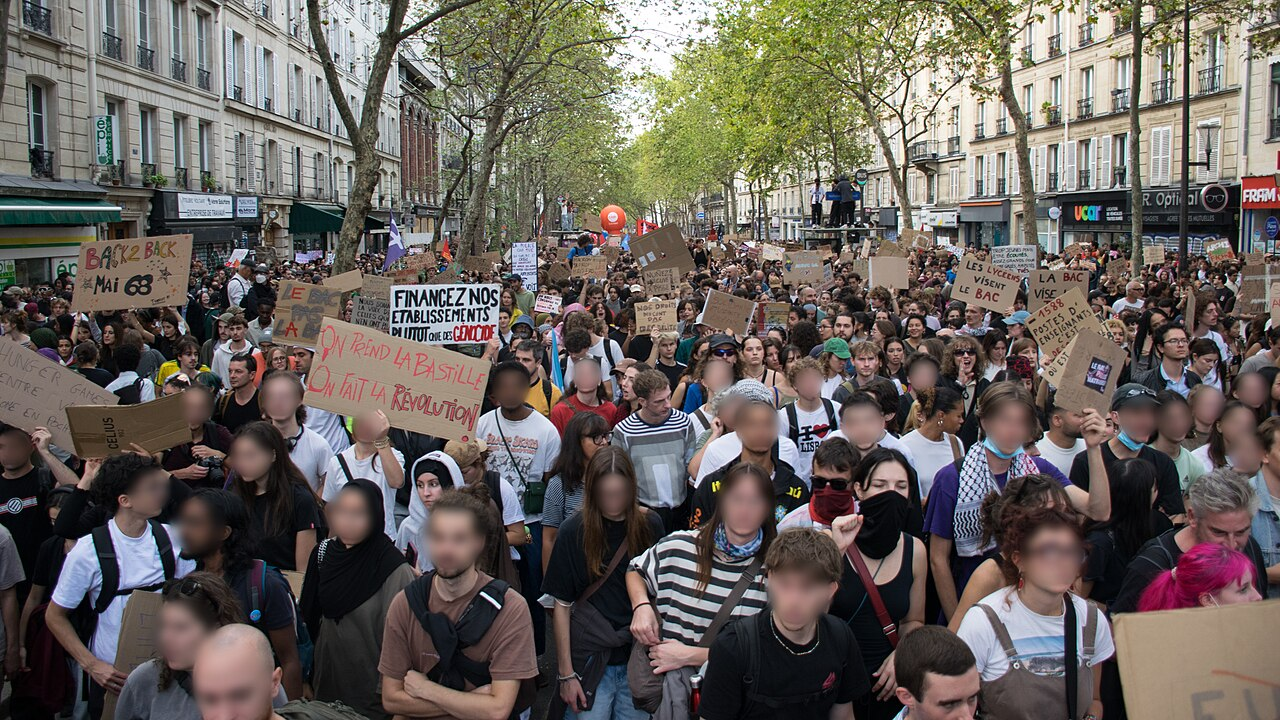
When it comes to the current social movement in France, it is primarily images of vandalism and clashes with police that have been circulating on social media and in the mainstream press. To provide a less sensationalized picture of the situation, The North Star sought to speak with people on the ground.
Félix Étienne and Léa LaSalle are students from Quebec currently doing a semester at the University of Bordeaux, France. Both of their departments are on strike right now, which has allowed the couple to participate in a few local protests.
In an interview with The North Star, Félix recounts that the first two protests he attended were massive and relatively calm. According to him, about 10,000 people had gathered in Bordeaux at the time. “Toward the end, some people set trash cans on fire […] but I’ve been told that’s relatively normal at the end of a protest.”
The October 17 demonstration, which Léa also joined, was more turbulent, however. The couple had joined an initial gathering at Place de la Victoire that marched toward a larger rally taking place at Place de la Bourse.
However, the heavy use of tear gas dispersed the second rally before it had even officially begun. “We hadn’t even reached Place de la Bourse yet, and there were really a lot of people there. The estimates put the number at at least 50,000 people. But the police were already firing tear gas before the protest had even started,” Félix recounts.
“We tried to head into the small side streets nearby, but the police were blocking many of the exits. They told us, ‘You have to go out that way,’ and pointed us in a direction where there was the most tear gas.”
Léa and Félix then went into cafés to escape the tear gas. “We took refuge in cafés for a little while and would go out when it seemed calm. We’d go out and try to get away from the protest.”
A questionable police strategy
The police in Bordeaux were using the “kettle” strategy at the tim. On social media, several French protesters reported that this strategy is widely used nationwide by the Compagnies républicaines de sécurité (CRS), the French police riot control units.
During “kettle” operations, police form a tight perimeter around the demonstration and designate a single exit. Citizens may thus find themselves forced to pass through clashes between police and protesters—or even through clouds of tear gas—if they want to leave the police cordon and avoid possible arrests.
According to Félix, the hasty use of tear gas had the effect of driving away protesters who had come to march peacefully. “The most peaceful ones will try to leave right from the start because of the tear gas, so who was left in the end? [Those] who were prepared, the provocateurs, or the people who took advantage of the situation to go loot stores.”
Léa adds that the police’s aggressiveness “also rattled those who are more seasoned and experienced in protests, because right from the start you think to yourself, ‘Well, the consequences are already here.’ ”
Vandalism: the media exaggerate
The couple, however, reports not having witnessed any vandalism firsthand. On the contrary, they say they took refuge in a café just a stone’s throw from the Bordeaux City Hall and were thus able to observe that in that area—‘literally at the gates of power,’ in Léa’s words—there were none of those rioters flooding the media. Félix adds that “The café where we were had a nice, big window, and nothing happened there.”
They say they did, however, see protesters confronting a hooded individual who wanted to escalate the violence of the demonstration. Léa provided a video to The North Star in which this person can be seen prying up the cobblestones in the area to use them as projectiles. However, he was confronted and then shoved by activists, who forced him to put the cobblestones back. Observers of the scene postulate the the hooded individual is an agent provocateur.
According to Léa, this is proof that media coverage exaggerates the supposed violence of the demonstrations that took place on October 17. “We’re at City Hall! If there’s one place where you’d want to throw those fucking cobblestones, it’s right here. But that’s not what happened.”
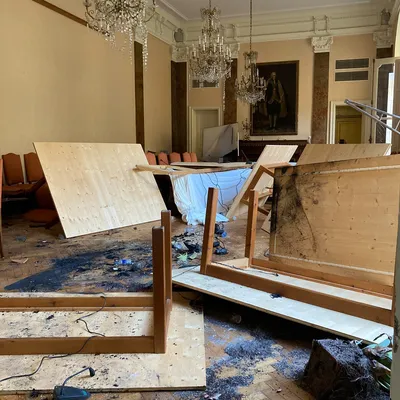
Demonstrators in Bordeaux – however – have invaded the residency of the Gironde prefect, who is housed by the State in a sumptuous hotel. In its Instagram publications, the Fédération syndicale étudiante – which seems to have taken part in the action – state that it’s State violence that must be denounced and not vandalism.
According to Félix, while the media had previously paid some attention to the demands of the protesting high school students, the October 17 demonstration changed the game, and since then, it’s only the violence of the protests that’s been highlighted by TV networks and newspapers.
Léa adds that media outlets that tend to be sympathetic to high school students are busy debunking the myth that the parliamentary party La France Insoumise is instigating violence during the protests. “The left-wing media are working overtime to try to dispel that narrative.”
Universities strike in support of high school students
The movement currently shaking France was initiated by high schools in former French colonies and metropolitan suburbs, but since then, schools at other levels and from other backgrounds have joined the struggle en masse. Félix and Léa, who each attend a different department at the University of Bordeaux, currently have no classes since their building is blockaded.
At Léa’s building, which houses political science students, the blockade was motivated by support for high school students, but also because the Ministry of Education refuses to appoint the newly elected director.
Félix, for his part, describes how, following an initial general assembly attended by about 200 people, the students in his department voted to stage a blockade the next day. “Starting at 7 a.m., people started arriving on campus and blockaded the university. The administration imposed a sort of lockout—they closed the buildings and announced, ‘Okay, classes will be held remotely; the university is closed; no buildings are accessible.’”
The following Tuesday, classes were held in the morning, but a general assembly brought together 1,000 students at noon, and about 75% voted in favor of resuming the blockade. According to Félix, this was an extraordinary event for this institution, which enrolls students in law and economics. According to his information, there had not been a general assembly on campus since 2023.
On October 27, the student movement, along with allies from the Yellow Vests movement and labor unions, called for a day of protests, but the French government may ban them. Next week, meanwhile, will be a school break.
Be part of the conversation!
Only subscribers can comment. Subscribe to The North Star to join the conversation under our articles with our journalists and fellow community members. If you’re already subscribed, log in.