
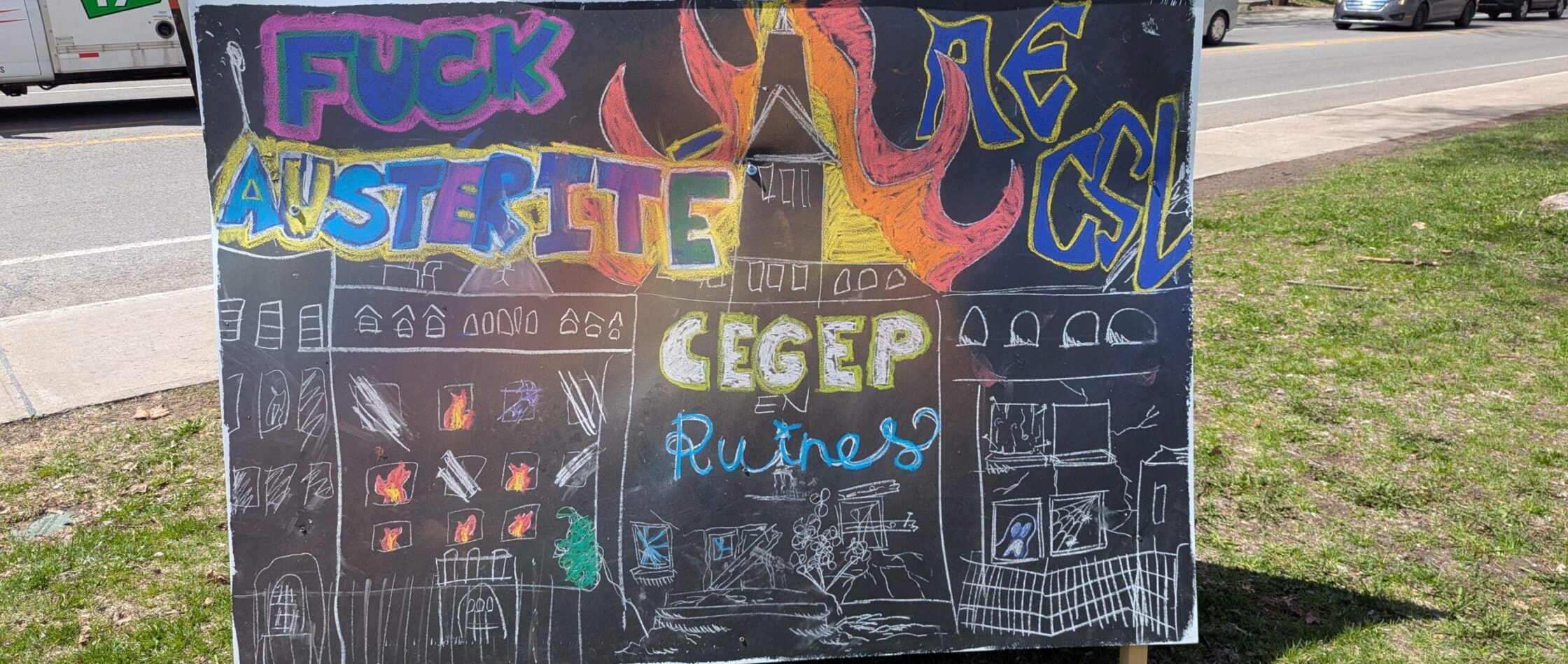
With the winter semester coming to a close and a strike mandate exercised, the students of Cegep de Saint-Laurent in Montreal have ended an important year of mobilization and action that fought against the school’s diminishing services and crumbling infrastructure. As one of the epicentres of the 2012 student movement, student organizers hoped to revitalize a culture of militancy that had waned in the past few years.
The students held their first strike days of the school year in November 2025, followed by a week-long strike in March 2026, and a final strike day on May 1st. The North Star was present at the picket line on May 1st, and spoke with Nour El-Hage, an organizer with the student union, to reflect on his experience and the progress made throughout the year:
“I think it was amazing. For the week of the strike, we were like five people doing all the work—and that’s fine. But after the week of the strike, we had committees with 20 people in it. And so I see it as a huge win. Maybe we didn’t get the immediate wins from the admin, but honestly, being able to get the student union back up, get the students interested in the student union, getting that whole community back alive and down to do shit. It’s better than just getting the little win.”
According to El-Hage, while the administration succeeded in pushing back the negotiations until the following semester, their actions throughout the year only drove more students into the movement:
“The fact that people were shown that the admin doesn’t necessarily represent their interests definitely helped garner hundreds of students. Before we really saw just a feeling of being powerless. People knew and people could see that the Cégep was in a shitty state. They didn’t have examples. Like: ‘This is how you could push the strike. This is the type of action you could do.’ Being able to show that example, I think now people want to show up with actions and with answers.”
“We now have a good base, we could follow through and we could escalate easily through the next semester. It would have been nice to just get the demands. But again, the potential that the student union now has just allows us to do way more.”

The students’ strike mandate came in the wake of the CAQ government’s $151 million budget cuts to Cégeps across the province, the school’s deteriorating services and infrastructure, and the subcontracting of maintenance jobs. Their demands included the institution of a permanent room for the school’s nurse, permanent positions for employees, full access to study areas, and that the Cégep take a stand against the CAQ government’s austerity.
On May 1st, The North Star also spoke with Jess Corneau, a support worker at the Cégep and union delegate, on his impressions of the students’ strike movement this year:
“We saw a very fast and very large mobilization. During the [strike] week in March, there were almost 300 people there, just students. And this morning, there were another 150 people, easy. Not that long ago, the picket line out front was basically just the 100 people living in residence halls, and even then it was a struggle. Now everyone is showing up. You can see that the young people are doing their part and learning really quickly. But what’s sad about it is that they’re learning quickly because they don’t have a choice. The CEGEP system is collapsing. And right now, all the CEGEPs in Montreal look like this.”
The year also saw the mobilization of the professional and support workers unions, who each face their own unique set of challenges, including hiring freezes and the threat of subcontracting. According to Corneau, an increased effort was launched on the part of organizers to link the struggles of these different groups together.
“We created an inter-union mobilization committee instead of each staying on our own, each doing our own activities and running our own campaigns. […] We’re talking about everyone in the CEGEP—students, teachers, professionals […] We merged our efforts together. We made a newspaper together, and the students took part in it. So naturally, it really changed the nature of the struggle, because the administration is very destabilized. They’re not used to seeing us this coordinated. And management is always afraid of organization in the workplace. It’s working really well. Our administration is panicking. They’re not really sure what to do about it.”
El-Hage spoke on the positive effect this inter-union collaboration had on the morale and outlook of the students:
“It was just an amazing feeling. Especially for the students too that saw their teachers at the strike. It’s not only that the student union is striking as always. It’s now, like, this is an actual issue. This is a common front for the common service that we all participate in. The teachers are the ones that give us those classes and the professionals are the ones that support those teachers and make sure that everything runs smoothly. We’re all part of this institution as active members. So it only makes sense that we fight for it as a group.”
Looking forward, El-Hage explained the importance of continuing their mobilization efforts over the summer to be ready for the next semester and a strike week in November that had been voted on by multiple Cegeps in the city. He also reflected on the potential that he sees for the student union in the wake of the growing convergence between different popular movements, exemplified by some students’ participation in an action on the morning of May 1st by striking blue-collar City workers in Montreal:
“Ideally, I would love to see the student union as, I don’t want to say a centre for organizing, but if students from the Cégep get mobilized and organized through the student union and are able to support campaigns and movements within the neighbourhood that would mean that […] they have a role in the actual community and the actual neighbourhood and that they’re able to participate in the organizing. Seeing them going to the blue-collar city workers’ action, seeing them be down to work with the teachers’ unions. That just gives me a path that I feel would be dope to follow.”
Be part of the conversation!
Only subscribers can comment. Subscribe to The North Star to join the conversation under our articles with our journalists and fellow community members. If you’re already subscribed, log in.