
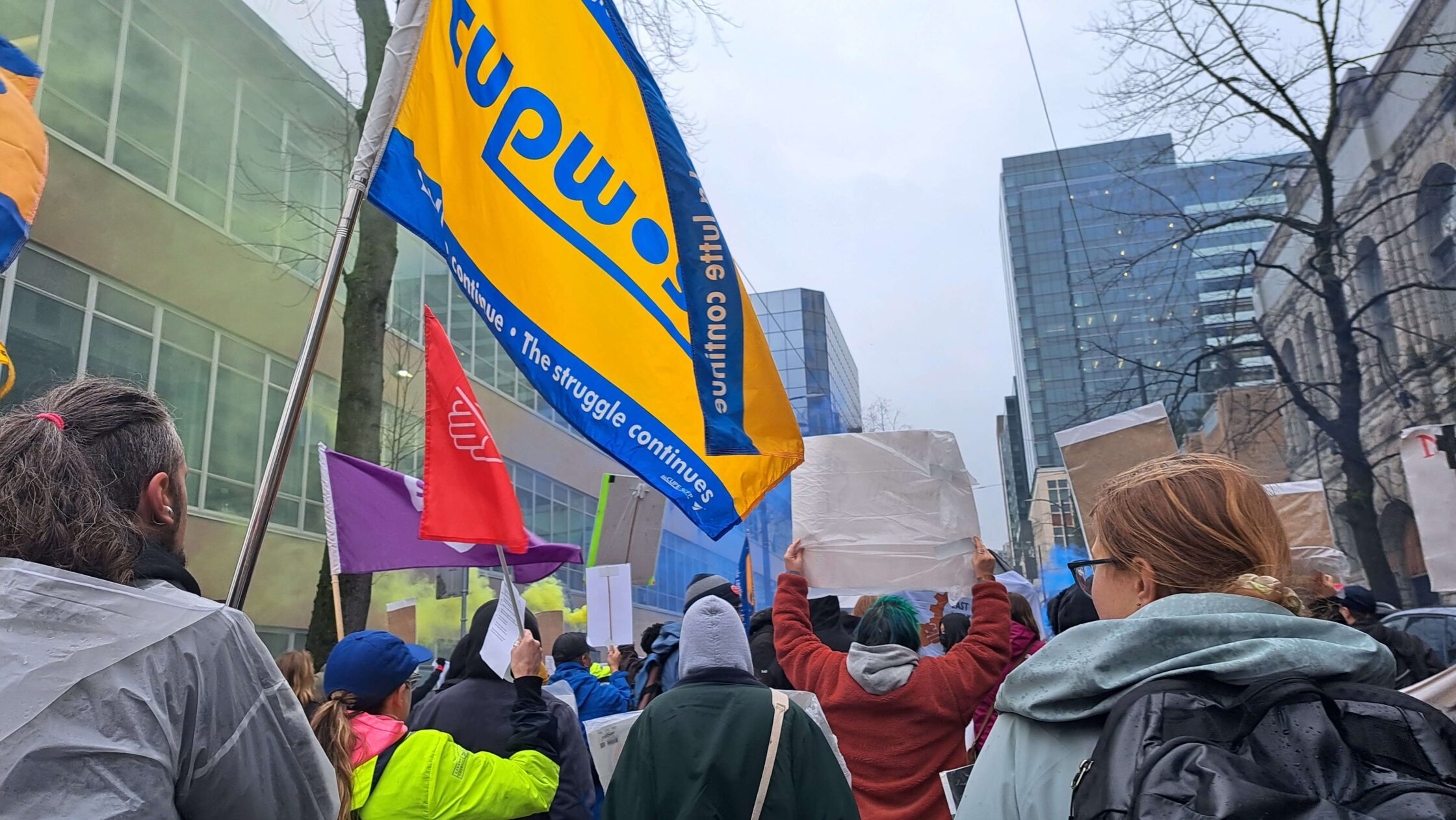
Canada Post workers are voting on whether to accept a new tentative agreement between Canada Post and the Canadian Union of Postal Workers (CUPW), after a long and bitter bargaining process marked by work actions, strike-breaking laws, and years of uncertainty. The ratification vote began on April 20 and will end on May 30.
The union’s national executive narrowly recommended that workers vote “yes,” but rank-and-file workers across the country told The North Star that the agreement has left them feeling trapped between accepting a deal they see as inadequate or rejecting it without knowing what comes next.
“They waited us out, and they gave us a worse deal,” said Nessa, a Canada Post worker from Prince George. Alex, a letter carrier from British Columbia, described the vote as a choice between “a rock and a hard place.” Although CUPW reached the tentative agreement with Canada Post in December, workers say they were only given the full text in late February, leaving them with limited time to study the deal before voting began.
Five key union executives in the board voted “no”, including the National President, Jan Simpson. Local executive boards are also dissenting, such as Local 846, which represents Alex and hundreds of other workers in Vancouver. An anonymous group of postal workers has also published a website titled “CUPW VOTE NO” laying out various arguments about how the agreement has addressed “none of [their] major demands”.
A tentative agreement that falls short
“Last July, the government forced 55,000 of us off the picket lines,” forcing a vote on a deal that met none of workers’ demands, while CUPW “recommended what we were all thinking … which was hell no,” said Harriet, an Ontario rural and suburban mail carrier. “The new agreement has lots of icing on it but it still doesn’t meet those same demands we’ve been making for years. What changed?”
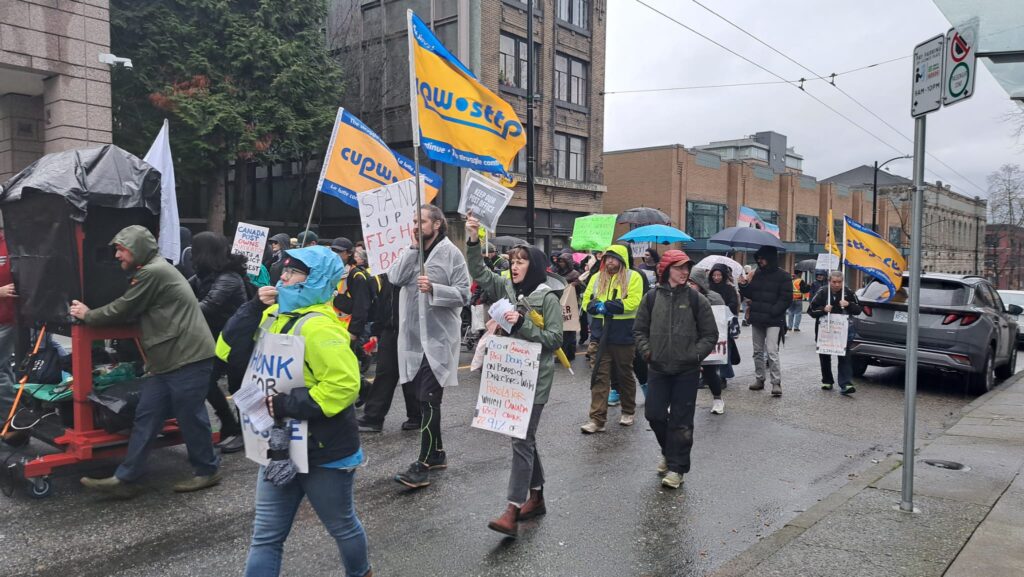
CUPW’s official website and newsletters reveal the “yes” group’s reasons for why, in the union’s words, “these agreements are the best we can get”. It argues the deal reflects a difficult bargaining position after months of stalled talks, government intervention, and pressure from Canada Post.
Rather than a major victory, the union says they are the strongest agreements possible in an uncertain economy, pointing to wage hikes, benefit gains, and the protection of key contract language.
However, according to Alex, who has been studying the agreement closely, the tentative agreement is “full of rollbacks”, ignoring a majority of demands from the rank-and-file. Dustin, a mail handler from Winnipeg, asserted that “these demands are not a negotiating position”. He adds: “when we demand these things, we aren’t trying to overstate what we want for a better middle ground. These are basic needs to make our working conditions tolerable. The fact that our agreement doesn’t address them is atrocious.”
Rollbacks in the tentative agreement
Rank-and-file opponents of the tentative agreement also say it would move Canada Post further away from secure, full-time public-sector employment. In a statement, the executive committee of Vancouver’s Local 846 pointed to the expansion of new part-time positions and the planned loss of 100 protected retail counters as a “shift away from secure employment, which the agreement does not adequately address or safeguard against.”
Members are also being asked to accept rollbacks without seeing Canada Post’s “broader plan” for the future of the public post office, which they say remains withheld from the public while negotiations continue.
Canada Post claims to be in arrears
Canada Post has framed the dispute around a severe financial crisis, reporting a $1.57 billion loss before tax in 2025, its largest on record. The corporation argues that labour uncertainty, declining mail volumes, and “decades-old rules and frameworks” have made it harder to compete with private delivery companies, requiring government loans and a major restructuring plan to return to “financial self-sustainability.”
CUPW argues that these supposed losses are being raised by the corporation out of context right before voting on the agreement started. The union says Canada Post has known for years that letter mail is declining, while the postal system has been shifting toward parcels, which are more competitive and more exposed to private delivery companies.
More broadly, Canada Post’s financial crisis reflects a deeper contradiction: it is expected to function as a public service while competing in a liberalized delivery market. As private firms moved into the most profitable parts of the sector, Canada Post remained responsible for universal service in mail delivery.
Fred, a mail handler, says that “the government has shot itself in the foot and blamed us for it … They weakened the conditions that make a public postal service viable, then used the resulting crisis to justify cuts, closures, and more precarious work.” Canada Post ironically participates in this process through its 91% majority ownership of Purolator, a private courier competitor.
Membership kept in the dark
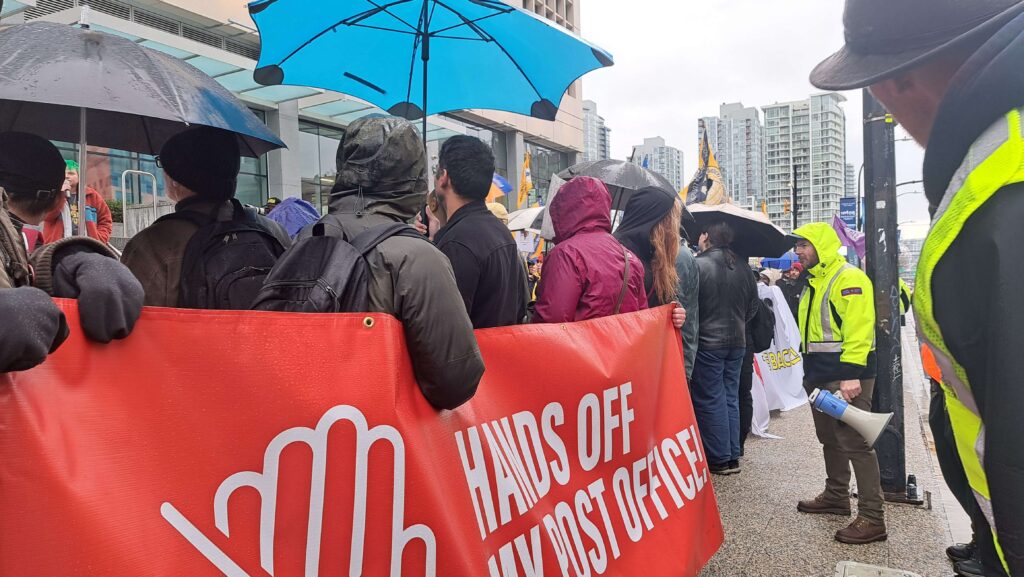
Some rank-and-file workers also say the ratification process has left members with too little time and support to understand what they are being asked to vote on. “We finally got to see the thing that we’re voting on in the beginning of March,” said Nessa. According to her, the delay between the announcement of a deal and the release of the full collective agreement left workers scrambling to understand its contents before casting a vote.
Others described the problem as part of a broader failure of union communication and internal democracy. Rahul, a postal clerk from Calgary, said the union’s approach has too often been to tell members to “trust that we are the smart people in the room that are getting results,” while keeping workers “in the dark” and disengaged from the process.
Veena, a rural mail carrier in BC, said many workers now feel like “a third party between a union and a corporation,” treated as “a bargaining chip” rather than active participants in negotiations. “If we continue to employ negotiations like this, that are not transparent,” she said, “it’s just going to get less and less people engaged, less and less people wanting to work here, while the corporation and government bleed us dry.”
Stuck between rock and hard place
For many rank-and-file workers, the vote has become a dilemma. Opponents say the deal fails to address low pay, growing precarity, and worsening safety, but many also feel pressure to accept it as the alternative remains uncertain. After repeated federal intervention, some workers say a return to strike action no longer feels realistic, even if the deal falls short.
“I honestly don’t know what to say to my fellow mail carriers when we talk about the vote,” said Kevin, a mail carrier of nine years in Quebec. “The agreement is so dismal, but saying no to it feels impossible for us. How can anyone tell these people that they should choose to upend their lives again? After the turmoil and fear and confusion of our past battles? We keep having to fight our own government for the survival of a public service, what kind of messed up world is this?”
Alex said he plans to vote no, but understands why some coworkers feel exhausted.
“I say to my coworkers that I’m voting no. I say, I’m not letting them kill me.”
But many of his coworkers are “beleaguered and hopeless.” They tell him: “‘What’s the point? I just want to move on.’ And how can I blame them?”
What’s next for posties?
“The way I see it, there are two ways that posties can respond to this,” said Rahul. “One is that you just give up, which I understand. But if you don’t want to give up, then it is clear the only step forward is to finally believe that only we, the rank-and-file, can save ourselves.”
He said the experience has shown workers that they need to transform CUPW into a union capable of resisting the “losing stance” imposed by the government and employer.
“That’s the only winning strategy at this point,” he said. “And the only way to do that is by democratizing the union from the bottom up.”
Be part of the conversation!
Only subscribers can comment. Subscribe to The North Star to join the conversation under our articles with our journalists and fellow community members. If you’re already subscribed, log in.