
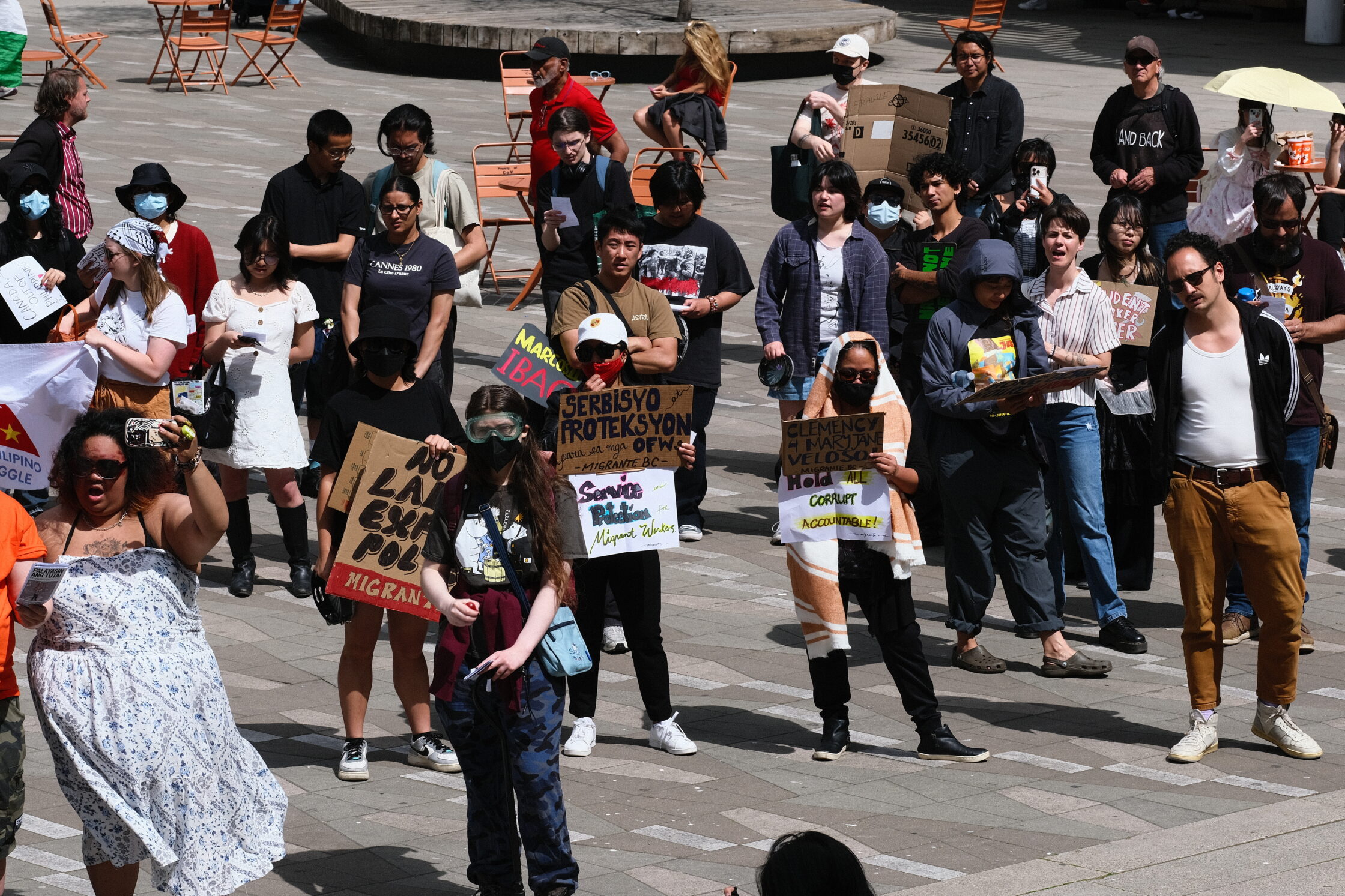
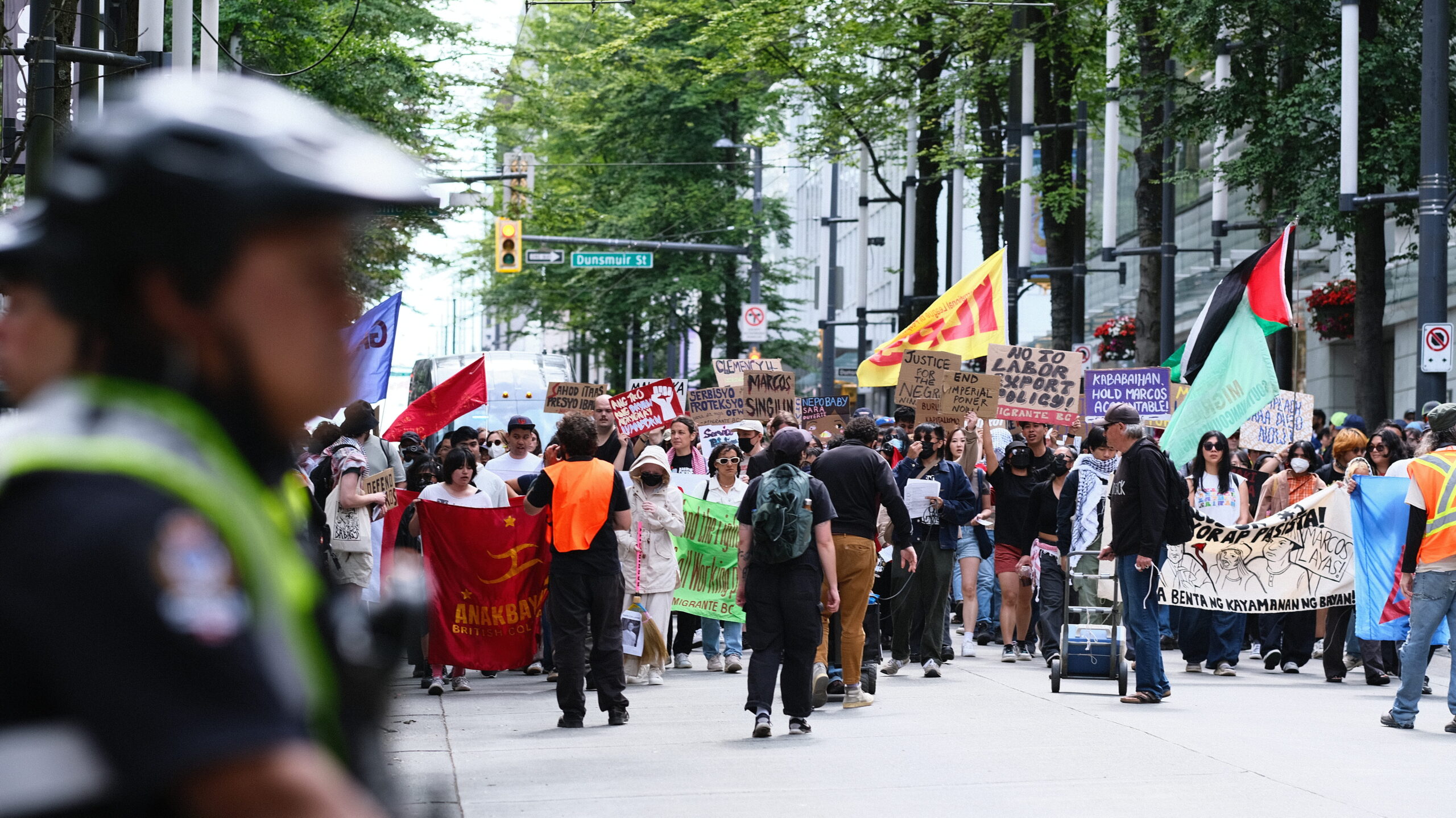
For the first time in 11 years, a Philippine president set foot on Canadian soil, and an angry crowd was waiting for him the moment he arrived in Vancouver. Several Filipino diaspora organizations came together for a series of actions to denounce the visit of Ferdinand Marcos Jr, known for his human rights abuses, and to protest the growing economic and military collaboration between Canada and the Philippines.
Carney and Marcos Jr. met in the last few days to negotiate the terms for various free-trade agreements and the Status of Visiting Forces Agreement (SOVFA)—which Canada entered into November of last year.
At šxʷƛ̓ənəq Xwtl’e7énḵ Square, protesters were also denouncing Marcos Jr.’s praise for the murder of the “Negros 19”, killed by the Armed Forces of the Philippines on the 19th of April. About half of the victims were civilians, including student leaders, a journalist, and peasant advocates and organizers.
This event is unfortunately not an isolated incident, but rather the most recent example of a broader trend. A People’s Tribunal in 2024 found President Ferdinand Marcos Jr, former President Rodrigo Duterte, U.S. President Joe Biden and the governments of the Philippines and the USA guilty of committing war crimes in the country.
“We can see the direct ties between the increasing militarization through agreements like the SOVFA signed last year and their desires to also further exploit the Philippines and the Filipino people for raw materials and cheap labour,” said Noa Sison of Bayan BC, a grassroots diaspora alliance supporting the Movement for Democracy in the Philippines, speaking to The North Star.
“[Canada desires to] accompany the U.S. in their attempts to build up this imperialist blockade that is trying to assert economic and military hegemony in the world.”
According to a June press release by the office of the Prime Minister of Canada, the country is embarking on a series of initiatives to “strengthen collective security and secure critical mineral supply chains.”
The Philippines would be a key source of support for the plan as part of the Critical Minerals Resilience and Production Alliance announced during the G7 conference in Kananaskas, Alberta last year.
A series of actions
On July 1st, a rally kicked off with a crowd of hundreds of attendees.
“We need to educate people to realize how the Canadian government is also complicit in enabling some of the human rights abuses, for example, through the continuing defence partnerships with the Philippine government,” said Luthfi, the Vancouver-based chairperson of the International Coalition for Human Rights in the Philippines (ICHRP) speaking to The North Star.
The next day, organizations conducted two snap actions in the city. The first was a disruption with loud speakers at the door steps of the Fairmont Pacific Hotel where Marcos Jr. was staying. Around 15 protesters demanded the president answer for his crimes and face justice for the deaths of countless murders of civilians, including the “Negros 19”.
Meanwhile, about 50 protesters did the same in front of the Philippine fast-food chain Jollibee on Granville Street. Marcos Jr. and Prime Minister Mark Carney had previously used the location as a photo opportunity with the smiling bee mascot and buckets of fried chicken.
Due to the high foot traffic, protesters were able to talk to passersby about the predatory deals Canada is set to make with the government of the Philippines, especially in the mining sector.
Foreign companies endangering the lands of indigenous people and their livelihoods is not unusual in the Philippines. Notoriously, Canadian mining companies are often implicated in encroaching on such lands and digging them up.
“It affects the agricultural output of the lands there, and it is really important because most of the indigenous peoples in this area are farmers. That’s their main livelihood.”
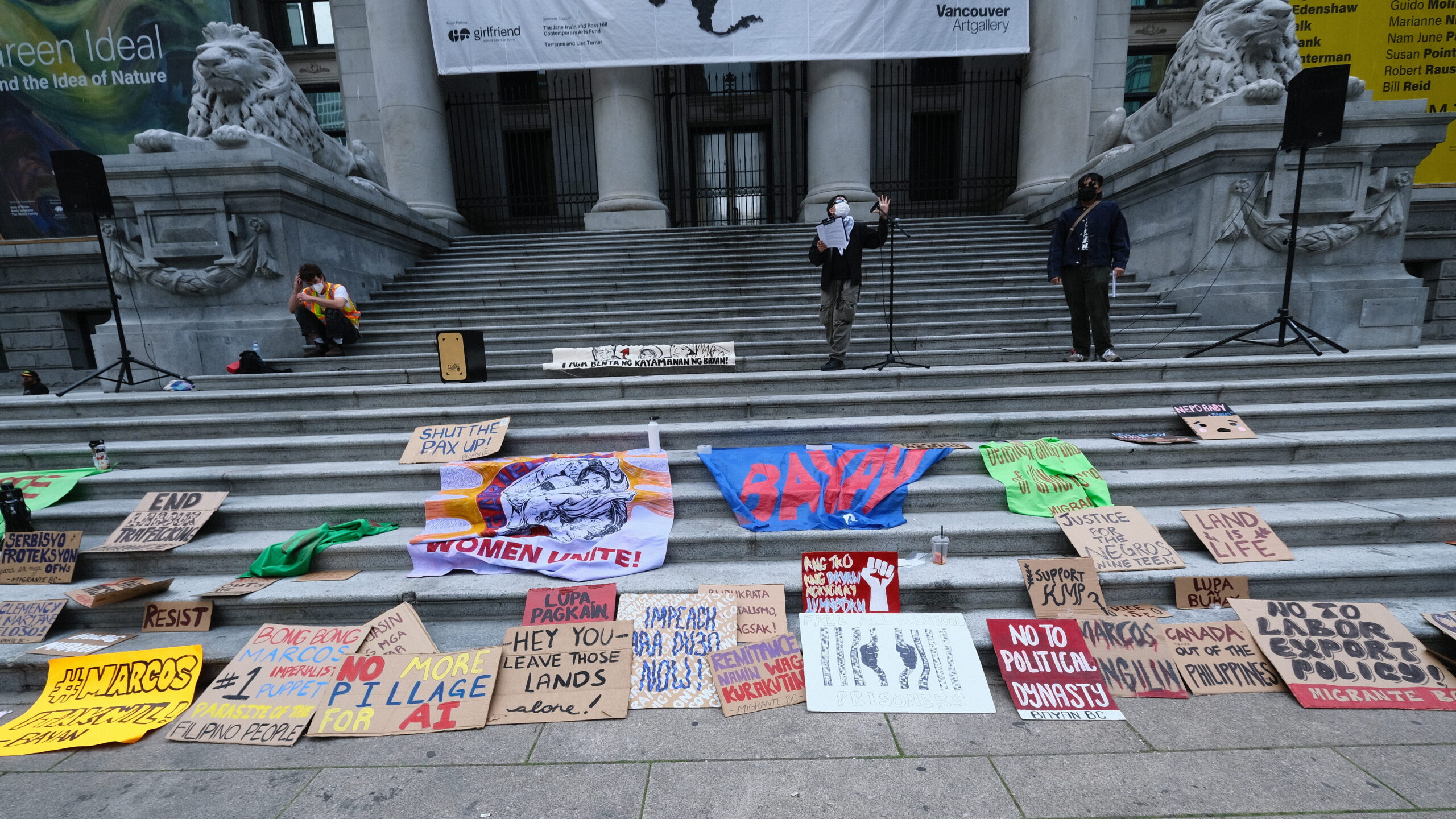
The next two days involved an even larger action at the Fairmont Pacific Hotel, and a final rally on the 4th on the Art Gallery steps, at Robson Square.
Similar demonstrations were coordinated across the country July 1–4 by Bayan chapters in Calgary, Edmonton and Toronto outside the Philippine consulates in their respective cities.
During their protests, Bayan organizations raised a prediction also voiced by Luthfi: in an effort to outcompete China, which currently dominates semiconductor supply chains, Canada and the Philippines are likely to deepen cooperation on critical minerals and possibly artificial intelligence. As Luthfi put it: “It is very likely that Canada and the Philippines will strengthen cooperation and partnerships on critical minerals and possibly artificial intelligence. This has long been a part of Canada’s Indo-Pacific strategy, and it’s also in alignment with the United States’ Pax Silica project.”
Be part of the conversation!
Only subscribers can comment. Subscribe to The North Star to join the conversation under our articles with our journalists and fellow community members. If you’re already subscribed, log in.