
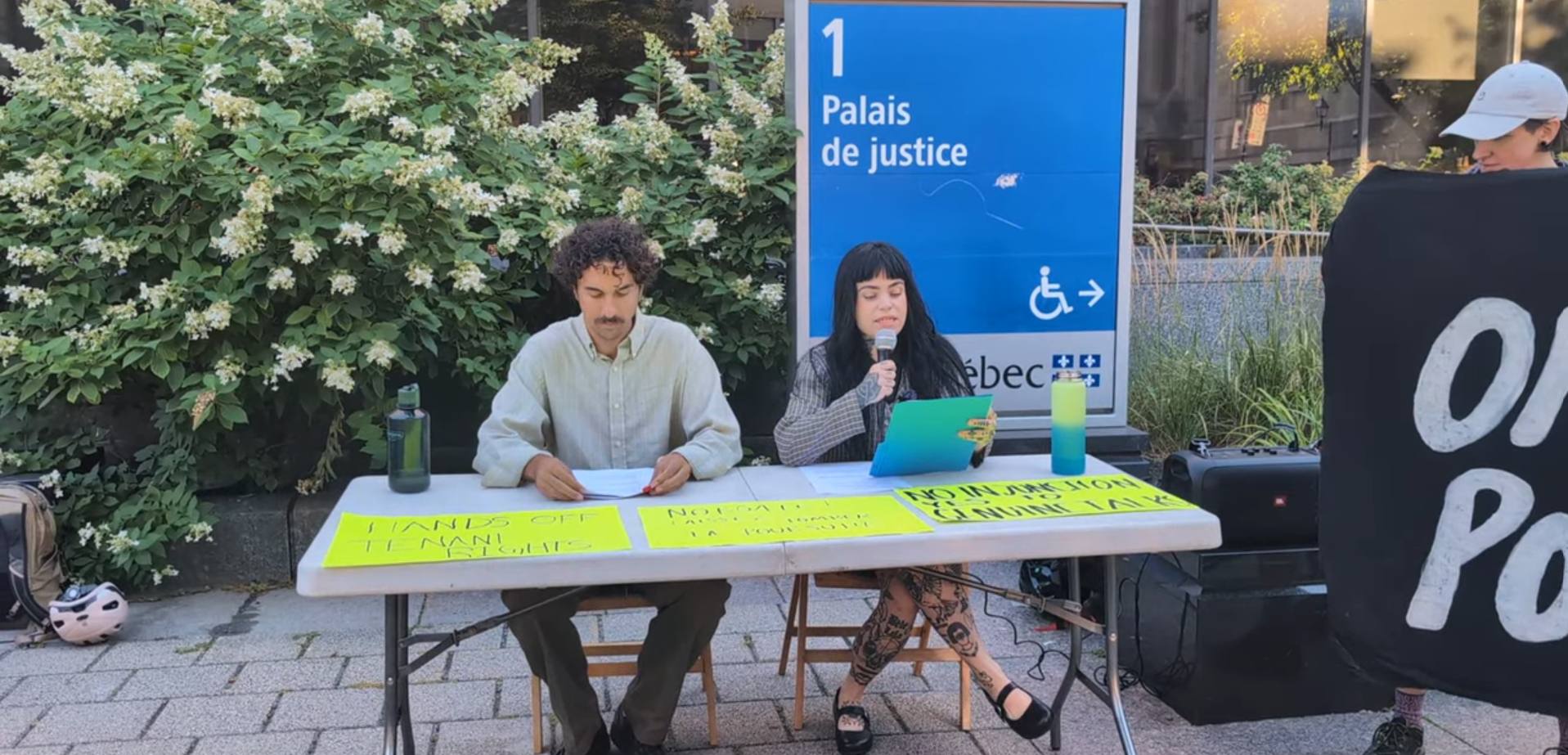
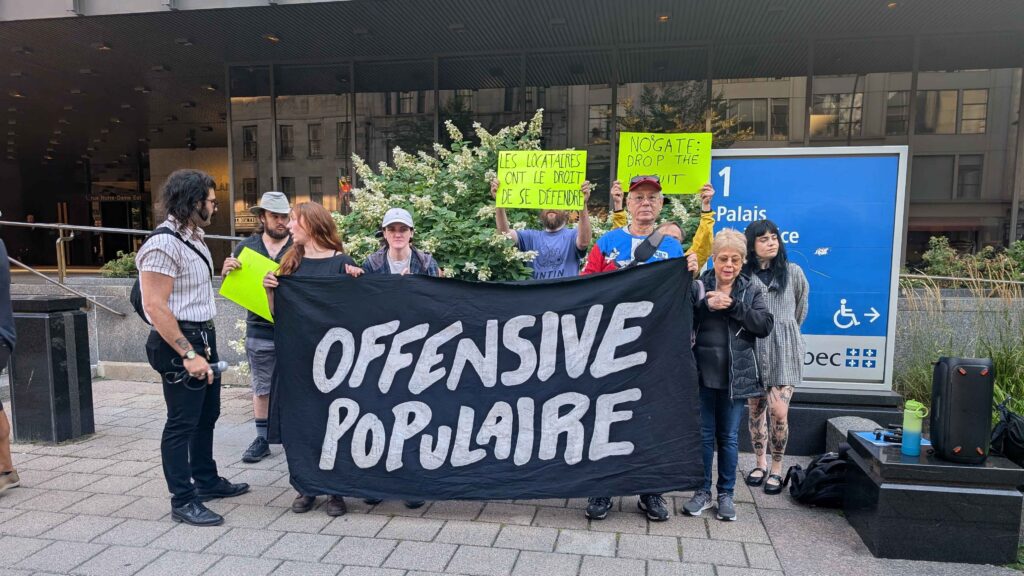
In early May, a group of tenants in Montreal‘s Saint-Laurent neighbourhood organized to block work in their apartment complex that they feared would expose them to asbestos. Three months later, the landlords responded with a defamation lawsuit and a request for an injunction against “the tenants’ assembly of Norgate and Chameran”, organized with the help of the group Off the Defensive. The North Star examines the role of such lawsuits in suppressing organizing efforts and political movements.
Besides an injunction against organizers, the lawsuit brought by the landlord seeks $50,000 in damages. When combined with legal fees, this would a hefty sum for a group composed of low-income tenants and volunteer neighbourhood organizers. For the four private investors who co-own the 1,100+ rental units that make up the Norgate complex, however, it’s a drop in the bucket. So, why would the landlords bother suing at all?
“We’re under the impression that this was a way for Norgate and the landlords to silence us, to stop our organizing and intimidate the tenants form collectivizing the struggle,” says Nicholas Harvest, an organizer with Off the Defensive who was named personally in the lawsuit.
“This is the only recourse the landlords have to scare and intimidate tenants from organizing. It is very common. There have been many cases of frivolous lawfare endeavours to stop organizing tenants.”
Here, Mr. Harvest is referring to SLAPPs—Strategic Lawsuits Against Public Participation. A SLAPP is a lawsuit whose purpose is to silence and suppress public criticism or advocacy for change. These often take the form of defamation lawsuits. The Canadian Civil Liberties Association describes SLAPPs as lawsuits in which “the goal of the party bringing the lawsuit is generally not to win a case, but to silence their critics.”
The limits of legal protections against SLAPPs
Quebec is one of only four Canadian provinces with laws to protect those targeted by SLAPPs. Defendants can apply to have a lawsuit against them declared abusive by a judge, which can result in the lawsuit being dismissed.
To have a SLAPP dismissed in Quebec, a defendant must be able to show that the case is an abuse of process. In a defamation case, for example, the defendant might try to establish that the statement in question is a matter of public interest, that the lawsuit is intended to silence them, or that the amount being claimed far exceeds any possible financial consequences resulting from the statement.
While these protections can certainly lighten the burden of those on the receiving end of a SLAPP, they cannot eliminate it. The time and money required to defend a lawsuit, even one that is dismissed in the initial stages, can be a major hurdle for ordinary people and grassroots organizations. As a consequence, SLAPPs can have a chilling effect on public speech before the matter is ever heard by a judge.
There is also, of course, no guarantee that a defendant will be successful in convincing the courts that a suit against them meets the legal definition of abusive. For example, in 2009 the mining giant Barrick Gold sued the authors and publisher of Noir Canada, a book denouncing abuses by Canadian companies in Africa, for $6 million. The Quebec Superior Court determined that Barrick’s lawsuit was intended to intimidate the defendants and not to protect the company’s reputation and that the damages Barrick sought were exaggerated. It did not, however, dismiss the lawsuit as a SLAPP.

Suppression of collective struggle
SLAPP defamation suits don’t just restrain criticism in the public sphere. They can also have chilling effects on organizing efforts that rely on agitational material to promote and mobilize for their cause.
For example, in 2012, a family of wealthy landlords in Montreal’s Côte-des-Neiges neighbourhood sued the housing rights group OEIL for nearly $6 million after losing a case to an OEIL client at Quebec’s housing tribunal. Among the forms of defamation they alleged were the leaflets OEIL distributed at their properties to educate tenants—many of them new immigrants—about their housing rights.
Similar lawsuits have been brought against environmental activists who mobilize against companies responsible for pollution and labour unions who denounce working conditions as a means of mobilizing workers during a conflict. The courts often identify such lawsuits as SLAPPs and dismiss them, but for organizers, dealing with litigation still redirects resources away from the struggle on the ground.

The firm representing the Norgate landlords in the case against Off the Defensive, Choueke Legal (formerly Choueke Hollander), has a history in the domain of lawsuits against grassroots organizers. In 2024, it acted for two Zionist student groups at Concordia University in a lawsuit against pro-Palestine student groups that organized demonstrations on campus.
They also served a cease-and-desist letter to the student association of Vanier College when it tried amend its bylaws to allow political discussion in student clubs. The letter alleged that allowing this freedom to the Palestinian student club would “expose the Vanier campus to radical activism.” The letter succeeded in shutting down the debate, and the amendment was withdrawn.
As for the Norgate case, Nicholas Harvest and the other defendants are determined to continue their organizing work at the complex. “We’re not scared,” says Harvest. “We’re going to keep supporting the Norgate tenants in their endeavour to create and organize their neighbourhood defense committee.”
Be part of the conversation!
Only subscribers can comment. Subscribe to The North Star to join the conversation under our articles with our journalists and fellow community members. If you’re already subscribed, log in.