

Every year, construction workers pay tens of millions of dollars in dues to the Quebec Construction Commission (CCQ). Such a windfall attracts its share of opportunists looking to line their pockets at the expense of this organization, which claims to defend workers. Hackers, spoiled bureaucrats, lawyers sniffing out a good deal, multinational firms: everyone wants their share of the CCQ’s budget.
The Quebec Construction Commission is the agency responsible for enforcing Act R-20, which governs working conditions in the province’s construction industry. It inspects construction sites and serves as a resource for labour placement, but it also administers vacation pay and workers’ insurance.
The CCQ is funded by contributions deducted from workers’ paycheques, equivalent to 0.75% of their gross salary. Employers also pay a contribution equal to that of their employees. In 2025, employers and workers contributed $170 million through these deductions.
A new website that’s too expensive
The Commission kicked off 2026 by launching its new website and immediately faced a barrage of criticism. On social media, several workers complained about bugs. Under a CCQ Facebook post promoting its “improved online services,” comments accused the new site of being worse than the old one. Construction contractors, for their part, voiced the same complaints, but in the mainstream media.
Besides the technical glitches, it was above all the exorbitant cost of the website that drew sharp criticism from workers in the industry. A labourer from Montreal‘s South Shore interviewed by The North Star believed the site was “just fine,” but that the millions invested were the problem.
Through this site, workers can access their pay and vacation information, as well as various services offered by the CCQ. This is the first phase of a series of IT projects at the CCQ known as “Chantier Numériccq.”
Originally, this first phase was scheduled to be completed in 2023 at a cost of $280 million or less. It ultimately cost over $350 million—a 25% cost overrun. The CCQ asserts, however, that the total planned budget of $543 million for all phases will not be exceeded.
During the first phase, the Commission partnered with the German giant SAP to overhaul its management system. This company’s platform had also been chosen for the SAAQclic fiasco.
The CCQ also contracted with Deloitte, which recently admitted to using artificial intelligence to write a $1.6 million report for the government of Newfoundland and Labrador.
Hackers hold payroll data hostage
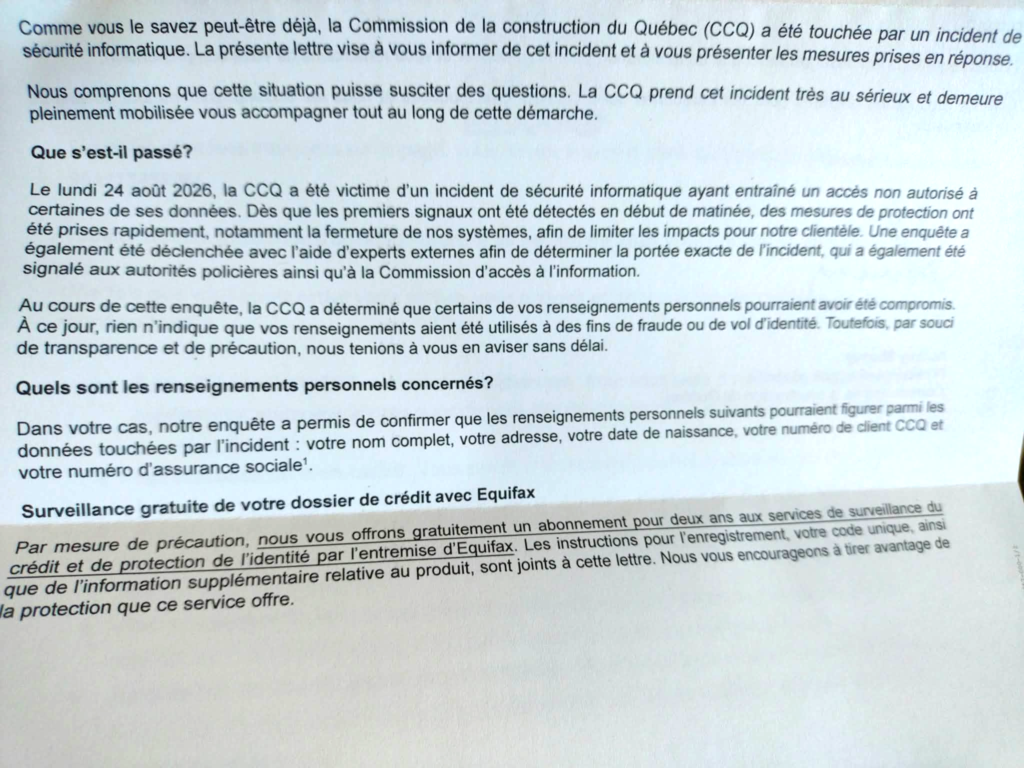
On August 24, the Commission suffered a cyberattack that allowed hackers to gain access to the personal data of approximately 350,000 people, including their banking information.
The attack was carried out by hackers using “ransomware,” created by the Qilin group. Ransomware is software that allows a hacker to steal data and establish a communication channel with the victim to demand a ransom. If the ransom is not paid, the hacker may then publish the data on a dark web site or sell it on the black market.
The North Star asked the CCQ whether a ransom had been demanded and, if so, why the decision was made not to pay it. The CCQ simply replied via email that “a police investigation is still underway to fully shed light on this incident, and our analysis will also continue over the coming weeks.”

The Qilin group reportedly recruits hackers online to carry out data thefts. In 2023, recruitment ads for the group posted on forums caught the attention of specialized bloggers. According to the Checkpoint blog, Qilin pockets 15 to 20 percent of the ransoms received by the hackers it hires.
Qilin is suspected of being a group based in Russia or its surrounding region. Its attacks primarily target companies and institutions in countries aligned with the European Union or the Anglo-American imperialist bloc, but the Chinese company Yanfeng has also been attacked.
The Commission maintains that there is no link between the IT vulnerability that enabled the cyberattack and the Chantier Numériccq project.
A class-action lawsuit is likely and could be costly
On September 12, it was reported that a man named François Laberge, whose information was stolen by hackers, had filed a lawsuit against the CCQ. The law firm he retained, Lambert Avocats, states in a press release that “the CCQ seriously neglected the protection of its clients’ personal information.”
The attorneys have also asked the court for authorization to file a class-action lawsuit against the CCQ so they can represent all victims of the data breach. In their submission to the court, the attorneys allege that the Commission “is more concerned with the costs associated with remedial measures than with the rights of the individuals affected.”
In particular, they argue that the protective measures put in place by the CCQ—namely, a free two-year subscription to Equifax—are insufficient. In their press release, they specify that “The risk of identity theft resulting from the theft of a Social Insurance Number does not disappear after twenty-four months.”
These lawsuits, which accuse organizations of failing to adequately protect the public’s data, are, in fact, a recurring phenomenon following ransomware attacks. In an anonymous interview, a member of Qilin stated that he has observed a recurring pattern following the group’s attacks:
“Employees and customers of companies that have been hacked often join forces to file a class action lawsuit against the company. Safekeeping personal data is one of the primary responsibilities of a company that collects personal data. If they violate this, a class action lawsuit is a logical step.”
The anonymous spokesperson even added, “I won’t hide the fact that we are often approached by lawyers who handle class action lawsuits. And we are glad to cooperate.”
In class-action lawsuits, it is common for attorneys to be compensated with a percentage of the amount recovered through the lawsuit. According to the Lambert Avocats website, a flat fee may also be added.
Numerous bureaucrats
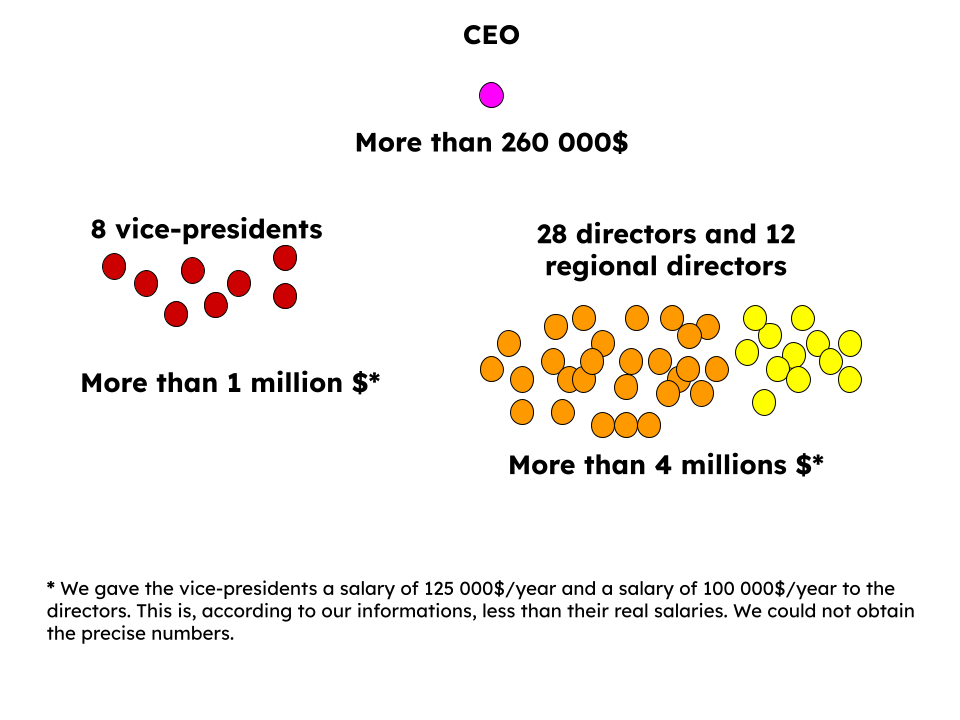
While several external parties want their share of the CCQ’s coffers, there are also people on the inside who are eating into the budget. The Commission employs dozens of bureaucrats earning more than $100,000 a year.
The organization’s structure includes 29 directors, 12 regional directors, and eight vice presidents, in addition to the CEO position. Besides these positions, there are several section heads, who report to the directors, and advisors who report to the section heads.
A job posting active in early October on the Commission’s website for the position of section head of “Procurement Governance and Operations” offered a salary ranging from $99,614 to $142,306 per year.
A position for “Senior Advisor, Corporate Business Continuity Strategy,” also according to the CCQ website, pays between $87,381 and $124,830 annually. This role is specifically aimed at preparing the organization for crisis management.
Only the exact salary of the CEO, Audrey Murray, is publicly available. For the 2025–2026 fiscal year, her salary was $259,380, plus “business expenses” that provided her with an additional $4,140 for the year. Audrey Murray was a candidate for the Coalition Avenir Québec in 2022 before being appointed to this position the following year.
She naturally does not pay for parking, transportation, or meals when they are work-related. This allowed her to save $1,175.75 in transportation costs and $149.52 in parking fees during the first three months of 2026.
As for meals, she was able to spend $664.59 on food from the CCQ’s budget from January through March. During a work meeting in March 2026, she spent a tidy sum of $196.26 on food. If this trend continued for the rest of the year, the CEO could have spent nearly $8,000 on food, transportation, and parking.
According to a CCQ table, the average annual salary for a construction worker in Quebec was $54,939 in 2025, including bonuses.
Workers are fed up with their money being wasted
There are thus dozens of bureaucrats, potentially Russian hackers, and multinational corporations siphoning off the CCQ’s budget. It’s no surprise, then, that workers are frustrated at having to pay dues to indirectly fund these various parasites.
Carpenters in Montreal told The North Star that the issues of their money being wasted and corruption are the main political concerns on their job sites. Their colleagues, they explain, are drawn to the Quebec Conservative Party precisely because of its pro-austerity rhetoric.
We were also told how, on a masonry job site in Abitibi, the CCQ’s IT woes have become a running joke. The workers find it particularly ridiculous that the CCQ paid millions for a new website, only to have their data stolen a few months after it went live. They also draw a connection between the SAAQclic scandal and the Chantier Numériccq fiasco.
Andreea Craciunescu, who serves on the executive committee of the construction caucus of Workers’ Alliance, explains that “Construction workers are sick and tired of having a union dues deduction taken from every paycheque, only for that money to be mismanaged by the bosses’ representatives. We’re being taken for fools.”
Be part of the conversation!
Only subscribers can comment. Subscribe to The North Star to join the conversation under our articles with our journalists and fellow community members. If you’re already subscribed, log in.