
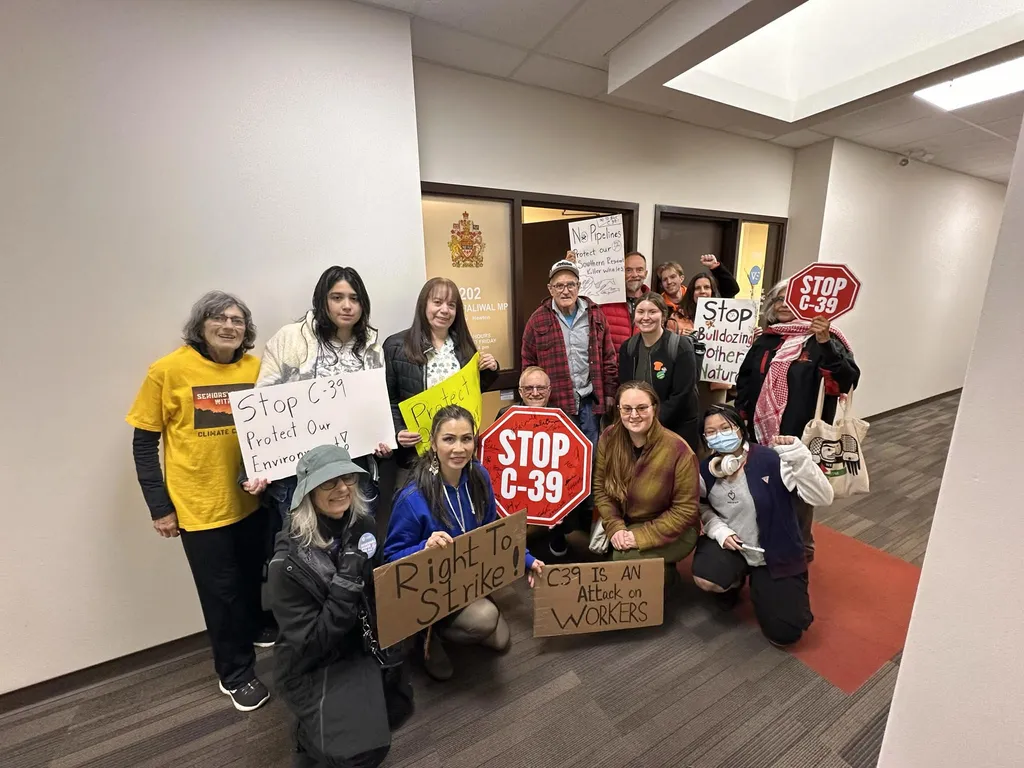
Yesterday, more than 60 different communities held a national day of action across Canada, pushing for an end to Bill C-39. Protesters mobilized to different MPs’ offices, questioning the side stepping of environmental protections and the constitutional rights of workers and Indigenous People. In Surrey, protesters criticized MP Sukh Dhaliwal.
Bill C-39, written to “respect certain measures to strengthen the economy,” can be seen as a continuation of Bill C-5, named also as the Build Canada Strong Act. Bill C-5 was pushed through parliament in just 20 days, despite strong opposition from worker, indigenous, and climate groups. The bill removes several rules and requirements for various mining and infrastructure projects, with the goal of streamlining them in national interest.
Surrey Community Calls out Their MP
Protesters in Surrey gathered outside Surrey-Newton MP Sukh Dhaliwal’s office to call out his role and work on Bill C-5 and C-39. Dhaliwal has extensive interests in real estate and industry. He is the sole owner and president of Geneco Engineering Consultants, which itself owns a real estate holding company.
Dhaliwal reluctantly agreed to speak with a group of three protestors at the rally to confer about the bill, its impacts on the community, and its future. The group said that, throughout the half hour discussion on the bill’s negative impacts, Dhaliwal did not note anything down except potentially including a sunset clause that would give the bill an expiration date after it has already affected communities.
Dhaliwal is a vice chair on the Special Joint Committee on the exercise of Powers under the Build Canada Act (Bill C-5). The committee is responsible for reviewing the decisions taken by the cabinet and ministers, and verifying that it follows the legal criteria, conditions, and timelines.
Lynn, a protester at the rally, brought up how the government and its MPs end up working for oil companies rather than the people through different lobbying efforts.
“These Oil and Gas companies have way more meetings at the federal level with these MPs [than constituents do]… When our elected leaders are not meeting with the CEOs, they’re in these big offices getting lonely. That’s the reason [Sukh Dhaliwal] had to come out of his office today [and talk with us], he was getting lonely.”
Dhaliwal voted yes to Bill C-5 last year; and voted yes to the second reading of Bill C-39 last month. He is suspected to be casting a final vote in support of Bill C-39.
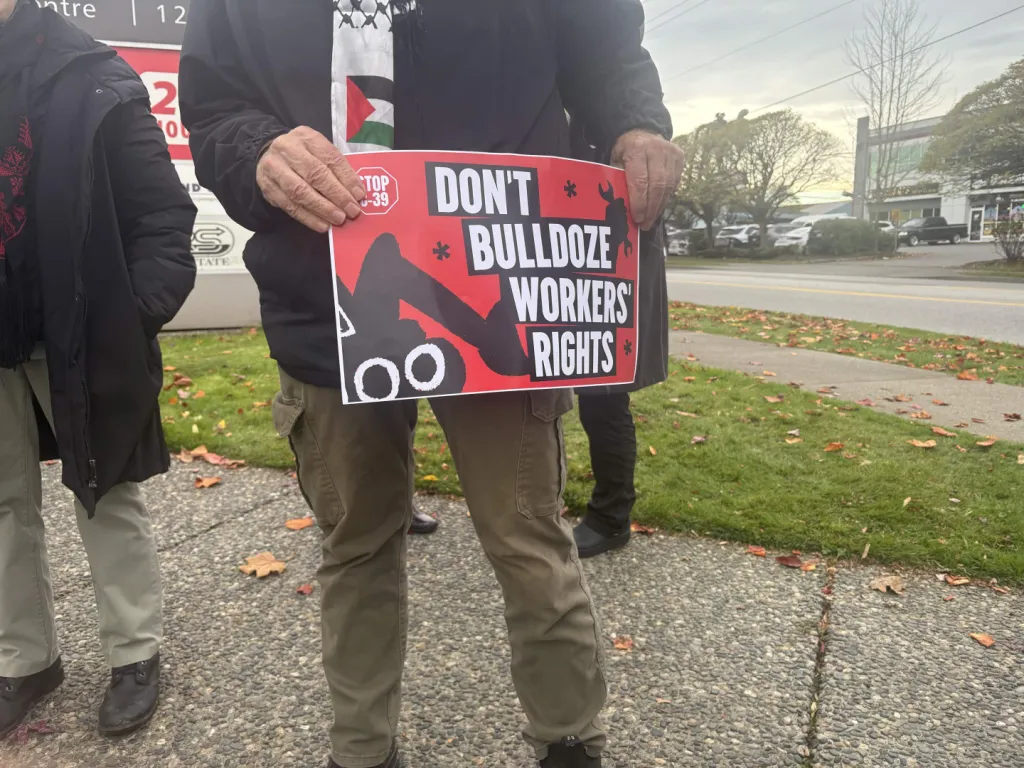
At the rally, Nolen Scott, who ran as the Surrey-Panorama candidate for the B.C. Greens, brought up concerns that Bill C-39 “would give ministers sweeping rights to trample on union rights.” He noted that “ Labour ministers could end legal strikes and force arbitration simply by declaring a project ‘in the national interest.’”
Scott described the process as a continuation of section 107, and can threaten workers’ right to strike. The right to strike is protected under the Canadian Charter of Rights and Freedoms, but is contradicted by what protesters say are “overreaching powers” granted to the government through this bill.
A press release published in September by the Canadian Labour Congress also explains that “Bill C-39 would give the Canadian government broader unilateral power to end a legal strike than exists in any other G7 country.” The law would set Canada apart from any other G7 country, which would allow a “single minister with sweeping new powers over workers’ right to strike,” something not even visibly repressive governments such as France or the USA are allowed to do currently.
First Nations Push Back
Formerly known as the West Coast Oil pipeline, Bill C-5 designated the Pacific Link pipeline as a project of national interest. The proposed project intends to transport up to one million barrels of oil per day from Bruderheim, Alberta to a marine terminal near Delta, B.C. The project has come under fire from First Nations because of the federal government‘s failure to consult them prior to making its decision.
The Union of B.C. Indian Chiefs stated in a letter to Mark Carney that Bill C-39 is failing to adequately protect First Nations’ constitutional rights and decision making authority through the Act’s accelerated decision making processes.
“[Bill C-39’s] emphasis on accelerated project reviews and a one-year timeline for project decisions risks the Crown being unable to adequately fulfill its constitutional obligations and prejudicing First Nations’ own decision-making processes. Economic objectives, regulatory efficiency, and investor certainty cannot pre-determine the time required for meaningful consultation. Consultation must determine the timeline; the timeline must not determine consultation.”
First Nations across Canada made a joint statement that the federal government is disrespecting the Constitution and the United Nations Declaration on the Rights of Indigenous Peoples. Under Section 35 of the Constitution Act, 1982, it is the Crown’s duty to consult and accommodate first nations for federal project timelines.
In the joint statement, Grand Chief Alvin Fiddler of the Nishnawbe Aski Nation says that “this government is writing legislation about our lands and our future without us at the table. That is not reconciliation – it is a continuation of the same pattern our people have fought against for generations.”
Be part of the conversation!
Only subscribers can comment. Subscribe to The North Star to join the conversation under our articles with our journalists and fellow community members. If you’re already subscribed, log in.